Violets Are Blue (audiobook) by James Patterson


Sigh...


Published in 2005 by Hachette Audio.
Read by Daniel Whitner and Kevin O'Rourke
Duration: 8 hours, 10 minutes
Unabridged.

I used to think the Alex Cross series had a lot going for it. I used to be very impressed with it when I first discovered it about 10 years ago. I don't know if my tastes have improved or if the series has declined but this is definitely not as good as I remember them being (and frankly, I'm scared about going back and re-reading one of them and ruining my only strong memories of the series).

There are two concurrent plots in Violets are Blue. One involves an investigation into the "Goth" underworld and vampires (are they real or are they just people who are REALLY into vampires and like to act like they are real vampires..?)

The other story involves the recurring criminal mastermind character conveniently named "the Mastermind". I hate to write spoilers so I won't re-hash the entire plot here, but let me say that Patterson probably owes Michael Connelly an apology. Michael Connelly basically wrote the same thing several years earlier in the thriller The Poet (and he did it better, too!)

I keep thinking I'm going to really like a Patterson book again, but this is about the 5th in a row that I have not liked. I'm tired of searching for the needle in the proverbial Patterson haystack. The stories just lack the depth and the realism that they used to have.

The audiobook version is read by two narrators - Daniel Whitner and Kevin O'Rourke. One reads the part of Alex Cross, one covers nearly everything else. It lasts a little more than 8 hours.

I rate this audiobook 2 stars out of 5.

This audiobook can be found on Amazon.com here: Violets Are Blue (Alex Cross Novels)

Reviewed on April 13, 2008.

Civil War Adventure #2: Real History: More Stories of the War That Divided America (graphic novel) by Chuck Dixon (author) and Gary Kwapisz (illustrator)


History in a more approachable format (for some)


Originally published in 2011. Re-published in 2016 with additions.
This is a review of the 2011 publication.


All forms of media have their fans and detractors. History teachers (like me) often have mixed opinions about different formats. Movies show the viewer but often skip details or over-emphasize items in order to make the stories work better. Textbooks cover the basics but do it in a dry, boring manner. History books can tell the story with more detail, but give the topic to a bad writer and it is an impossible challenge to the reluctant reader. Audiobooks may help, but how many students will listen to a 13 hour history book? Historical fiction - it is a mixed bag, but has potential to keep the interest up and teach something along the way. The internet - it's literally all there - the good, the bad, the delusional.

As a teacher, I have always espoused the theory that I have borrowed from Malcolm X - teach it "by any means necessary." There are good movies out there. There are good books. Well-written historical fiction can do the job. The internet can be used if it is all verified with other sources. Graphic novels like Civil War Adventure #2: Real History: More Stories of the War That Divided America published by History Graphics Press have a place, too. While I would hate to think that someone got all of their knowledge about history from a graphic novel (or from movies or the internet or any one format), I have no problem with a student (or an adult) reading books like these for a bit of "edu-tainment" - certainly this is more edifying than most graphic novels I have read.

The best thing that Dixon and Kwapisz have done here is they have put the grit, sweat and fear back in a topic that the textbooks have mostly removed. Let's face it, the life of a Civil War soldier was dirty, full of hard work and at times, absolutely terrifying. You can't convey that with a map that shows a blue arrow moving along a map towards gray rectangles in a line. In the seven stories of this volume we see the "black flag" offered to African-American soldiers who fought for the Union (no mercy offered, no prisoners were to be taken for them or their officers), the gruesomeness of battlefield surgery, the heartbreak of the nurses who gave so much to help the wounded and the dying, and the dangers of going out on a little reconnaissance patrol in the middle of enemy territory.

I was particularly fond of the story of the Battle of Milliken's Bend in the story Will the Black Man Fight? which was a concern of the Union generals. They simply could not imagine that they were even more motivated than their white counterparts - with the take-no-prisoners policy of some Confederate generals and the threat of enslavement (or re-enslavement) the fact that those men would even join in the first place should have shown their willingness.

The emphasis is on the small, tiny bits of action in a vast war that killed hundreds of thousands and injured just as many and displaced an untold number. But, those small stories are bound to be forgotten as they are shoved aside by the larger stories of the war, so I am all for re-telling them here (and in other formats as well). Like I said in the beginning of this review, I would hate to think that this was the only source of information that a person had about the Civil War, but it is an entertaining supplement.
Used with permission of Gary Kwapisz

Gary Kwapisz's work on the art is very strong - lots of action, dramatic shading and he does not spare the reader the violence and pain of the war. This is not an episode of Gunsmoke, with its gunshot but no blood and a man wordlessly crumpling and dying. Men are bayoneted, there are gunshots through the head and a civil war surgeon's work is shown in hideous detail (I loved it - show it for what it was). I also loved the full page artwork (see left) in the story about Milliken's Bend with the buzzards gathering as the battle is about to start. Not only do we get a view of the battle from above, we feel the impending doom and we are told what motivated some of the Confederate soldiers.

I rate this book 4 stars out of 5. It can be found on Amazon.com here: Civil War Adventure #2: Real History: More Stories of the War That Divided America.

Reviewed on August 6, 2011.

Superman: The Never-Ending Battle (Justice League of America) (audiobook) by Roger Stern


GraphicAudio delivers the goods


Published in 2008.
Performed by 29 actors.
Duration: 6 hours

GraphicAudio promises "A Movie In Your Mind" and they come awfully close with 29 actors, special effects, music and a go-go-go plot. While not the best of the Justice League series that I have listened to, Superman: The Never-Ending Battle was still quite entertaining.

Superman and the rest of the Justice League get caught up in a series of weather-related missions and about one-third of the way into the story the JLA begins to suspect that someone is manipulating the weather - summertime blizzards, ultra-thick fogs, record numbers of tornadoes, droughts and even worse abound. The questions, of course, are who is doing this and why are they doing it?

The main characters in this mission are Superman, Batman, Wonder Woman, The Flash, Green Lantern, The Martian Manhunter and the Atom who mostly sits in the satellite headquarters monitoring maps and analyzing data. Superman, though, is the star.We get to see how he he somehow pulls off having a secret identity and still has time to be the "Man of Steel." We learn about his specially designed interest to the apartment he shares with his wife, Lois Lane and how he manages to turn in his assignments for the Daily Planet despite the time he takes out to save the world on a regular basis.

Superman has long conversations with his parents, Lois Lane, The Flash (including a nifty little cross-country run together), the Martian Manhunter, Batman and a particularly good one with the Green Lantern in which he is directly asked if he has ever considered just taking over the world and using his powers to make things about as good as they can be. The answer? Yes (who wouldn't, just for a moment?) but he looks to the example of George Washington who turned down the chance to be king twice (for that his old opponent George III called him the greatest man in the world). Superman even philosophizes to the villain in the story about why he fights for the rights of people to lead their own lives, even if they do not appreciate him.

Really, the plot is just an excuse to look at Superman, his life, his fears and how he moves past them, his influences, his philosophy and how he inspires and supports the rest of the Justice League. Batman is intriguing and the Flash is fun but Superman, the original Boy Scout superhero is really the foundation of the whole phenomenon. He is what we would all hope that we would be if we were suddenly endowed with super powers. Listen to this one for a boatload of action, but mostly listen to this one as an homage to Krypton's Last Son and a Kansas farm boy - Superman.

I rate this audiobook 4 stars out of 5.

This audiobook can be found on Amazon.com here: Superman: The Never-Ending Battle.

Reviewed on August 5, 2011.

The Colonel's Lady and No Man's Gun : Unabridged Stories from The Tonto Woman and Other Western Stories by Elmore Leonard


Short but pretty sweet


Read by James Naughton and Dylan Baker
Duration: about 1 hour, 30 minutes
Published in 1999 by Simon and Schuster.

These two stories are taken unabridged from a larger collection of Elmore Leonard short stories called The Tonto Woman and Other Western Stories.

Both stories last about 45 minutes each. The entire package consists of one audio cassette lasting about one and one-half hours. They are read by veteran television actors James Naughton and Dylan Baker.

I thought that "The Colonel's Lady" (she is taken captive as a result of an ambush) had a pretty good twist to it but was a bit slow. I would give it three stars. On the other hand, I enjoyed "No Man's Guns." In that story, a recently discharged member of the cavalry is framed for murder. I give the second story 5 stars. That makes an average of four stars.

This audiobook can be found on Amazon.com here: The Colonel's Lady and No Man's Gun.

Reviewed on April 13, 2008.

Twenty Decisive Battles of the World by Lt. Col. Joseph B. Mitchell and Sir Edward Creasy


Interesting collection


Published in 2004 by Konecky and Konecky

Sir Edward Creasy published a book called Fifteen Decisive Battles of the World: from Marathon to Waterloo in 1851. His original work was expanded in 1964 by Lt. Col. Mitchell in order to create Twenty Decisive Battles of the World. In some cases, Mitchell corrected factual errors in Creasy's original work that came to light since it was first written.
The main criteria for picking these twenty battles was that the battle had to have a lasting impact on the war it was a part of and also have a lasting impact on history. For example, the Confederate victory at the battle of Chancellorsville in the American Civil War was not chosen despite the fact that it was brilliantly fought by Robert E. Lee. The Confederacy went on to lose the war and the victory at Chancellorsville may have prolonged the war by a few months at most. On the other hand, Mitchell picked the Vicksburg campaign as a battle that was decisive in the history of the world because it spelled out the doom of the Confederacy in the West and led to the Grant's appointment as leader of all of the Union armies. A weakened United States (without the Confederate States) would not be as big a player in world politics as it is now, so that victory had a lasting impact.

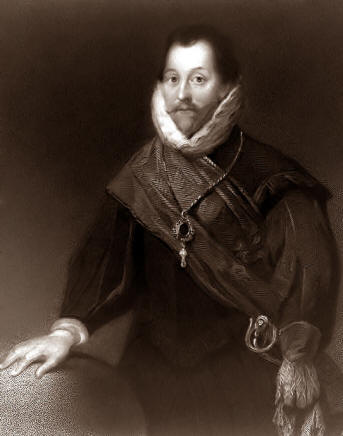
Francis Drake (ca. 1545-1596), 
victor over the Spanish Armada
The battles are:
-Marathon;
-Syracuse;
-Arbela;
-The Metaurus;
-Teutobarger Wald;
-Chalons;
-Tours;
-Hastings;
-Orleans;
-The Spanish Armada;
-Blenheim;
-Poltava;
-Saratoga;
-Valmy;
-Waterloo;
-Vicksburg;
-Sadowa;
-First Marne;
-Midway;
-Stalingrad.

Each chapter describes the situation before and after the battle and tells why this battle was so important, a hinge of history, so to speak. In some cases, there is a lot of detail about the battle itself, in some cases there is only some hazy detail to draw from so there is not much to tell. Clearly, this is a Eurocentric, or at least Western-based series of battles. Nothing from Asia or Africa unless a European/American force is fighting against them. This makes the basis for calling it Twenty Decisive Battles of the World pretty iffy, but these are certainly twenty well chosen battles that created the West.

I rate this history 4 stars out of 5.

This book can be found on Amazon.com here: Twenty Decisive Battles of the World

Reviewed on August 4, 2011.

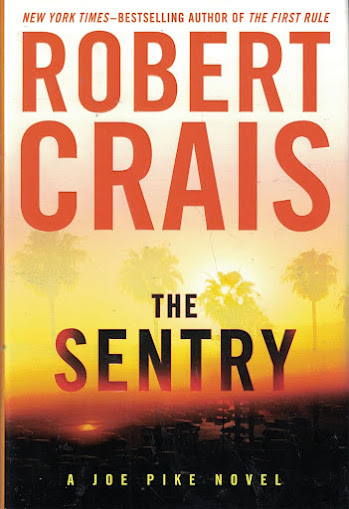
The Sentry: A Joe Pike Novel by Robert Crais


Relentlessly paced


Published in 2011 by G.P. Putnam's Sons

The Elvis Cole/Joe Pike series continues with The Sentry. Technically, it is a Joe Pike novel, but as with most of the books in this series, you get a little bit of both.

Joe Pike stumbles into a gang intimidation racket (the famed "give us money or your restaurant gets damaged" routine) in progress and, of course, the two fools actually attempt to fight Pike.

When the police come to arrest the one assailant that Pike captures the victim refuses to cooperate with the police. Pike takes a protective interest in Dru, the niece of the owner who was beaten by the gang members before Pike's intervention. Dru and Joe share a nice moment over coffee and, for a moment, Joe's impenetrable emotional armor is actually penetrated. Joe takes a shine to Dru and gets involved and tries to protect her by taking steps to stop the ongoing harassment by the Latino gang.

But, somewhere along the way things go awry. The FBI has Dru and her Uncle's restaurant under surveillance, the talk with the gang's leader seems to have come to nothing despite promises that were made and Dru and her uncle go missing after their restaurant is gruesomely vandalized. Joe and Elvis start to dig to see what has happened and they find out that almost nothing is what it seemed...

I rate this book 4 stars out of 5 and it can be found on Amazon.com here: The Sentry: A Joe Pike Novel.

Reviewed on August 4, 2011.

Naked Economics: Undressing the Dismal Science by Charles J. Wheelan


Don't know much about economics? Well...


Published in 2003 by W.W. Norton and Company.

If, like most, you don't know much about economics, than I strongly recommend giving yourself a painless, entertaining introduction to the major concepts by checking out Naked Economics: Undressing the Dismal Science.

Serious economists are sure to argue all sorts of fine points with Charles Wheelan, but the broad strokes of economic theory are laid out in an easy-to-read, fun, informative format that uses no graphs, charts or mathematical formulae. The experts may love all of those tools and jargon, but they do get in the way for most everyone else. Wheelan is one of those rare people who speaks technical econ-speak and regular English and can translate for the majority.

This is a strong enough book that I would seriously recommend it for anyone taking a basic econ class as a primer. I would also recommend it as a supplemental textbook to go along with a basic econ textbook for advanced high school students or Econ 101 type classes in college. I would even recommend it instead of most basic econ textbooks since they are usually about as interesting as reading the owners manual for a microwave oven. Naked Economics is a book that will be read and enjoyed, rather than skimmed, dreaded and cursed.

Read this along with Thomas Friedman's The World is Flat and you have doubled your education about economics and the modern world and you have a fundamental grasp of the modern economy. Notice I said fundamental, not complete - these book are tremendous places to start your learning.

I rate this book 5 stars out of 5.

This book can be found on Amazon.com here: Naked Economics by Charles Wheelan.

Reviewed on April 13, 2008.

Farnham's Freehold (audiobook) by Robert A. Heinlein


Often frustrating. Sometimes shocking. Never boring.


Read by Tom Weiner
Duration: 10 hours, 24 minutes.
Blackstone Audio
Unabridged.

Robert A. Heinlein was recognized many times over as a master of the science fiction tale – he is a multiple winner of the Hugo award and the first recipient of the Grand Master Award for lifetime achievement. Heinlein is one of those golden age writers that moved science fiction from being stories strictly for kids to a separate and recognized literary genre for adults, too.

Farnham’s Freehold is, at best, a difficult book. Perhaps books like this were a requirement when moving science fiction from a kid’s genre to an adult genre. It seems that Heinlein the iconoclast was out to irritate as many sensibilities as possible in an attempt to question some of society’s long held ideas about race, sex and the male-female relationships, even if it caused the story to suffer at the expense of all of that questioning.

The story first appeared as a magazine serial in 1964 and has some superficial similarities to Pierre Boulle’s 1963 novel Planet of the Apes. The story features Hugh Farnham, a building contractor, and his family. They live in a suburban Colorado neighborhood during an undefined time, most likely the mid to late 1960s at the height of the Cold War. The Soviet Union and the United States have maintained a Cuban Missile Crisis state of readiness and it is clearly getting worse.

Hugh Farnham is prepared for nuclear war, however. As already noted, he is a contractor and he has designed, built and stocked a fallout shelter. Nuclear war begins while the entire Farnham clan (and a visitor) are home so Hugh quickly moves his wife, college-aged daughter, her sorority sister, his lawyer son and their house servant Joseph into the shelter. The Farnham family is white while Joseph is African American. They all survive the attack and emerge in a world that is not destroyed, but actually a lush forest with wildlife and no radiation and no sign of the nuclear war that occurred.
Robert A. Heinlein 
(1907-1988)

The Farnham family just may be the most dysfunctional family in all of science fiction. Mrs. Farnham is so chemically dependent that in literally every scene she is either passed out, drunk, high or looking to get drunk or high. Her daughter openly considers incest with her father or her brother. The brother Duke gets into two fistfights with his father, fawns over his mother and openly hates Joseph because of his race. Hugh advocates eugenics, seriously threatens to kill his son several times, orders everyone to take sleeping pills and alcohol or other drugs on a regular basis, openly leers at his daughter’s naked body, insists that everyone walk around naked in multiple scenes and conceives a child with his daughter’s best friend during the nuclear attack while his wife sleeps in the next room after he has drugged her.

This creepy cast of characters and their fallout shelter are actually thrown about 2,000 years into the future – that is the reason for the lush landscape rather than a nuclear wasteland – Colorado has had time to recover. They set out to build a little settlement in the wilderness and Heinlein goes to great lengths to describe everything that Farnham included in the shelter and the difficulties that modern people would have in going back to a log cabin lifestyle.

Hugh assumed that they were in some sort of Eden and makes plans to re-populate the Earth.  One day, however, flying ships arrive and the Farnham’s discover that the world is a very different place than they had assumed. The lush wilderness actually belongs to a feudal type lord who is part of a worldwide, very high tech culture based on countries that were not part of the American-Russian nuclear war – Africa, India, the Arab world and some parts of Latin America, but especially Africa and India. Race becomes an issue, and the ruling ethnic groups are a complete reversal from the situation that the Farnhams knew back home.

Skin color is still important but whites are the enslaved and the ruling class is entirely made up of people with darker skins tones. White females are primarily used for sexual entertainment (they are called “sluts” – a word that Heinlein must use a hundred times in the second half of the book) and white males are used for all sorts of labor. Hugh wants to escape with Barbara, his daughter’s best friend, because their sexual encounter during the nuclear attack has resulted in twin sons. Hugh is particularly motivated to act quickly once he discovers that the ruling class is fond of eating white people and he fears that one of his sons or Barbara will be a victim of cannibalism. Farnham’s plans to escape and possibly return to his own time take up the last quarter of the book. As Farnham puts it, “We go on…no matter what happens.”

As I listened to Farnham’s Freehold I questioned Heinlein’s motives throughout. I had to wonder why Heinlein included such things as the open and positive discussion of incest and why he made every female character weak and dependent - their entire world revolves around men – they attach themselves to them and have little else in their lives but their approval or their scorn. His continual reference to them as “sluts” in the last half of the book only reinforces that thought. The choice to make the African rulers of the world some 2,000 years from now cannibals is, for me, the most confusing aspect of the book. What seemed a neat trick to show the folly of racism by having the positions reversed instead becomes a reinforcement of the most pathetic of racial stereotypes from the days when Africa was known as the “dark continent.”

The only conclusion I can come to is that Heinlein was just writing in what interested him and really did not care if it went down smoothly with his readers – he was in full iconoclast mode. In that case, he achieved his goal. At best, this is an uncomfortable book with some good points mixed in with the bad, like an elderly relative that can give good advice and in the next breath go off on some racist or sexist rant. At worst, Farnham’s Freehold is an anti-minority, anti-woman survivalist rant. It is oftentimes frustrating. It is sometimes shocking. It is never boring.

Tom Weiner read the book. He did an exceptionally good job with the voices of Hugh Farnham and Joseph. His female voices were not as good, but they were also hampered by Heinlein’s oftentimes-stilted female dialogue.

I rate this audiobook 2 stars out of 5 and it can be found on Amazon.com here: Farnham's Freehold by Robert A. Heinlein.

Reviewed on July 8, 2011.

A Lynching in the Heartland: Race and Memory in the Heartland by James H. Madison


An important look at a terrible act


Published in 2001 by Palgrave Macmillan

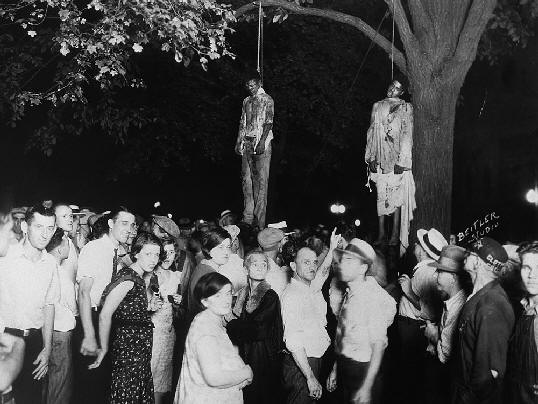
On August 7, 1930 a crowd of hundreds, possibly thousands swarmed around the Grant County Court House in Marion, Indiana with the intent to remove three black teenagers and kill them by hanging from the trees on the Court House lawn - a lynching. Two of the young men were lynched, the third was spared for reasons that no one seems to remember. The survivor claims it was a miracle that he was released and put back into the jail, and it may well have been so. Nevertheless, it may have mostly disappeared from America's collective memory except as an aberration from the stereotypical norm of lynchings being a mostly Southern phenomenon.

That is, it may have been forgotten except for the picture taken by a local photographer named Lawrence Beitler who printed off hundreds of copies and sold them to gawkers the next day. Those copies made their way across the state and eventually across the world to be reprinted in newspapers, magazines, textbook and even in movies. The Beitler print is the iconic photo of a lynching. Two young men hang dead while a crowd of onlookers gawk. An angry man points. A husband and his pregnant wife hold hands and smile as though a lynching were as much fun as the county fair. Old men and old women stand and stare - one old woman uses the occasion to people watch. The surreality is striking and disturbing.

The infamous photo by Lawrence Beitler of the lynching of Tom Shipp and Abe Smith. August 7, 1930 - Marion, Indiana

 James H. Madison's A Lynching in the Heartland: Race and Memory in the Heartland is more than a look at that one awful night. He puts it in context. He discusses lynching throughout the country, looks at the history of Grant County and its history of race relations and what he refers to as the ever-shifting "color line" - those unnamed rules of proper relations between blacks and whites in America as a whole and in Grant Country in particular.

Madison does not try to portray the victims of the lynch mob as martyred saints, nor does he demonize white Hoosiers. There are heroes and villains in the book, to be sure but they come as individuals, not in racial groups. This is not a case of the Ku Klux Klan rolling into town and killing two young man (the KKK was mostly disgraced and defunct in Marion after many statewide scandals despite having had a popular run a few years before). Nor is it the case of a consistently intolerant city just doing what came naturally. Madison shows us the frustrating nuances that make this a complicated piece of history.

Madison follows the city through the 1940s and into the Civil Rights era of the 50s, 60s and 70s to the turn of the 21st century. Real racial progress was made, in fits and starts. But, always looming in the background was the awful image of Beitler's photograph...

Truly a remarkably well-written and deftly handled history.

I rate this book 5 stars out of 5.

This book can be found on Amazon.com here: A Lynching in the Heartland.

Reviewed on August 1, 2011.

J.R.R. Tolkien (Christian Encounters series) by Mark Horne


A nifty little biography


Published in 2011 by Thomas Nelson

Mark Horne's J.R.R. Tolkien is an enjoyable biography of the famed writer of The Hobbit and The Lord of the Rings trilogy. It is not a large biography (130 pages) but, if you are like me and knew just a little about Tolkien and wanted to know a bit more, this biography fits the bill perfectly.

Horne begins with quite a bit of detail about Tolkien's early life, especially the difficulties caused by the loss of his father when 
he was very young and the death of his mother when he was 12 years old. His mother's faith and the difficulties she endured when she converted to Catholicism are very important foundations of Tolkien's young life.

Tolkien's relationship with his wife Edith (both before and after they were married) are covered quite well. Horne skimps a bit on his children and we almost completely lose track of Tolkien's brother, who endured the same difficulties but chose a different path through life.

Tolkien had no inheritance or lofty standing in society to help him prosper in pre-World War I England. But, he did have a first class mind and despite the distraction of his budding romance with Edith, he was able to procure an academic scholarship to Oxford. Tolkien and academia were a great fit and he continued to teach throughout most of his life. He seems to have been an excellent teachers as his academic programs grew even though he was very much an advocate of letting students have more choices and less rigid programming in their education (this is in line with the general freedoms he promoted throughout his works).
J.R.R. Tolkien (1892-1973)


Academic male companionship was important to Tolkien and he almost always had a group of students and/or professors that he met with regularly. They discussed the news of the day, literature, various academic disciplines and they served as willing foils for each one another's new projects. This seems to have been the great joy of Tolkien's life. C.S. Lewis was one of these companions, being a fellow member of group that called themselves the Inklings.

This little biography's strength is how it tells the tale of the creation of Tolkien's beloved books and their enormous influence on literature and culture even today and how truly surprised Tolkien was at his success. Tolkien was prone to multiple re-writes, self-doubt and what might be referred to as attention deficit disorder when it came to finishing projects - he was constantly adding this or that and re-working sections of books, even while the presses were waiting, as was the case for The Return of the King. Thrown in is Tolkien's omnipresent and ultimately quixotic desire to publish the never-quite-done The Silmarillion, his background source for the world of Middle Earth (it was published after his death after careful editing by his son, Christopher).

I received my copy of this book without charge from Thomas Nelson Publisher's BookSneeze program. There was no expectation of a positive review in exchange for the book, nor would I simply "give" a positive review since that would be unethical.

I rate this biography 5 stars out of 5.

This book can be found on Amazon.com here: J.R.R. Tolkien by Mark Horne.

Reviewed on August 1, 2011.

Indigo Slam (Elvis Cole #7) (audiobook) by Robert Crais


Published in 2008 by Brilliance Audio.
Read by David Stuart.
Duration: 8 hours, 27 minutes.
Unabridged.

While not as action-packed as The Last Detective (which follows Indigo Slam in the series, but I've not read a single one of them in order so why start now?), this is a strong book. Lots of smart comments, action and twists and turns, although the very last twist was so obvious that only the clinically brain dead couldn't see it coming. But, that didn't lessen the overall value of the book for me.

Elvis is hired by a group of children who have been living on their own for a while to find their missing father. As the investigation progresses, Cole and his enigmatic partner Joe Pike get caught up in the Witness Protection Program, a counterfeiting ring, a crime syndicate and all sorts of other incidents of violence and mayhem. Cole's deep down soft heart and his smart mouth are, of course, an enjoyable part of the story.

The audiobook is read by David Stuart who captures the voice of Elvis Cole perfectly.

I rate this audiobook 5 stars out of 5.

This audiobook can be found on Amazon.com here: Indigo Slam (Elvis Cole/Joe Pike Series).

Reviewed on April 24, 2008.

Jack Arute's Tales from Indy 500 by Jack Arute with Jenna Fryer


Published in 2006 by Sports Publishing

Jack Arute's first Indy 500 was in 1969 as an 18-year-old spectator. His family owns a track in the Northeast and racing is in his blood. His dad passed down a love for the Indy 500 in particular. Arute turned that love into a long career covering racing. 


In Jack Arute's Tales from Indy 500, Arute only tells stories from 1969 to the present (2004 in the hardback version, 2005 in the paperback version). Nothing too complicated and a real fun read, especially if you want to re-live some of the more exciting, interesting and sad moments from the last 35 years or so.

Jack Arute (center) 
joking with Tony Kanaan
I'd recommend the paperback version over the hardback since it has been expanded to include the 2005 race - the race where Danica Patrick became a household name.


This is a quick read - I finished it in just one evening, but to be fair, I did read into the wee hours of the morning because the stories were that much fun.

I rate this book 4 stars out of 5.

This book can be found on Amazon.com here: Jack Arute's Tales from the Indy 500

Reviewed on May 2, 2008.

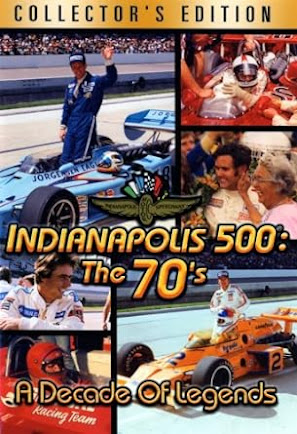
Indianapolis 500: The 70's A decade Of Legends (Collectors Edition) DVD


A must for Indy 500 fans

Part of a series of DVDs produced by the Indianapolis Motor Speedway, this collection reviews all of the races from 1970-1979, including A.J. Foyt's famed and unprecedented fourth win.

The collection features original TV & radio commentary, sound and video and lots of interviews with the drivers. Some of the interviews are from the 1970s and some are from nowadays looking back.
Janet Guthrie


Indianapolis 500: (The 70's A decade Of Legends) Collectors Edition is more than mindless promotion of the race - the lowlights (1973) are exposed along with the controversy associated with the arrival of Janet Guthrie, the first female participant in the 500. Changes with racing technology is highlighted throughout.

DVD features include collecting all of the bits and pieces of interviews with several drivers and some owners and adding a few bonus bits. Rick Mears and Roger Penske are especially strong interviews.

Well done.

5 stars out of 5.

This DVD can be found on Amazon.com here: Indianapolis 500: the 70's.

Reviewed on May 2, 2008.

Liberal Fascism: The Secret History of the American Left, From Mussolini to the Politics of Meaning by Jonah Goldberg


An Impressive Amount of Research


Published in 2208.

According to Goldberg, the traditional left-right concept of political beliefs is incorrect. Understanding this is key to understanding Goldberg's thesis that modern liberalism is the intellectual heir to Rousseau's ideas, the French Revolution and is, at the very least, the intellectual cousin to both fascism (especially Italian Fascism) and Soviet Communism.

To fully understand this you have to understand that measuring political philosophy with a one-dimensional left-right line lack the depth to measure both social and economic political philosophies. A quadrant map used to measure political beliefs will more accurately show depth of support for government involvement in economic issues, political rights and social issues. Anarchists lie at the edge of one quadrant, Libertarians a little more toward the center of that same quadrant but totalitarians lie in the opposite corner. Search the web to discover more about the grid concept for yourself.

Knowing this and actually knowing the stated goals of the fascist states (not including the racial discrimination of the Nazis), one can easily see that those goals are more in line with those of modern liberals and not with those of the Right, despite the popular belief that Fascists are nothing more than extreme Conservatives.

On the political grid, one can see that Fascists and Communists are really nearly the same thing, or at the very least political cousins of one another. They are both Totalitarians. Totalitarianism it the opposite of the Enlightenment philosophies that America was founded upon (see John Locke) and they are the opposite of the views of Classical Liberals.

Goldberg's thesis in Liberal Fascism: The Secret History of the American Left, From Mussolini to the Politics of Meaning is that modern liberals are not Adolph Hitler death camp fascists. Rather, they are akin to Mussolini's pre-World War II vision of fascism. Goldberg likens Mussolini's fascism to being very masculine and he likens modern liberalism to being more of an "eat your vegetables" nanny-state style of fascism, a more feminine model, if you will. Not classic Totalitarianism, but with clear Totalitarian features. The government is getting more and more involved in your daily life. The government tells you cannot smoke in your own business (Indianapolis), the type of grease you can cook with (New York City) and what types of grocery bags you can use (San Francisco).

None of those things belongs in the realm of government in the view of Classical Liberalism, which is more concerned about protecting you from government intervention, not in protecting you from yourself. While a nanny state is clearly not a Totalitarian state, it also is clearly closer to fascism on the quadrant grid than it is to classical liberalism.

Goldberg uses an impressive array of quotes and sources to back up his arguments. Goldberg is not afraid to go after Republicans as well. He's not happy with Karl Rove or George W. Bush for their own fascist tendencies. Mind you, his complaints are not those that the hyperbolic bloggers on the Left obsess over. He is bothered by the faith-based initiatives and the tremendous reach of No Child Left Behind into areas that were once left to local and state government.

Liberal Fascism is often dense reading, more like a political science textbook than the typical political stuff put out by partisans like Michael Moore, Ann Coulter and Sean Hannity. A strong working knowledge of political philosophy and political science vocabulary is a must with this book.

Goldberg provided tons of endnotes to document his work which is a strength and indicative of the quality of work that he has created. It was also quite annoying. Not the notes themselves, but the fact that they were endnotes with commentary requiring the reader to constantly flip back and forth to the end of the book and to keep two sets of bookmarks- one for the text and one for the endnotes. If a writer plans to write additional commentary in his or her notes common decency would suggest that footnotes are better for the reader. The continuity and flow of the main text is not broken by constant flipping to the back of the book. Shelby Foote did this to great effect in his gigantic 3 volume Civil War series. Tom Holland uses both in his book "Rubicon" - notes at the end, additional commentary at the bottom of the text.

I rate this book 5 stars out of 5.

This book can be found on Amazon.com here: Liberal Fascism.

Reviewed on May 2, 2008.

America Alone: The End of the World as We Know It by Mark Steyn


Important information but not well-presented


Published in 2006

I am a genuine fan of Mark Steyn. I am a frequent reader of National Review and his "Happy Warrior" column is what I read first. I picked this book up as a result of listening to a half-hour interview with him on my local radio station. I picked it up less than 4 hours after hearing him.

The information in America Alone The End of the World as We Know It is important, but the presentation is lacking. Steyn repeats himself so often that, if properly edited, this book would only have about 50 pages. Steyn writes brilliant columns. This book reads like a series of columns that overlap information, commentary and theme and was not up to the standards that I expected.

Steyn has done a lot of research, includes dozens and dozens of quotes and paraphrasing. However, he includes absolutely no endnotes, no footnotes, heck, he doesn't even include a bibliography! C'mon, Mark, I expect my tenth grade students to show their sources. You should do the same.

An interesting side note: A Canadian court tried to ban this book, Mark Steyn and the magazine that printed excerpts from this book due to some sort of 30 year old politically correct hate crimes law (can't write items critical of ethnic groups, etc.). While I'm not fond of the way this book is written, I can't stand the idea of banning a book for PC reasons. Steyn's book describing the trial is Lights Out: Islam, Free Speech and the Twilight of the West. Click here for my review of that book.

This book can be found on Amazon.com here: America Alone: The End of the World As We Know It

I rate this book 3 stars out of 5.

Reviewed on May 2, 2008.

Talking God (audiobook) by Tony Hillerman


Originally published in 1989.
Read by John MacDonald
Duration: 6 hours, 35 minutes
Unabridged

Talking God is good, but not the typical Tony Hillerman book. Rather than being based in the Four Corners area, this one mostly takes place in Washington, D.C.

Navajo Tribal Police Lt. Joe Leaphorn and Jim Chee investigate a body found in Gallup, New Mex
Tony Hillerman
(1925-2008)
ico. Some digging into the case discovers a trail that leads to the Smithsonian in Washington, D.C. and Navajo artifacts that are on display there.

It is interesting to see D.C. through Navajo eyes, but we do spend a lot of time in the mind of the bad guy as well, which is to the detriment of the story in my mind.

Chee's personal life features prominently as he re-connects with his on again-off again love interest Janet Pete, who is now an attorney in D.C. Leaphorn's painful loneliness and a general feeling of loss pervades throughout the book.

I would have rated the book as four stars, but I am reviewing the audiobook. My audiobook was read by John MacDonald and I cannot think of a worse pairing than MacDonald's voice and Hillerman's writing. It's not that MacDonald isn't clear - he's easy to understand. But, his voice sounds like Eastern establishment, not Western. This audiobook lasted about 6 hours and 35 minutes.

I rate this audiobook 3 stars out of 5.

Reviewed on May 2, 2008.

Note:  a new audiobook version of Talking God has been released with a different reader. I have not listened to the new version, but this book deserved another chance. This link leads to the new audiobook on Amazon.com because I cannot find a link to the edition that I listened to. 

Indianapolis 500: The 80's - A Decade for The Ages DVD


A must for Indy 500 fans

Released in 2005.

Part of a series of DVDs produced by the Indianapolis Motor Speedway, this collection reviews all of the races from 1980-1989.

The collection features original TV & radio commentary, sound and video and lots of interviews with the drivers and owners. Some of the interviews are from the 1980s and some are from nowadays looking back.

1988 Indy 500: all Penske front row
(Mears, Sullivan, Big Al)
Indianapolis 500: The 80's -  A decade for The Ages is more than mindless promotion of the race - the lowlights (1981 and the ridiculous court case that determined the winner) are exposed as well. Changes with racing technology is highlighted throughout.

DVD features include collecting all of the bits and pieces of interviews with several drivers and some owners and adding a few bonus bits. Rick Mears, Roger Penske and Tom Sneva are especially strong interviews.

Another nice feature is the inclusion of an uninterrupted highlight reel of great duels from the 1980s on the track, such as Mears-Johncock, Danny Sullivan's "Spin and Win" with Mario Andretti and Sneva vs. both Little Al and Big Al.

Well done.

I rate this DVD 5 stars out of 5.

This DVD can be found on Amazon.com here: Indianapolis 500: The 80's.

Reviewed on May 2, 2008.

Featured Post

<b><i>BAN THIS BOOK (audiobook)</i></b> by Alan Gratz

Published in 2017 by Blackstone Audio, Inc. Read by Bahni Turpin. Duration: 5 hours, 17 minutes. Unabridged. My Synopsis Ban This Book is t...

Popular posts over the last 7 days