The World Is Flat: A Brief History of the Twenty-first Century by Thomas L. Friedman


Where were you when you discovered the world was flat?

Originally published in 2005. 
Revised and updated versions released in 2006 and 2007.

I've taken a number of economics classes and I've tried to tell people about what I have learned about globalization as a reality. Friedman likes to ask people when they learned that the "world was flat", meaning when they learned that the advent of cheap instantaneous technology coupled with lowering trade barriers, and the fall of many political barriers (like the Berlin Wall) has made the world a very small, very competitive place, indeed. 

Well, I learned the world was flat last summer when one of my econ classes visited a Subaru plant in Lafayette, Indiana. When I tried to tell people who have not taken economics lately about global supply chains and comparative advantage they looked at me like I was a babbling fool. Now, my mom has read this book and now she suddenly understands my economic babblings and we speak the same language.

Thomas Friedman
What kind of book is The World Is Flat? Well-written, often funny, well-researched, full of interesting facts and, perhaps, a glimpse at the future. I followed my wife around the house reading passages to her - and she didn't tell me to get lost! I must have told 15 people to get this book and read it.

Do I agree with everything in it? No. I think he fundamentally misunderstands George W. Bush (it's just two pages so don't let that offend you or thrill you - it really is not a big part of the book), which is surprising because he really, really understands the threat of Al-Qaeda and bin Laden and explains the rise of the Islamo-Leninists (a.k.a. Islamo-fascists in other circles).

This book is a chunk (469 pages of text) but it is very readable. Friedman makes the complex really quite simple (although this "world is flat" stuff isn't that hard once you get it) and usually doesn't over explain things. Once or twice I found myself skimming passages, but this is no dry textbook.

Couple this book with Jared Diamond's Collapse: How Societies Choose to Fail or Succeed and you have a lot of food for thought to mull over the rest of the summer.

I rate this book 5 stars out of 5 and it can be found on Amazon.com here: The World is Flat.

Reviewed on July 5, 2006.
Review updated on December 28, 2025.

Sea Change by Robert B. Parker


The Good News: It's a Robert B. Parker Book...

Published in 2006.

The Bad News: It's not a particularly good one.

However, Robert B. Parker's books remind me of those bumper stickers that say 'A Bad Day Fishing is Better Than a Good Day at Work.'

A bad Jesse Stone book is still a fun read.

In Sea Change Stone's police department is investigating a woman's body found floating in the harbor. Along the way, Stone discovers lots of perversion, money, yachts and messed-up rich kids. Or, as his psychologist puts it, Stone is working on a case 'in which control and loveless sexual objectification is rampant.'

Stone comments that pornography is fun for about the first 10 seconds and then it loses most of its appeal for him (he has to wade through hours of personal videotapes of the stuff in the search for victims and suspects) because it gets so repetitive. Unfortunately, this book has the same problem. Lots of sex parties and videotape. Lots of rich boys, easy girls and videotape. The problem is that the story just gets stuck in a rut for about a hundred pages or so. The dialogue is wonderful. The observations are witty. At one point, though, I realized that I was just reading for the witty dialogue and the observations - not for the plot.

Too bad. The last Jesse Stone novel I read was one of the best novels Parker had written, in my opinion. This one goes in the lower half of that long, long list of books.

As has been the case for several of Parker's books now, the book seems quite hefty when you pick it up. However, open it up and it reminds me of when a college student tries to pad the length of his paper by enlarging the margins and the font size. This book features large print, extra thick paper, lots of space between each line and full one inch margins. Each chapter also starts about 2/3 of the way down the page and there are 62 chapters, so that's a good way to stretch it out an extra 30 pages or so. Not that it makes any difference, but I wonder why they've done this. It weighs in at 296 pages and could have easily have been printed in a 200 page format without straining the eyes. This little one-day read is wider than most textbooks! This has to be more expensive, it adds to shipping costs and makes it harder for the stores to stock multiple copies...

I rate this book 3 stars out of 5.

This book can be found on Amazon.com here: Sea Change (Jesse Stone Novels)

Reviewed on June 22, 2006.

Lawn Boy and Lawn Boy Returns by Gary Paulsen


Lots of fun and you learn a little about economics along the way


Published in 2009 and 2011.

Beloved YA author Gary Paulsen (Hatchet) shows a side I was not aware that he had: a madcap sense or humor (he may have lots of funny books, but the ones I am aware of are not particularly funny). I am not much of a reader of YA books, but my daughter was reading Lawn Boy and she was laughing out loud so much and begging to read passages to my wife and I that I decided to look into it. When I saw on the back of Lawn Boy Returns that the series had been named a Notable Book by the National Council for the Social Studies I was certainly intrigued. I discovered a simple, fun book that just about any kid would love to read that could also easily be incorporated into an economics lesson (in fact, here's a sample I discovered online: click here).

The book follows a pretty simple idea - a 12 year-old boy is given his deceased grandfather's small lawn mower. He mows his family's tiny lawn just to try it out and he is offered the chance to get paid to mow a neighbor's lawn. He decides he needs some money to buy a new inner tube for his bicycle tire so he might as well  go for it. One job leads to another and because the local lawn service owner has recently left town with the wife of one of his customers there are a lot of lawns that need servicing. There are so many lawns that "Lawn Boy" has multiple adult employees, a stockbroker advising him and more money than he knows what to do with.
Gary Paulsen

When his stockbroker gets lucky with a couple of penny stocks and then accidentally invests in a prize fighter the fun really starts. As his stockbroker (my favorite character for his unabashed love of capitalism and his short, odd explanations) notes to Lawn Boy, "You have had a very groovy month..."

Of course, the ridiculous amount of money that "Lawn Boy" generates in just a few weeks is unrealistic, the beauty of the book is that it could happen if this happens and that happens and everything aligns just right. If...if..if.  Paulsen names most chapters after an economic (or business) concept. For example, Chapter 3 of Lawn Boy is called "The Law of Increasing Product Demand Versus Flat Production Capacity" (the chapter where he adds employees because he can no longer service all of the lawns by himself). What a chapter to introduce supply and demand and how business deals with excess demand!

Anyway, the economics teacher in me got all excited about Lawn Boy. The avid reader in me liked it even more - a book that is fun to read that actually teaches something!

I rate this series 5 stars out of 5. Both books can be found on Amazon.com here: Lawn Boy and Lawn Boy Returns. 

Reviewed on July 18, 2011.

Sojourner Truth: American Abolitionist (Heroes of the Faith series) by Terry Whalin


Good introduction to the life of a true American heroine


Originally published in 1997.

Sojourner Truth has always been one of my personal heroes. She was willing to stand up for what was right in a time when being a woman and being black and being an illiterate former slave were three strikes that took most people out of the public arena. Sojourner did more than stand up for herself - she thrived confronting slavery, advocating women's rights and proclaiming the Gospel of Christ.

Sojourner Truth: American Abolitionist does a pretty good job of telling her story, but it is not a particularly lively rendition. The facts of her life add punch on their own, but that is despite the writing.

My favorite Sojourner Truth quote comes from the year 1851, which is in response to a man who doubted women had the "strength" to deal with the responsibility of voting and being an active citizen:

Sojourner Truth (1797-1883)
"That man over there says that women need to be helped into carriages, and lifted over ditches, and to have the best place everywhere. Nobody ever helps me into carriages, or over mud-puddles, or gives me any best place! And ain't I a woman? Look at me! Look at my arm! I have ploughed and planted, and gathered into barns, and no man could head me! And ain't I a woman? I could work as much and eat as much as a man - when I could get it - and bear the lash as well! And ain't I a woman? I have borne thirteen children, and seen most all sold off to slavery, and when I cried out with my mother's grief, none but Jesus heard me! And ain't I a woman?"

I give this book 4 stars out of 5, mostly because of the strength of her story, not the strength of its telling.


This book can be found on Amazon.com here: Sojourner Truth: American Abolitionist by Terry Whalin.

Reviewed on  June 21, 2006

What Price Freedom: The Adventures of Early American Heroes By Theron Nelsen and Doug Wead


A look at the Revolutionary War generation

Originally published in 1983.

Theron Nelsen and co-author Doug Wead's What Price Freedom: The Adventures of Early American Heroes is a series of short biographies of 9 men and 1 woman of the Revolutionary War generation. None of the biographies is too detailed (vary from 7-17 pages) and none focus on the more controversial parts of their lives (like Jefferson and Sally Hemmings, for example).

Nevertheless, the book is pretty well done and chock full of good quotes.

The biographies included are:
John Paul Jones
(1747-1792)

Benjamin Franklin,
Nathaniel Greene
Alexander Hamilton,
John Hancock,
Patrick Henry,
Thomas Jefferson,
John Paul Jones,
Francis Marion,
Deborah Sampson,
George Washington.

John Adams is left out, but then again, when this book was written, Adams was not as popular as he is today. If you are an Adams fan, he is quoted extensively in the book, which is one of the reasons I was surprised he was left out.

I give this book a 4 stars out of 5. Solid introduction to many of the players in the Revolutionary War. It can be found on Amazon.com here: What Price Freedom: The Adventures of Early American Heroes

Reviewed on June 21, 2006.

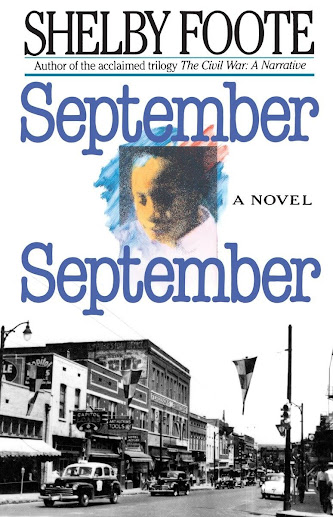
September September by Shelby Foote


Sex and kidnapping in 1957 Memphis

Originally published in 1978.

Shelby Foote is most famous for his massive history of the Civil War (The Civil War: A Narrative), but he was also an author of fiction. I have read several of them and they mostly qualify as Southern gothic - moody, dark and full of tragedy. September September fits that description perfectly, although it takes place later than his other novels.

Set against the backdrop of the racial integration of Little Rock Central High School in September of 1957, the novel features two white men and a white woman who kidnap the grandson of a wealthy black Memphis businessman. They use the Little Rock incident as their cover to blame the kidnapping on racial strife when it is really a brazen attempt to get $60,000 from a man who will not expect much cooperation from the police.

Shelby Foote (1916-2005)
The problem is summed up in a line from one of the kidnappers: "Truth is, we're not very smart, those of us who go in for crime." A sexual triangle forms between the three kidnappers. Anger and jealousy start to take precedence over "the plan" with tragic results.

Foote does a great job of creating characters with a past that feels real and his dialogue is first rate. The most interesting character to me was Theo, the grandfather who pays the ransom. His story would have been worthy of another book.

A surprising part of the book was the frequent and open discussion of sex. Racial tension is the topic of the book - racial strife in Little Rock, as the purported excuse for the kidnapping, as the source of anger in Eben's (the kidnap victim's father) burgeoning racial consciousness - but that is really a veneer. The real topic is sex and how it can strengthen, confuse and even weaken the bonds between men and women. There are quite a few graphic scenes, much more than I remember in his other novels.

I rate this book 4 stars out of 5.

Reviewed on July 15, 2011.

This book can be found on Amazon.com here: September September by Shelby Foote.

A Time for Patriots (Patrick McLanahan #13) (audiobook) by Dale Brown


Up and Down


Published by HarperAudio
Read by William Dufris
Duration: 12 hours, 27 minutes
Unabridged

Dale Brown knows how to write action very well. He certainly knows all about airplanes (sometimes he talks about them so much that it's quite easy to drift off for a while and then come back), he has created enough new technological gizmos to outfit an entire fleet and he does a solid job of creating dialogue that sounds good to the ear - from old men to teenage boys. But, the promised confrontation with militias in A Time for Patriots just sort of fizzles rather than pops.

Lt.-General Patrick McLanahan is retired and living in Battle Mountain, Nevada on a remote air base safeguarding the last of America's space planes in the hopes that the program will be re-developed in earnest when the economy picks up and the budget can allow for it. In the meantime, he and his son are flying missions for the Civil Air Patrol (CAP). Brown, who is also a member of CAP, spends a great deal of time describing its mission and even runs the reader (or in my case, listener) through an actual search and rescue operation which was interesting but not really germane to the storyline as described on the back of the book.

******Spoilers*******


Meanwhile, a militia group uses a dirty bomb on an airplane to attack the federal building in Reno. Brown uses all sorts of red herring leads to confuse multiple story lines and try to make it a surprise as to where the attacks were coming from. Although my original suspicions turned out to correct, I was fooled for a while.

But, in the end, Brown's fundamental misunderstanding of the militia movement as a whole - a misunderstanding he could have cleaned up in just a few seconds if he had did as little as researched on Wikipedia (I have linked the article here) hurt the book. I am not a militia member nor do I particularly sympathize with them, but I do follow politics and pay attention. He claims that the militias have formed due to a lack of federal government involvement in support of poor relief or job training. Instead, they are almost always a reaction to the perception of too much federal involvement in local issues. This is especially an issue in Nevada since 84.5% of Nevada is owned by the federal government.

When the big reveal happens and the bad guys are discovered and thwarted I was very disappointed to find out the real reasons that drove the entire movement. I thought to myself, "Really? Would anyone actually nuke downtown Reno for that reason?" I just didn't buy it.

So, to sum up - nice action scenes, I like the stuff on CAP, the technological toys are pretty cool but the main reason the book was written - the militia part, just landed flat on its face.

I rate this audiobook 3 stars out of 5. The education about CAP and the performance by William Dufris make up for the militia misfires.

This book can be found on Amazon.com here:  A Time for Patriots by Dale Brown.

Reviewed on July 15, 2011.

Ancient Trade Routes of the Arab World DVD


This made for school DVD highlights an important and oft-ignored facet of history


Published by Schlessinger Media.
Duration: 38 minutes.

Any teacher of world history knows that some subjects have plenty of supplemental resources available. For example, the Ancient Romans and Greeks have literally thousands of DVDs, books, workbooks, programs, units, games and activities available as supplements, including whole weeks of programming on the History Channel.

Equally influential eras, such as the Arab Trade Routes are often ignored or have scant materials available even though these trade routes were the source of medieval Islam's strength, wealth and intellectual flowering.

The DVD Ancient Trade Routes of the Arab World does address this topic, but only in a 3-star (ok, but not great) way. The DVD features three short films (12 minutes or so for a total of 38 minutes) about three trading hubs - Zanzibar in East Africa, Dhofar in the Arabian Peninsula and Ghadames in the Sahara. The movies show the modern-day versions of these cities and discuss their place in history. The Dhofar video does a great job of explaining the past value of frankincense and how it was made and traded in the ancient world.

There is a support website available (listed in the movie intro credits) but you'll probably have to make your own worksheet to make sure the your students' attentions don't wander too much.

I rate this DVD 3 stars out of 5.

This DVD can be found on Amazon.com here: Ancient Trade Routes of the Ancient World.

Reviewed on August 29, 2008.

The Long Hunters by Jason Manning


A solid bit of historical fiction

Published in 2002.

Jason Manning has written a series of novels about the Barlow family, starting with Lt. Timothy Barlow. The Long Hunters is set during the War of 1812 and the Seminole War and features Barlow, young Ensign Sam Houston, General Andrew Jackson and a Creek warrior/family man named Rook. The book covers the Battle of Horseshoe Bend and some of Jackson's Seminole Campaign in some detail, while we get a history book type overview of the Battle of New Orleans.

Manning's books are always well-researched and I am always a bit surprised that his stuff is always marketed with the pulp fiction westerns. Not that I dislike a good Western, mind you, but Manning's stuff is a cut above.

The next book in the series is The Fire-Eaters.

I rate this novel 4 stars out of 5 and it can be found on Amazon.com here: The Long Hunters

Reviewed on August 30, 2008.

First Daughter by Eric Van Lustbader


Good action marred by laughable political conspiracies and a not-so-hidden message

Published in 2008.

Eric Van Lustbader is better known as the author who has picked up the Bourne series since the death of Robert Ludlum. First Daughter has some similarities to that series in that we have vast government conspiracies, brainwashing and one man versus the system.

Positives:
The action in the book is strong.

Negatives:
The backstory Van Lustbader told to introduce us to the main character, Jack McClure, is much more interesting than the main plotline.

The politics in this book are laughable. The President is a thinly disguised clone of Bush43 (Iraq, 9/11, Patriot Act, Faith-based initiatives, etc.) except he has the paranoia and anger level of 3 or 4 Richard Nixons. The President makes new policy initiatives in his last week in office. With less than a month to go he has a major negotiation with the Russians, even though everyone knows that no one negotiates with a President with so little time left in office - his replacement will just countermand all of them in a matter of days!

Atheist terrorist groups abound even though there's no such things as atheist terrorist groups - there are terrorists that are atheists, but there are not terrorists FOR atheism. People will kill for their religious beliefs, but I can't imagine anyone killing over their lack of belief...

Even more annoying is Van Lustbader's insistence on ridiculing religion throughout the book. The President is a religious fanatic. The President-elect uses religion as a tool to get elected. The minister who is out to save the neighborhood sells out in a political alliance. A grieving mother finds comfort in the church of her youth - but she leaves it and now acts much more sane. A religious peer of McClure (the only one) ends up leaving the church and McClure congratulates him for it. The bad guy comes off as sort of a good guy in this anti-religious mindset.

It is one thing to decry religion in politics (I'm very religious and I don't like religion in bed with politics) but, it is entirely another thing to decry religion altogether. Maybe Van Lustbader thought he was being subtle, but he was about as subtle as a wrecking ball.

Recommendation: There are plenty of other action/political thrillers out there.

I rate this book 2 out of 5 stars.

This book can be found on Amazon.com here: First Daughter by Eric Van Lustbader.

Reviewed on September 1, 2008.

Forced Out: A Novel by Stephen W. Frey


This book had such potential and then...


Published in 2008.

I really liked the premise behind Forced Out: a young baseball player hides from the New York mob by playing single A ball in Florida but he is discovered by a former Yankees talent scout. Soon enough, the mob is on the hunt again.

But... (WARNING: Spoilers, sort of...)

The book gets increasingly complicated (which is fine, life is complicated) and the only way Frey resolves anything with any character in this book is by having someone killed off. I expected lots of people to die (it is about the mafia, after all) but this story gets ridiculous. The book ends up feeling like Frey was either: a) under a tight deadline; or b) unable to figure out how to end this complicated book in a reasonable way so he just started killing everyone off.

Either way, it was a very unsatisfying ending. In good conscience, I cannot recommend this book to all but the most ardent of Stephen Frey fans.


I rate this book 2 stars out of 5 and it can be found on Amazon.com here: Forced Out by Stephen W. Frey. 

Reviewed on September 5, 2008.

Samuel Adams: A Life by Ira Stoll


The "Forgotten" Founding Father

Published in 2008.

George Washington. Thomas Jefferson. Benjamin Franklin. John Adams. All there at the founding of our country. All recognized for their unique contributions to the revolution. Author Gary Wills noted that Adams was "the most influential man at the first two Congresses." He was on the committees of correspondence that tied the colonies together in the first place and no one was on more committees in the Continental Congress. It is easily argued that Samuel Adams had as great a role, if not greater than any other member of the Congress. He had such an integral part to play that a local newspaper noted in his obituary that "to give his history at full length, would be to to give an history of the American Revolution."

In Samuel Adams: A LifeIra Stoll tells the story of Samuel Adams. Called by some the Last of the Puritans for his strong religious faith and willingness to express it openly, Adams was certainly one of the strongest defenders of liberty from the outset. In fact, a general amnesty was offered to everyone in the Massachusetts colony by the British government, except for Samuel Adams and John Hancock. At other times, the British government approached him with clumsy attempts to bribe him with high office or favors, which he rejected with flair ("tell Governor Gage it is the advice of Samuel Adams to him no longer insult the feelings of an exasperated people.") Stoll correctly labels Adams a "religious revolutionary" - those two themes dominate his life until the very end.

Samuel Adams (1722-1803)
Politically, he was closer to Thomas Jefferson than his Federalist cousin John Adams. But, unlike Jefferson, he decried slavery and acted upon it (his wife received a slave as a gift and he freed her that day). He also advocated education for women. He wrote page after page for newspapers supporting the idea of independence and would not compromise on that point. He could whip up a crowd with his voice as well, and he often did during the years when Boston led the protests against taxes, leading up to the Boston Tea Party.


Stoll's prose is not necessarily the most exciting of reading, but Adams words and life are inspiring enough that I rate this book 4 stars out of 5.

This book can be found on Amazon.com here: Samuel Adams: A Life.


Reviewed on July 13, 2011.

The Quotable Rogue: The Ideals of Sarah Palin In Her Own Words edited by Matt Lewis


Sarah Palin, without the filter


Published in 2011 by Thomas Nelson

There is no one, and I mean no one that generates as much energy and as much anger in American politics as Alaska's former governor Sarah Palin. In The Quotable Rogue: The Ideals of Sarah Palin In Her Own WordsMatt Lewis has collected a number of Palin's quotes on a variety of topics from her speeches and interviews over the last 5 or 6 years. He has organized them into broad 32 categories ranging from abortion to Barack Obama to Gun Control to Tina Fey. He also has a category of quotes from others about Sarah Palin.

I was interested in this book because so much of what I hear about Sarah Palin is filtered through the opinions of columnists or edited heavily for TV or radio. This book is just Sarah's comment with a brief note about where and when it was said or written. That's it - no spin one way or the other.
Sarah Palin


Being that it is a book of quotes, it really can only be judged on the quality of the quotes - did they clarify Sarah Palin's point of view and were they interesting? Yes, on both counts. I picked this book up and ended up quickly reading it while in the middle of another book.

I rate this book 4 stars out of 5.

Reviewed on July 13, 2011.

I received this book for free as part of Thomas Nelson's Booksneeze program in exchange for a fair and honest review. This book can be found on Amazon.com here: Quotable Rogue.

What They Didn't Teach You About the Civil War by Mike Wright


Entertaining but too many errors.

Published in 1996 by Presidio Press

Mike Wright is a television writer. In fact, he writes a pretty entertaining book as well. But, his lack of training as a historian shows in What They Didn't Teach You About the Civil War

 Some of the facts things he writes about were not taught to you because they just are not facts. In other cases, they are factual, but not truthful. For example, the fact about Robert E. Lee not owning any slaves at the time of the Civil War (p. 23) is technically true - but ignores the fact that his wife owned the slaves and they freed them in 1862 (not "long before the Civil War" as the book asserts) because of a requirement of her father's will).

Wright makes the comment that the Confederacy only had one good general (Lee) on page 40. Perhaps Wright meant to clarify his point and say that Lee was the Confederacy's only good commanding general because one cannot say that Stonewall Jackson was a bad general (Lee called him his "right arm"). Or Longstreet (despite Wright's derision of his abilities on page 40). Or Stuart. Or Forrest. Even some of the Confederacy's fair to middling generals, such as Beauregard or J. Johnston or even Hood compare relatively well to the average Union general. Can you imagine if John Bell Hood with his attack at all times philosophy would have done in place of McClellan in the Peninsula Campaign or at Antietam?

On page 39 Wright makes a gigantic mistake. He claims that on May 3, 1861 the U.S. Congress declared war on the Confederacy. It was the other way around - the Confederacy declared war on the U.S. The Union never declared war on the Confederacy because according to international law can only declare war on a country and the Union argued to the European powers that the Confederacy was NOT a country - it was a rebellion. If the Union had declared war on the Confederacy, it would have been an admission that the Confederacy was a country and the European powers would have been free to make alliances with the Confederacy and intervene in the war.

Benjamin Butler (1818-1893)
Good points:

-Wright totally nails the personality and career of McClellan.

-The book is full of fun quotes, stories and facts. His story of the attempt to rid Nashville of its prostitutes by shipping them out to Louisville and Cincinnati was my favorite.

-He includes nice small biographies of Nathan Bedford Forrest and Benjamin Butler.

To sum up, a number of errors combine to make this book less than trustworthy, even though it is quite fun.

I rate this book 3 stars out of 5.

This book can be found on Amazon.com here: What They Didn't Teach You About the Civil War by Mike Wright.

Reviewed on July 13, 2011.

Motherhood and Hollywood: How to Get a Job Like Mine by Patricia Heaton


A fun, breezy read about a normal girl who made it big

Published in 2002 by Villard

Motherhood and Hollywood: How to Get a Job Like Mine is not out to change anyone's life, but it is a funny, light look at one woman's meandering quest to be an actress. Also, it is quite reassuring to find out that there are people in Hollywood who are quite normal.

Patricia Heaton's book is irreverent, sometimes serious, frank, cute, and her tales of a time when kids could run the neighborhood in suburban Cleveland without fear reminded me of my own fun in small town Indiana. She pokes fun at her own silliness and naivete and reminded me of my own way back when.

The author, Patricia Heaton
This is a weekend read (it also has great potential as a read-out-loud-to-your-spouse-in-the-car book), but it will be one that you'll pass on to friends so they can have a fun weekend as well.


I give this one 4 stars out of 5.

This book can be found on Amazon.com here: Motherhood and Hollywood: How to Get a Job Like Mine.

Reviewed on June 20, 2006.

Keeping Black Boys Out of Special Education by Jawanza Kunjufu


Full of good advice about ALL boys and special education

Published in 2005.

While Jawanza Kunjufu, an author of nearly two dozen books, writes primarily for an African-American audience, Keeping Black Boys Out of Special Education is full of good observations about boys in special education in general.

There is a growing concern about the number of boys in special education as compared to girls. Kunjufu joins more established authors such as Christina Hoff Sommers ('The War Against Boys') and Michael Guiran ('Boys and Girls Learn Differently') in pointing out that there is something wrong out there in the world of education as far as boys are concerned.

Kunjufu gives wonderful advice about the questions parents should ask if they are brought in to the school to discuss placing their student into special education. His suggestions include signing nothing until you completely understand it, insisting on seeing what modifications have been done up to this point (unfortunately, some teachers have the reputation of referring every student who does not learn quickly from that teacher's ONE teaching style for special education services) and asking for a different assessment test (it is your right) - scores can vary widely from one test to the next.

His best advice comes in the area of the IEP, or Individualized Education Plan. All special education students must have one and most are vague. He insists on specificity and the book is worth the purchase price just for this chapter alone - both for the prospective special education parent and the special education teacher.
Jawanza Kunjufu


Kunjufu's target audience is African-American, as I've already said. I am not, so some passages were not really aimed at me. I was not comfortable with Kunjufu's seemingly equating inner-city poverty with African-American culture in general. As he points out in the beginning of the book, that this is a stereotype. However, he reinforces that stereotype over and over again. It could be that he is really targeting that segment of the African-American population... Like I said, I don't know.

Regardless of my comfort level with certain passages, this is a must read if your student is being referred for special education services. It is a quick and practical read with a clear table of contents to get you quickly to the IEP and Parent Empowerment sections and room for notes in the back.

I rate this book 5 stars out of 5.

This book can be found on Amazon.com here: Keeping Black Boys Out of Special Education by Jawanza Kunjufu.

Reviewed on June 20, 2006.

The Keeper by Meg O'Brien


This thriller does its job but misses the mark on being a great read.


Originally published in 1992.

In The Keeper Meg O'Brien produces a thriller that keeps the suspense up but still comes up short from being a truly satisfying read.
The plot concerns the kidnapping of Charly Hayes, the daughter of a Nathan and Brooke who are divorced. Accusations of parental kidnapping fly from both parties and eventually Brooke is secretly sent to John Creed, an ex-cop who is known as the Keeper (Keeper of the Flame, Keeper of the Faith, Keeper of the Files) who is unofficially attached to LAPD as a one-man department to find missing children. When things get rough, he has a team of volunteers to help him out - both inside and outside the department. Creed is an emotional train wreck who obsesses since his own son has been missing for 5 years.

Some of O'Brien's transitions from one character to the next are clunky and the relationship between Creed and Brooke is telegraphed from the first page that they meet. O'Brien has several discrepencies, such as having Brooke chamber a round in a revolver and using plain, untreated tap water to clean a fish tank. Those are annoying, but mostly I found myself wishing that this same premise for a plot were re-written by someone else who could make the characters come alive a bit better. The character of Brooke just did not work for me. Unfortunately, despite the name of the book, The Keeper and his team were not the focus of the book. If they had been, it probably would have been a better book.

Once again, it's not a bad book, but it certainly isn't a great one either.

This book can be found on Amazon.com here: The Keeper.

I rate this book 3 stars out of 5.

Reviewed on June 9, 2006.

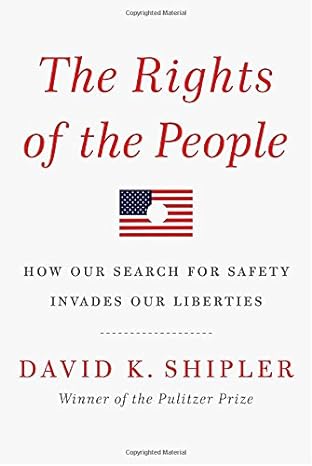
The Rights of the People: How Our Search for Safety Invades Our Liberties by David K. Shipler


An Important Book - for Liberals and Conservatives

Published by Alfred A. Knopf in 2011

Pulitzer Prize-winning author David K. Shipler takes a long hard look at the rights we have sacrificed in the era of the War on Drugs and the War on Terror, and lesser wars such as the War on Handgun Violence in The Rights of the People: How Our Search for Safety Invades Our Liberties. I picked this book up figuring that my Conservative sensibilities might get ruffled a bit by a New York Times reporter but I might learn a thing or two along the way.

I always tell people that the traditional left-right continuum used to describe someone's politics is so inaccurate as to be useless. Really, what is the difference between an aging hippie living on a hill somewhere raising some dope for personal use and telling the government to get out of his business and a Barry Goldwater-type conservative (like me) living by himself on a hill somewhere that tells the government to get its nose out of his business? Some dope. Otherwise, they are both determined advocates of civil liberties - keep out of my business if it is not hurting anyone else.

Mr. Shipler and I meet on that continuum at the spot I just described.

The Rights of the People starts with a history of civil rights in American history and there were a few things that surprised this American history addict (let's just say that the more I read about Woodrow Wilson, the less I like).  Shipler then moves into a chapter called "Another Country." This country is inner-city Washington, D.C., a place where the Fourth Ammendment (The right of the people to be secure in their persons, houses, papers, and effects, against unreasonable searches and seizures, shall not be violated, and no Warrants shall issue, but upon probable cause, supported by Oath or affirmation, and particularly describing the place to be searched, and the persons or things to be seized.) simply does not exist. Because Washington had very stringent anti-handgun laws, the police openly frisk people on the street, at family picnics, on their front steps, in their cars, in parked unlocked cars, just about anywhere - looking for guns. Temporary roadblocks are set up, drivers are pulled from their cars and frisked and their cars are searched without cause just to snag a pistol here or there (to be honest, I would not drive in some of those neighborhoods without a pistol, either.)


This is the kind of activity that I would not tolerate and I have lived next door to an armed drug dealer that I desperately wanted to have arrested. But, I did not want my entire neighborhood turned into a police state to achieve it. This section angered me, especially as I recognized a behavior described by Shipler that I have seen in some of my middle school students - young men pulling up their shirts to show that they are not carrying pistols in their waistbands. Some of my students do this when challenged by authority figures at school as well, which tells me they live in an America that does not have a Fourth Amendment.

Or, maybe the whole country is going that way. Shipler describes multiple cases of people's homes being searched with flimsy warrants, or none at all. Or, public school-based drug tests in order to participate in any extracurricular activities. At a school I used to work at I sponsored a Key Club (a volunteer organization). Every member of the club was subject to a urine test simply because they wanted to help out in a nursing home or collect the recycling during their study halls and be recognized for it during our meetings. How silly is that?

Shipler moves on to the Patriot Act and describes in histrionic-free language what it enables and what it has been used for. He describes in great detail how NSA data mining is used. To be honest, I was bothered by this as well, but not as much as I was by the first section, but only because the first section was much less abstract and more visceral, more real.

A chapter called "The Right to Be Let Alone" describes how all of the data we produce about ourselves every day can be used by private entities or employers. Some of his examples are a bit weak, including a police officer who was disciplined for using his department-issued pager to send personal sexual messages. He sent so many messages that he went over the contracted limit. Work tools are for work and the employer has a right to ensure that they are used for work, in my opinion.

He wraps up the book with a look at how counter-terrorism has eroded rights.

Of course, history continues to march along. Shipler released his book before the death of Osama Bin Laden and before the Supreme Court of Indiana ruled “In sum, we hold that [in] Indiana the right to reasonably resist an unlawful police entry into a home is no longer recognized under Indiana law.” Which means that, in Indiana, warrants are not technically not necessary at this time. Fun, huh?

Here is a link to Mr. Shipler's  second book called  Rights at Risk with other aspects of this topic.

I rate this book 5 stars out of 5. Highly recommended.

This book can be found on Amazon.com here: The Rights of the People.

Reviewed on July 12, 2011.

Featured Post

<b><i>BAN THIS BOOK (audiobook)</i></b> by Alan Gratz

Published in 2017 by Blackstone Audio, Inc. Read by Bahni Turpin. Duration: 5 hours, 17 minutes. Unabridged. My Synopsis Ban This Book is t...

Popular posts over the last 7 days