More than 2000 reviews over the last 25 years.
A Death in Victory by Gregory Bean
A pleasant surprise
Published in 1997.
If you are an avid reader, you know how much of a gamble it can be to pick up a book by an author you've never heard of and jump into the middle of a series. You could get lucky and find a great new author to read or you could just be wasting your time.
Well, I'm pleased to report that this is a great book and I'm going to seek out the others in the series. A Death in Victory is the third in a series featuring Harry Starbranch, the town police officer in Victory, Wyoming.
Rather than go through plot details I'll give you a general idea about the book. A Death in Victory reads a bit like Robert Parker meets Tony Hillerman. Starbranch is a wisecracking cop who is not afraid to throw his fists. He has friends and connections everywhere and is not afraid to use them. But, like Hillerman, there's an acknowledgment of the reality of the immenseness of the wide open western spaces. He describes Wyoming and its culture as lovingly as Hillerman describes the Navajo reservation and its environs.
In case you are wondering, you do not have to read the previous books in the series in order to follow along with this one.
Good plot, well-paced. The ending surprised me but also made sense. I thoroughly enjoyed it.
I give A Death in Victory 5 stars out of a possible 5 stars.
This book can be found on Amazon.com here: A Death in Victory by Gregory Bean.
Reviewed on April 25, 2006.
Blow Fly (Kay Scarpetta #12) by Patricia Cornwell
Easily the worst of the series
This was an utterly disappointing book. I have stepped away from Cornwell for a couple of years, but I was an avid reader before that, including the horrid series of books that Cornwell started with Hornet's Nest and Isle of Dogs.
Blow Fly is just as bad, if not worse, than those books. I had thought that it was the characters that I disliked in that other Cornwell series but now I am convinced that Cornwell has changed her writing style and I am not a fan of the new Cornwell style at all.
Recommendations:
*Spin Lucy off. She's becoming too Batman-esque, with all of her high-powered technological gadgets, a sidekick and a helicopter. I'm sick of her and I have not liked her since she joined the FBI.
*Do something with Marino other than having him drink, burp, and look unhealthy. He appears throughout the book but only does something useful at the beginning. He is a pathetic version of his rough-edged self in the earlier books.
*Benton. Hated him in every book. Still do.
*I know the French brothers are supposed to be Scarpetti's nemesis but, honestly, how many cops have a nemesis? Give it a rest.
*Do something with the plot other than drag the reader through page after page of Lucy's antics, Marino's unhealthiness, Scarpetti's desire to be a powerful woman (How many times is her 'power' referred to? I'd bet it's at least half a dozen.), Benton's dispassionate scheming and the insane thoughts of a deformed French madman who is constantly playing with his tiny genitalia. Lots of emoting, musing and rambling. Not much action.
*Note to Patricia Cornwell. I know it may have been a while since you had to shop at a Wal-Mart, but they would make an awful place to kidnap someone since the parking lots are constantly watched by cameras. How do I know this? Go to the customer service counter at any Wal-Mart in America and you'll see the monitors showing the display outside.
So, to sum up: This book is terrible. Read the early books in the series - they are great.
I give Blow Fly 1 star out of 5.
This book can be found on Amazon.com here: Blow Fly by Patricia Cornwell.
Reviewed on April 19, 2006.
Blow Fly is just as bad, if not worse, than those books. I had thought that it was the characters that I disliked in that other Cornwell series but now I am convinced that Cornwell has changed her writing style and I am not a fan of the new Cornwell style at all.
Recommendations:
*Spin Lucy off. She's becoming too Batman-esque, with all of her high-powered technological gadgets, a sidekick and a helicopter. I'm sick of her and I have not liked her since she joined the FBI.
*Do something with Marino other than having him drink, burp, and look unhealthy. He appears throughout the book but only does something useful at the beginning. He is a pathetic version of his rough-edged self in the earlier books.
*Benton. Hated him in every book. Still do.
*I know the French brothers are supposed to be Scarpetti's nemesis but, honestly, how many cops have a nemesis? Give it a rest.
*Do something with the plot other than drag the reader through page after page of Lucy's antics, Marino's unhealthiness, Scarpetti's desire to be a powerful woman (How many times is her 'power' referred to? I'd bet it's at least half a dozen.), Benton's dispassionate scheming and the insane thoughts of a deformed French madman who is constantly playing with his tiny genitalia. Lots of emoting, musing and rambling. Not much action.
*Note to Patricia Cornwell. I know it may have been a while since you had to shop at a Wal-Mart, but they would make an awful place to kidnap someone since the parking lots are constantly watched by cameras. How do I know this? Go to the customer service counter at any Wal-Mart in America and you'll see the monitors showing the display outside.
So, to sum up: This book is terrible. Read the early books in the series - they are great.
I give Blow Fly 1 star out of 5.
This book can be found on Amazon.com here: Blow Fly by Patricia Cornwell.
Reviewed on April 19, 2006.
The Story of 1 (DVD) narrated by Terry Jones
It's math, it's history, it's a lot of fun
Released in 2006.
I watched The Story of 1 when it premiered on my local PBS affiliate and I thought it was a lot of fun and full of loads and loads of interesting history.
As a world history teacher, I am always on the lookout for something that can tell our story with a twist. This one does it quite nicely.
The documentary is narrated by Terry Jones of Monty Python fame. It tells the story of man's use of the number one (and other numbers, but the focus always returns to the number 1) throughout time with a humorous twist. It explores early uses of math, why mankind had to develop math, why the Roman Numerals were inferior to our current system and continues on to the modern use of binary numbers.
As soon as I saw it I knew I wanted it for my history class. It will be great as a different sort of review of the history that we have studied thus far.
I rate this DVD 5 stars out of a possible 5 stars.
The Story of One can be purchased on Amazon.com here.
Reviewed on April 14, 2006.
Released in 2006.
I watched The Story of 1 when it premiered on my local PBS affiliate and I thought it was a lot of fun and full of loads and loads of interesting history.
As a world history teacher, I am always on the lookout for something that can tell our story with a twist. This one does it quite nicely.
![]() |
| Terry Jones in a still from the DVD |
As soon as I saw it I knew I wanted it for my history class. It will be great as a different sort of review of the history that we have studied thus far.
I rate this DVD 5 stars out of a possible 5 stars.
The Story of One can be purchased on Amazon.com here.
Reviewed on April 14, 2006.
Bill Peet: An Autobiography by Bill Peet
While not aimed at someone my age...
I nevertheless found Bill Peet: An Autobiography quite fascinating and engrossing.
First published in 1994.
Bill Peet was a self-professed reluctant student, especially of English classes, but he was nonetheless quite the good writer. Peet's illustrations added a lot to the pace and feel of the book and are a joy in their own right. His stories of life in Indianapolis before World War II will be interesting to any native Hoosier (as am I).
However, the most interesting part details his jobs at Walt Disney studios. His descriptions of how they made movies in the old days as well as the insider's look at Walt Disney himself are fascinating. Peet worked on several Disney movies, including Pinocchio, Fantasia, Cinderella (he created the lovable mice) and the original 101 Dalmatians.
Peet brushes over his life after he left Disney a little too quickly. Peet left Disney to write and illustrate more than 30 books for children. I would have liked to have read his descriptions of life in the publishing world as well. Also lacking is much history of his family life.
![]() |
| Bill Peet (1915-2002) |
That being said, it was still fascinating, entertaining and totally worth the reader's time.
I give this one 5 stars out of a possible 5 stars.
This book can be found on Amazon.com here: Bill Peet: An Autobiography
Reviewed on April 13, 2006.
The Spirit of the Place: Indiana Hill Country by James Alexander Thom and Darryl Jones
A wonderful coffee table book that espouses the beauty of much-maligned Indiana
Photographer Darryl Jones and author James Alexander Thom teamed together to make a wonderful little book about the natural beauty of the southern Indiana hill country in The Spirit of the Place: Indiana Hill Country. Thom's text complements Jones' photographs wonderfully.
Indiana does not have mountain vistas or magnificent buttes or gigantic canyons that overwhelm the senses. Being a native Hoosier, I have an appreciation for the subtle beauties of the state. Jones does as well. Most of his pictures are taken in hilly Owen county. He captures every season, as well as forest, field, stream, farm, and town scenes.
![]() |
| James Alexander Thom |
Thom's text is part biography and part stories he heard growing up in Owen County. If you are a fan on Thom's other works, this one will be a nice addition. If you've never heard of Thom, this is a great place to get to know him and his motivations as an author.
I give this book 5 stars out of a possible 5.
This book can be found on Amazon.com here: The Spirit of the Place: Indiana Hill Country
Reviewed on April 12, 2006.
Sanctuary (Star Trek, Book 61) by John Vornholt
You can't go home again
Published in 1992.
I picked my title for this review for two reasons:
#1 - Sanctuary describes a legendary planet called 'Sanctuary' - a place where any and all fugitives are welcomed and spared from any further persecution. Unfortunately, McCoy, Kirk and Spock discover that once you come to Sanctuary you can never leave again. Thus the main challenge of the book - how do our intrepid three break out and get back to the 'Enterprise'?
#2 - I used to be a gigantic reader of Star Trek books. In the 80's and very early 90's I had a rather large collection. In fact, my cousin and I had a complete collection if we put ours together. I was quite the fan. I ran across this book and picked it up for old times sake and discovered that 'You can't go home again'. The old magic just was not there. Not that I dislike the characters or even the basic plot idea. It was the way the book was written:
-The supporting characters are one-dimensional cutouts.
-There's no character development.
-The planet is apparently covered with the same plant life since they encounter it in nearly every outdoors scene.
-I found myself being drawn into the last scene until I realized that my own fear of heights was making me imagine it much, much better than it was written.
Probably the last of the series for me. It's not the fault of the series - I have moved on to greener literary pastures and expect more.
I give this one a grade of 2 stars out of 5.
This book can be found on Amazon.com here: Sanctuary (Star Trek: The Original Series Book 61)
Reviewed on April 11, 2006.
#1 - Sanctuary describes a legendary planet called 'Sanctuary' - a place where any and all fugitives are welcomed and spared from any further persecution. Unfortunately, McCoy, Kirk and Spock discover that once you come to Sanctuary you can never leave again. Thus the main challenge of the book - how do our intrepid three break out and get back to the 'Enterprise'?
#2 - I used to be a gigantic reader of Star Trek books. In the 80's and very early 90's I had a rather large collection. In fact, my cousin and I had a complete collection if we put ours together. I was quite the fan. I ran across this book and picked it up for old times sake and discovered that 'You can't go home again'. The old magic just was not there. Not that I dislike the characters or even the basic plot idea. It was the way the book was written:
-The supporting characters are one-dimensional cutouts.
-There's no character development.
-The planet is apparently covered with the same plant life since they encounter it in nearly every outdoors scene.
-I found myself being drawn into the last scene until I realized that my own fear of heights was making me imagine it much, much better than it was written.
Probably the last of the series for me. It's not the fault of the series - I have moved on to greener literary pastures and expect more.
I give this one a grade of 2 stars out of 5.
This book can be found on Amazon.com here: Sanctuary (Star Trek: The Original Series Book 61)
Reviewed on April 11, 2006.
The Last Detective (Elvis Cole #9) (audiobook) by Robert Crais
Excellent!
Published by Brilliance Audio in 2008
Read by James Daniels.
Duration; 8 hours, 4 minutes.
Unabridged.
First things first - this is an excellent work - and James Daniels, the reader, was absolutely great. First rate job. I found myself taking advantage of any chance to listen (while showering, housework, etc.).
The Last Detective is the 9th installment of the Elvis Cole series but it really is the sequel to L.A. Requiem. Not that the bad guys return, but rather Crais continues to show the readers insight into the mechanics of our duo - Pike and Cole. In L.A. Requiem we were treated to the psyche of Pike. This time it is Cole.
I would not recommend this book as a stand-alone since it spends so much time delving into the heart and soul and past of Cole. This means a lot to the fans of the series but most likely means little to newcomers.
The plot in just one sentence: Elvis Cole's girlfriend's 10 year old son is kidnapped and Elvis pulls all of the stops to find him.
I rate this audiobook 5 stars out of a possible 5 stars and it can be found on Amazon.com here: The Last Detective by Robert Crais.
Reviewed on April 11, 2006.
The Vig (Dismas Hardy #2) by John Lescroart
A solid, more upbeat sequel to Dead Irish
Published in 1990.
Although The Vig is intended to be a stand alone, I would strongly recommend reading the previous Dismas Hardy book entitled Dead Irish to understand some of the self-torment on the part of Dismas Hardy that continues into this book.
For those that have read Dead Irish, this book is not nearly so dark and tortured. Not that it's a comedy since there are plenty of people dying, being set up in criminal schemes and hard choices are faced by many of the main characters. However, the overall climate of the book is much less severe.
As to the general plot - an old colleague of Hardy's named Rusty from the DA's office warns him that a murderer who had threatened to kill them both when he was released was being released soon. Rusty's houseboat becomes the scene of an apparent double murder and it turns out that lots of people had a motive to kill Rusty, including an ex-cop, a jealous husband, the mafia, a prosecutor and the ex-con murderer.
Good, solid read. I give this one 4 stars out of 5.
Reviewed on April 6, 2006.
This book can be found on Amazon.com here: The Vig by John Lescroart.
For those that have read Dead Irish, this book is not nearly so dark and tortured. Not that it's a comedy since there are plenty of people dying, being set up in criminal schemes and hard choices are faced by many of the main characters. However, the overall climate of the book is much less severe.
As to the general plot - an old colleague of Hardy's named Rusty from the DA's office warns him that a murderer who had threatened to kill them both when he was released was being released soon. Rusty's houseboat becomes the scene of an apparent double murder and it turns out that lots of people had a motive to kill Rusty, including an ex-cop, a jealous husband, the mafia, a prosecutor and the ex-con murderer.
Good, solid read. I give this one 4 stars out of 5.
Reviewed on April 6, 2006.
This book can be found on Amazon.com here: The Vig by John Lescroart.
For Gold and Glory: Charlie Wiggins and the African-American Racing Car Circuit by Todd Gould
For racing fans of any stripe and any color
Published in 2007 by Indiana University Press
Todd Gould has written a number of articles and books on Indiana business and history. With For Gold and Glory: Charlie Wiggins and the African-American Racing Car Circuit he has addressed a fascinating time in racing history and Indiana history as well.
The main focus is Charlie Wiggins, an African-American auto mechanic originally from Evansville, Indiana who moved to Indianapolis in 1922 to take advantage of the bustling (yet segregated) cultural and business climate around Indiana Avenue. At the same time, several Indianapolis businessmen (both black and white) are looking into starting up the Colored Speedway Association (CSA), a racing division for Blacks that was to be modeled after Negro League Baseball. The hope was to demonstrate that African-Americans were fully capable of driving high-performance racecars and create a groundswell that would cause the American Automobile Association, the main sanctioning body of most races back then, to de-segregate big-time auto racing. Their main goal would be to race in the hometown Indy 500.
The title, Gold and Glory, comes from the name of an annual race, the Gold and Glory Sweepstakes started by the CSA at the 1 mile dirt track at the Indiana State Fairgrounds in Indianapolis. This one mile dirt track hosted 10 'Gold and Glory' 100 mile races. Charlie Wiggins won 4 of them and earned the nickname 'Negro Speed King' in race cars of his own design and manufacture.
Gould tells about the active role the KKK played in Indiana politics in the 1920s and does a nice bit of 'parallel lives' biography with Klan leader D.C. Stephenson and Charlie Wiggins for about 50 pages in the book. He also tells about the mini-Harlem Renaissance that occurred in Indianapolis in the 1920s and the cultural life of Indy's near west-side. He also ties in a lot of basic history of the early days of auto racing - of the dangers and pitfalls of dirt track racing, of mechanics building cars in their garages, of having to tow your race car with a rope and having a young apprentice steer it while it was being towed, of race tracks being built in the middle of a cornfield for a one day event, and so on.
Gould tells the story of the CSA, Charlie Wiggins and the racial politics of the time in a near-seamless fashion. He ties it all together and leaves the reader a bit amazed. Amazed at how far we have come politically, amazed at the changes that have taken place in racing (long gone are the days of a big-time racer building his own car in his spare time) and heartened by the fact that racing really knows no color. While the sport was strictly segregated by rule, every racer and race fan knows that every advantage has to be pursued in order to win - white teams helped black teams and black teams helped white teams. Why? Because regardless of color, racers are a group unto themselves.
This is a must read for all auto racing fans, but especially for fans of the Indy 500.
I rate this book 5 stars out of 5.
Reviewed on March 31, 2006.
This book can be found on Amazon.com here: For Gold and Glory: Charlie Wiggins and the African-American Racing Car Circuit
.
Todd Gould has written a number of articles and books on Indiana business and history. With For Gold and Glory: Charlie Wiggins and the African-American Racing Car Circuit he has addressed a fascinating time in racing history and Indiana history as well.
The main focus is Charlie Wiggins, an African-American auto mechanic originally from Evansville, Indiana who moved to Indianapolis in 1922 to take advantage of the bustling (yet segregated) cultural and business climate around Indiana Avenue. At the same time, several Indianapolis businessmen (both black and white) are looking into starting up the Colored Speedway Association (CSA), a racing division for Blacks that was to be modeled after Negro League Baseball. The hope was to demonstrate that African-Americans were fully capable of driving high-performance racecars and create a groundswell that would cause the American Automobile Association, the main sanctioning body of most races back then, to de-segregate big-time auto racing. Their main goal would be to race in the hometown Indy 500.
![]() |
| Charlie Wiggins (1897-1979) |
The title, Gold and Glory, comes from the name of an annual race, the Gold and Glory Sweepstakes started by the CSA at the 1 mile dirt track at the Indiana State Fairgrounds in Indianapolis. This one mile dirt track hosted 10 'Gold and Glory' 100 mile races. Charlie Wiggins won 4 of them and earned the nickname 'Negro Speed King' in race cars of his own design and manufacture.
Gould tells about the active role the KKK played in Indiana politics in the 1920s and does a nice bit of 'parallel lives' biography with Klan leader D.C. Stephenson and Charlie Wiggins for about 50 pages in the book. He also tells about the mini-Harlem Renaissance that occurred in Indianapolis in the 1920s and the cultural life of Indy's near west-side. He also ties in a lot of basic history of the early days of auto racing - of the dangers and pitfalls of dirt track racing, of mechanics building cars in their garages, of having to tow your race car with a rope and having a young apprentice steer it while it was being towed, of race tracks being built in the middle of a cornfield for a one day event, and so on.
Gould tells the story of the CSA, Charlie Wiggins and the racial politics of the time in a near-seamless fashion. He ties it all together and leaves the reader a bit amazed. Amazed at how far we have come politically, amazed at the changes that have taken place in racing (long gone are the days of a big-time racer building his own car in his spare time) and heartened by the fact that racing really knows no color. While the sport was strictly segregated by rule, every racer and race fan knows that every advantage has to be pursued in order to win - white teams helped black teams and black teams helped white teams. Why? Because regardless of color, racers are a group unto themselves.
This is a must read for all auto racing fans, but especially for fans of the Indy 500.
I rate this book 5 stars out of 5.
Reviewed on March 31, 2006.
This book can be found on Amazon.com here: For Gold and Glory: Charlie Wiggins and the African-American Racing Car Circuit
No Lesser Plea by Robert K. Tanenbaum
A legal thriller that gets lost in its own antics
Originally published in 1987.
Robert K. Tanenbaum has created a well-regarded series of legal thrillers set in New York City and featuring D.A. Roger 'Butch' Karp. I have read others in this series. No Lesser Plea is the first and is set from 1970-1973.
The main legal focus of the book and the source of the title is the case of Mandeville Louis, a user of men and women who masterminds a murderous liquor store heist and causes his getaway driver to die from an overdose. Louis has a plan to avoid punishment by faking to be mentally ill and eventually plea bargain his way to freedom based on time served in a mental institution rather than a harsher penal institution (shades of One Flew Over the Cuckoo's Nest).
Butch Karp sniffs out the true legal motives of Louis and writes in magic marker on the case file 'No Lesser Plea' just in case it comes up for review again and he is not informed.
The legal story is quite good but Tannenbaum's story bogs down in the antics of the District Attorney's office (it reminds me of the movie M*A*S*H but without the excuse of an insane war to push the characters to the edge of sanity). Butch's friend Guma is insufferable (he drags pistols out of the evidence room to play cops and robbers and then promptly loses some of them, he sets of a C-4 charge in a reflection pool during an office garden party, has sex on his office desk and so on) and the whole office politics scene is too hurried. If Tannenbaum had paced himself a bit these antics would have been more tolerable. As they are presented, they distract from the legal thriller at hand.
I rate this book 3 stars out of 5.
This book can be found on Amazon.com here: No Lesser Plea.
Reviewed on March 27, 2006.
The main legal focus of the book and the source of the title is the case of Mandeville Louis, a user of men and women who masterminds a murderous liquor store heist and causes his getaway driver to die from an overdose. Louis has a plan to avoid punishment by faking to be mentally ill and eventually plea bargain his way to freedom based on time served in a mental institution rather than a harsher penal institution (shades of One Flew Over the Cuckoo's Nest).
Butch Karp sniffs out the true legal motives of Louis and writes in magic marker on the case file 'No Lesser Plea' just in case it comes up for review again and he is not informed.
The legal story is quite good but Tannenbaum's story bogs down in the antics of the District Attorney's office (it reminds me of the movie M*A*S*H but without the excuse of an insane war to push the characters to the edge of sanity). Butch's friend Guma is insufferable (he drags pistols out of the evidence room to play cops and robbers and then promptly loses some of them, he sets of a C-4 charge in a reflection pool during an office garden party, has sex on his office desk and so on) and the whole office politics scene is too hurried. If Tannenbaum had paced himself a bit these antics would have been more tolerable. As they are presented, they distract from the legal thriller at hand.
I rate this book 3 stars out of 5.
This book can be found on Amazon.com here: No Lesser Plea.
Reviewed on March 27, 2006.
Long Lost (abridged audiobook) by David Morrell
I was very impressed with the audiobook experience.
Published in 2002.
Published in 2002.
Long Lost is one of the best audiobooks that I have ever heard. Neil Patrick Harris does an absolutely wonderful job of conveying the emotions of Brad Denning, the main character. Harris makes you feel the loss of Denning, the joy of re-discovering his long-lost brother, the horror of having his family kidnapped...Well done!
The plot of the book is compelling. Brad Denning is a successful architect with a happy wife and son. One day, a scruffy stranger approaches him and tells him that he is Petey, Brad's long-lost little brother who was presumed abducted when Brad was 13. Something is not quite right about Petey (who has no real proof as to his identity) and Brad's wife has her doubts. But, Brad's guilt about his part in his brother's disappearance (he told his brother to get lost because he was being a pest and that is when he was disappeared) leads him to let Petey into their lives.
After several disturbing episodes with Petey, Brad 's entire family is abducted. Brad follows clues across the country
This audiobook was an absolute joy and a thrill to listen to. If you are looking for something to do during a boring commute, this is the book you are looking for. I couldn't wait to hear more.
Note: as I am editing this review for inclusion in this blog I want to remark that the climactic scene of this book was written with such power and read with such force by Neal Patrick Harris that I can still clearly see the scene in my mind, including hearing the flames and imagining the smoke and the heat ripping across the landscape. It is one of the most vivid scenes I have ever had the pleasure of listening to in an audiobook.
I give this one 5 enthusiastic stars out of a possible 5 stars. Kudos all around!
This audiobook can be found on Amazon.com here: Long Lost
.
Reviewed March 24, 2006.
![]() |
| David Morrell |
This audiobook was an absolute joy and a thrill to listen to. If you are looking for something to do during a boring commute, this is the book you are looking for. I couldn't wait to hear more.
Note: as I am editing this review for inclusion in this blog I want to remark that the climactic scene of this book was written with such power and read with such force by Neal Patrick Harris that I can still clearly see the scene in my mind, including hearing the flames and imagining the smoke and the heat ripping across the landscape. It is one of the most vivid scenes I have ever had the pleasure of listening to in an audiobook.
I give this one 5 enthusiastic stars out of a possible 5 stars. Kudos all around!
This audiobook can be found on Amazon.com here: Long Lost
Reviewed March 24, 2006.
Riding the Snake by Stephen J. Cannell
A thrill ride - and a joy to read
Published in 1999
After having slogged my way through a couple of books lately Riding the Snake was a real pleasure. Now, don't get me wrong with the 5 star rating here - it's not a life-changing book. It's just a whole lot of fun.
And it should be since it comes from famed television producer and writer Stephen J. Cannell (1941-2010). One can tell that he has plenty of experience (what kind of experience? How about working on Adam-12 and Columbo, creating the Rockford Files, Baretta, 21 Jump Street, The A-Team , The Greatest American Hero and at least a dozen more) with creating likable, interesting characters and putting them over their heads in difficult situations.
In this case, a white ne'er-do-well playboy from Beverly Hills and a black female street-hardened cop from South Central team up (out of desperation) to take on the Chinese Triad criminal syndicate in Los Angeles and Hong Kong while trying to solve two murders.
Sound hoaky? Sure, it does.
But, it works anyway.
Lots of fun and a breeze to read means that this reader gives this one 5 stars out of 5.
This book can be found here: Riding the Snake.
Reviewed on March 22, 2006.
And it should be since it comes from famed television producer and writer Stephen J. Cannell (1941-2010). One can tell that he has plenty of experience (what kind of experience? How about working on Adam-12 and Columbo, creating the Rockford Files, Baretta, 21 Jump Street, The A-Team , The Greatest American Hero and at least a dozen more) with creating likable, interesting characters and putting them over their heads in difficult situations.
In this case, a white ne'er-do-well playboy from Beverly Hills and a black female street-hardened cop from South Central team up (out of desperation) to take on the Chinese Triad criminal syndicate in Los Angeles and Hong Kong while trying to solve two murders.
Sound hoaky? Sure, it does.
But, it works anyway.
Lots of fun and a breeze to read means that this reader gives this one 5 stars out of 5.
This book can be found here: Riding the Snake.
Reviewed on March 22, 2006.
Chromosome 6 (audiobook) by Robin Cook
Published in 1997 by Putnam Berkley Audio.
Unabridged.
I've read 2 or 3 Robin Cook books and Chromosome 6 will most likely be my last. To be completely truthful, I didn't read this one, I heard it as an audiobook.
The story idea is quite original - scientists are using bonobos (a chimp-like primate in West Africa) to grow hybrid human/bonobo organs for the ultra-rich. These are specifically matched to each client and held in an animal preserve until needed. Unfortunately, there may be unintended results by mixing animal and human DNA...
Good premise for the story. Poor, poor, poor dialogue and awful follow through. There are stilted, silly sentences that sound unnatural when spoken out loud. Unexplained odd illogical behavior such as the downright stupid employees at the morgue. How stupid are they? The body of a mob boss disappears in the city morgue. The mayor is super angry and making telephone calls. People's jobs are on the line. The media is everywhere and asking questions. Do the morgue employees even bother to open up ALL of the body drawers just to see if the body was just misplaced? NO, because if they did they would have found one of the biggest clues of the mystery at the beginning of the book rather than towards the end.
The premise of the book is a sound one and it would have been a heckuva read if it had been placed in the hands of a different author.
I rate this review 2 stars out of 5.
This book can be found on Amazon here: Chromosome 6
.
Reviewed on March 17, 2006.
I've read 2 or 3 Robin Cook books and Chromosome 6 will most likely be my last. To be completely truthful, I didn't read this one, I heard it as an audiobook.
| A bonobo mother and infant |
Good premise for the story. Poor, poor, poor dialogue and awful follow through. There are stilted, silly sentences that sound unnatural when spoken out loud. Unexplained odd illogical behavior such as the downright stupid employees at the morgue. How stupid are they? The body of a mob boss disappears in the city morgue. The mayor is super angry and making telephone calls. People's jobs are on the line. The media is everywhere and asking questions. Do the morgue employees even bother to open up ALL of the body drawers just to see if the body was just misplaced? NO, because if they did they would have found one of the biggest clues of the mystery at the beginning of the book rather than towards the end.
The premise of the book is a sound one and it would have been a heckuva read if it had been placed in the hands of a different author.
I rate this review 2 stars out of 5.
This book can be found on Amazon here: Chromosome 6
Reviewed on March 17, 2006.
Far Side of the World by Patrick O'Brian
Originally published in 1969.
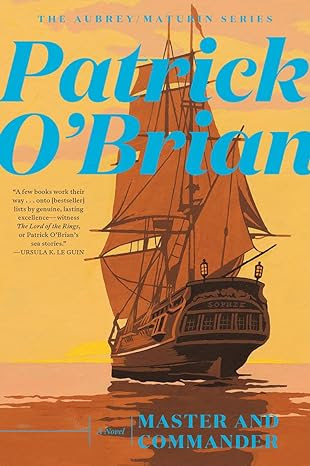
Beware all readers who are looking for the literary counterpart to the Russel Crowe movie Master and Commander: The Far Side of the World. While the books share the same title, the same premise (Napoleonic-era British ship HMS Surprise goes after an enemy that is attacking British whalers in the South Pacific) and many, but not all, of the same characters, they are in no way the same story.
Patrick O'Brian's attention to historical detail is almost unparalleled in historical fiction. He even extends this to his writing style. He writes in a style similar to the style that was used in the 1800s. To me, reading this book was akin to reading a Dickens novel or Stowe's Uncle Tom's Cabin. The words and phrases were often archaic and I found that I had to re-read passages from time to time. While some may appreciate this unique trait of the series, I found it distracting and, at times, discouraging.
So, in summary, great historical detail but the writing style gets in the way.
I rate this book 3 stars out of 5.
This book can be found on Amazon.com here: Far Side of the World by Patrick O'Brian.
Reviewed on March 16, 2006.
The Judge (audiobook) by Steve Martini
Strong plot + annoying writing habits = 4 stars
Published in 1996.
The Judge is my second Martini book (the first as an audiobook) and I am almost embarrassed to say that I really liked it. I didn't realize that I was such a literary elitist (especially if you looked at the stuff I've reviewed) but deep-down inside I guess that there are just some books that I want to hate simply because everyone else likes them.
Well, there's a reason why Martini's books have been perennial best-sellers - they're entertaining legal thrillers.
Plot synopsis:
Shenanigans in the police union have attracted the attention of an abrasive judge. He is leading a grand jury investigation into the union's finances when he is arrested for prostitution and later murder.
Paul Madriani is dragged into the case as the judge's defense attorney as a favor to a friend and soon everyone is stuck in a web of intrigue that involves the police, the prosecutor and Madriani's family.
The plot works well but Madriani overuses the 'simile' as a literary device. As I listened to this book on tape I started to become distracted by the sheer number of them. If I'd have had a notepad I would have started a tally sheet!
I rate this audiobook 4 stars out of 5.
This book can be found on Amazon.com here: The Judge by Steve Martini.
Reviewed on March 6, 2006.
Published in 1996.
The Judge is my second Martini book (the first as an audiobook) and I am almost embarrassed to say that I really liked it. I didn't realize that I was such a literary elitist (especially if you looked at the stuff I've reviewed) but deep-down inside I guess that there are just some books that I want to hate simply because everyone else likes them.
Well, there's a reason why Martini's books have been perennial best-sellers - they're entertaining legal thrillers.
Plot synopsis:
Shenanigans in the police union have attracted the attention of an abrasive judge. He is leading a grand jury investigation into the union's finances when he is arrested for prostitution and later murder.
![]() |
| Steve Martini |
Paul Madriani is dragged into the case as the judge's defense attorney as a favor to a friend and soon everyone is stuck in a web of intrigue that involves the police, the prosecutor and Madriani's family.
The plot works well but Madriani overuses the 'simile' as a literary device. As I listened to this book on tape I started to become distracted by the sheer number of them. If I'd have had a notepad I would have started a tally sheet!
I rate this audiobook 4 stars out of 5.
This book can be found on Amazon.com here: The Judge by Steve Martini.
Reviewed on March 6, 2006.
Brotherhood of the Rose by David Morrell
Like all Morrell books, it has a good bit of action
Synopsis:
Brotherhood of the Rose is set in the Cold War era in the world of big time spies. Two orphans living in an orphanage, Saul and Chris, were singled out for education and training that led to them being paired together as super spies working for the CIA. Now, the man who trained them - the man they consider to be their father - has betrayed them. Saul and Chris avoid all sorts of troubles as they unravel an international plot against them and combat the international forces arrayed against them.
My review:
Like in all of Morrell's books, there is plenty of well-written action and interesting characters. Plenty of thought went into this world of conspiracy. The action is detailed, but not overly so. It is not Morrell's best work, but it is certainly worth the read.
I give this one a solid 4 stars out of 5.
This book can be found on Amazon.com here: The Brotherhood of the Rose
Reviewed on March 4, 2006.
L.A. Requiem (Elvis Cole #8) by Robert Crais
Great Elvis Cole novel
Published in 2000 by Ballantine Books.
L.A. Requiem is a wonderful hard-boiled detective novel - a real pleasure, especially since I've run across a string of sub-par books lately.
No worries with that here.
The reader does not have to have read the previous Elvis Cole novels to read and enjoy this one - in fact, you will discover more about Cole's mysterious partner, Joe Pike, in this one book than you will have read about in all of the previous books combined.
L.A. Requiem is book #8 in the Elvis Cole series and well worth the read. Rather than ruin it with lots of spoilers, let me describe it like this: lots of action, good old-fashioned detective work, flashbacks, tragedy, revenge, honor, loss and re-dedication. Very well done.
Crais is definitely on my short list of authors to watch out for!
I rate this book 5 stars out of 5 and it can be found on Amazon.com here: L.A. Requiem (Elvis Cole #8) by Robert Crais.
Reviewed February 28, 2006
No worries with that here.
The reader does not have to have read the previous Elvis Cole novels to read and enjoy this one - in fact, you will discover more about Cole's mysterious partner, Joe Pike, in this one book than you will have read about in all of the previous books combined.
L.A. Requiem is book #8 in the Elvis Cole series and well worth the read. Rather than ruin it with lots of spoilers, let me describe it like this: lots of action, good old-fashioned detective work, flashbacks, tragedy, revenge, honor, loss and re-dedication. Very well done.
Crais is definitely on my short list of authors to watch out for!
I rate this book 5 stars out of 5 and it can be found on Amazon.com here: L.A. Requiem (Elvis Cole #8) by Robert Crais.
Reviewed February 28, 2006
The No. 1 Ladies' Detective Agency (audiobook) by Alexander McCall Smith
Thoroughly enjoyable
Originally published in 1998.
Read by Lisette Lecat.
Duration: 8 hours, 9 minutes.
Unabridged.
Duration: 8 hours, 9 minutes.
Unabridged.
The No. 1 Ladies' Detective Agency started out pretty slowly and I nearly stopped listening about 45 minutes into it. Suddenly, the story "clicked" for me and I gladly listened to the whole 8 hours and 9 minutes.
Narrated wonderfully by Lisette Lecat, a native South African who injects a touch of authenticity with her lovely accent and voice rhythms, this book is much more than a series of detective stories. It is also the story of Botswana and its culture and the complex interactions between traditional and modern, male and female, rich and poor, and white, black and Indian.
A lovely book and a real joy to listen to. Sometimes laugh out loud funny, sometimes deeply moving.
Well done.
I rate this book 5 stars out of 5. It can be found on Amazon.com here: The No. 1 Ladies' Detective Agency.
Reviewed on February 13, 2009.
Narrated wonderfully by Lisette Lecat, a native South African who injects a touch of authenticity with her lovely accent and voice rhythms, this book is much more than a series of detective stories. It is also the story of Botswana and its culture and the complex interactions between traditional and modern, male and female, rich and poor, and white, black and Indian.
A lovely book and a real joy to listen to. Sometimes laugh out loud funny, sometimes deeply moving.
Well done.
I rate this book 5 stars out of 5. It can be found on Amazon.com here: The No. 1 Ladies' Detective Agency.
Reviewed on February 13, 2009.
This Hallowed Ground: The Story of the Union Side of the Civil War by Bruce Catton
![]() |
An Amazing One Volume History of the Civil War
Originally published in 1956.
When I was a freshman in college, way back in 1986, I happened upon a Bruce Catton (1899-1978) book in the bookstore while buying all of my textbooks for my first semester. I picked it up just because I was in a mood to be educated with something that looked more interesting and less daunting than my economics and math textbooks. My fascination with all things Civil War began with that book. I traded it in a fit of stupidity a couple of years later at a used book store near campus. I read his trilogy, re-printed articles in American Heritage and then I moved on to other talented authors, such as James McPherson.
I had forgotten how truly gifted Catton was as a writer and I just assumed that because Catton was the historian of my childhood, he was an inferior writer. Why? I don't know.
I picked up this older copy (see picture above) of This Hallowed Ground: The Story of the Union Side of the Civil War to read on a family vacation. I was reminded, once again, that this man could truly write and he belongs right there in the pantheon of truly gifted storytellers who can tell the story of America in an entertaining, factual and compelling way. For those that scoff at narrative history in favor of "serious history" I say that the purpose of a historian is to tell his society their own story and make it seem that it matters. Bruce Catton did just that.
Catton begins with a single week in May of 1856. We have the beating of abolitionist Senator Charles Sumner by a pro-slavery Congressman in the Senate Chamber, the sacking of Lawrence, Kansas by pro-slavery forces and John Brown's brutal attack at Pottawatomie Creek. All within a few days of each other - all portents of things to come. One thing seemed to unhinge everyone in America - slavery and the disagreement over a state's right to declare a man to be another man's property.
Catton does tell the story almost completely from the Union perspective and it is clear that he is sympathetic to the Union cause in this book. He is not the only author of Civil War histories to have favorites, but he is clearly not disrespectful of the Confederate soldiers or of their efforts. He is also leery of some of the liberties Lincoln took in his effort to maintain the Union, as is clear in the section on Clement Vallandigham.
Mostly, though, Catton's strength is just his storytelling. It moves along crisply with a penchant for telling the odd, humorous and tragic little stories that make up the overall big story. Along the way, Catton produces some profound little gems, like this paragraph about 1864 the slow, bloody demise of slavery and what that meant for the country that concluded a chapter:
"It would be that sort of year: year of Jubilo, year of overturn and disaster and ruin, year infinite bloodshed and suffering, with the foundations of the great deep broken up; hard tramp of marching military feet, endless shuffle of splay-footed refugees running from something they understood little better than they could understand what they were running toward; the significance of their march being that it led toward the unknown and that all America, like it or not, was going to follow."
To sum up, this is a lovely little history - beautifully written, skillfully told by a master storyteller. It is not the only history that someone should read of the Civil War, but it is a great place to start. Also, I am thrilled that I went back and re-discovered Bruce Catton and found that he is not only as good as I remembered - he is better.
I rate this book 5 stars out of 5. Highly recommended.
This book can be found on Amazon.com here: This Hallowed Ground: The Story of the Union Side of the Civil War by Bruce Catton.
Reviewed on June 3, 2011.
Originally published in 1956.
When I was a freshman in college, way back in 1986, I happened upon a Bruce Catton (1899-1978) book in the bookstore while buying all of my textbooks for my first semester. I picked it up just because I was in a mood to be educated with something that looked more interesting and less daunting than my economics and math textbooks. My fascination with all things Civil War began with that book. I traded it in a fit of stupidity a couple of years later at a used book store near campus. I read his trilogy, re-printed articles in American Heritage and then I moved on to other talented authors, such as James McPherson.
![]() |
| Bruce Catton (1899-1978) |
I picked up this older copy (see picture above) of This Hallowed Ground: The Story of the Union Side of the Civil War to read on a family vacation. I was reminded, once again, that this man could truly write and he belongs right there in the pantheon of truly gifted storytellers who can tell the story of America in an entertaining, factual and compelling way. For those that scoff at narrative history in favor of "serious history" I say that the purpose of a historian is to tell his society their own story and make it seem that it matters. Bruce Catton did just that.
![]() |
| John Brown (1800-1859) |
Catton does tell the story almost completely from the Union perspective and it is clear that he is sympathetic to the Union cause in this book. He is not the only author of Civil War histories to have favorites, but he is clearly not disrespectful of the Confederate soldiers or of their efforts. He is also leery of some of the liberties Lincoln took in his effort to maintain the Union, as is clear in the section on Clement Vallandigham.
Mostly, though, Catton's strength is just his storytelling. It moves along crisply with a penchant for telling the odd, humorous and tragic little stories that make up the overall big story. Along the way, Catton produces some profound little gems, like this paragraph about 1864 the slow, bloody demise of slavery and what that meant for the country that concluded a chapter:
"It would be that sort of year: year of Jubilo, year of overturn and disaster and ruin, year infinite bloodshed and suffering, with the foundations of the great deep broken up; hard tramp of marching military feet, endless shuffle of splay-footed refugees running from something they understood little better than they could understand what they were running toward; the significance of their march being that it led toward the unknown and that all America, like it or not, was going to follow."
To sum up, this is a lovely little history - beautifully written, skillfully told by a master storyteller. It is not the only history that someone should read of the Civil War, but it is a great place to start. Also, I am thrilled that I went back and re-discovered Bruce Catton and found that he is not only as good as I remembered - he is better.
I rate this book 5 stars out of 5. Highly recommended.
This book can be found on Amazon.com here: This Hallowed Ground: The Story of the Union Side of the Civil War by Bruce Catton.
Reviewed on June 3, 2011.
Black Alley: A Mike Hammer Novel (audiobook) by Mickey Spillane
Mike Hammer almost kicks the bucket
Published in 1996 by Penguin Audio.
...and he drives around a lot with a seeping gut wound, visits old friends, gets put in a coma, gets a marriage license and looks for $89 billion. Sounds like a lot of action, doesn't it? In reality, there's not too much going on here.
The series is not aging well. I find myself running the math figures on this 1997 book and most of Hammer's friends and contacts are in their 70s, 80s and 90s. One former Prohibition cop that he uses as an informant would be at least 93 years old - that is if he served as a division chief in the fight against booze brought in to get around the Prohibition laws at the tender age of 18! I conservatively estimated his age to be at least 103 - how many 103-year-olds are sources of current mafia information?
Also, has Spillane ever actually seen a backhoe? It is a heavy duty piece of construction equipment. Even the small ones are extremely heavy and must be towed with special trailers. He has Hammer towing one behind his car on a mountain on a regular trailer with no brakes - that must be a heckuva car!
Anyway, problems like this drug the book down for me.
I listened to Black Alley as an abridged audiobook read by, of course, Stacy Keach (who else?!), who played Mike Hammer on the TV series. Keach did a decent job despite being hampered by a poor story.
I rate this abridged audiobook 2 stars out of 5. It can be found on Amazon.com here: Black Alley: A Mike Hammer Novel by Mickey Spillane.
Reviewed on February 27, 2006.
The series is not aging well. I find myself running the math figures on this 1997 book and most of Hammer's friends and contacts are in their 70s, 80s and 90s. One former Prohibition cop that he uses as an informant would be at least 93 years old - that is if he served as a division chief in the fight against booze brought in to get around the Prohibition laws at the tender age of 18! I conservatively estimated his age to be at least 103 - how many 103-year-olds are sources of current mafia information?
Also, has Spillane ever actually seen a backhoe? It is a heavy duty piece of construction equipment. Even the small ones are extremely heavy and must be towed with special trailers. He has Hammer towing one behind his car on a mountain on a regular trailer with no brakes - that must be a heckuva car!
Anyway, problems like this drug the book down for me.
I listened to Black Alley as an abridged audiobook read by, of course, Stacy Keach (who else?!), who played Mike Hammer on the TV series. Keach did a decent job despite being hampered by a poor story.
I rate this abridged audiobook 2 stars out of 5. It can be found on Amazon.com here: Black Alley: A Mike Hammer Novel by Mickey Spillane.
Reviewed on February 27, 2006.
The Hornet's Nest: A Novel of the Revolutionary War by Jimmy Carter
Published in 2003 by Simon and Schuster
Regardless of your views on Jimmy Carter the politician, he is also Jimmy Carter the author. A good reviewer should separate his opinions, be they pro or con, about the politician from a politician's works of fiction. I will endeavor to do so here.
Carter's interest in his native state of Georgia has led him to write, The Hornet's Nest: A Novel of the Revolutionary War, a historical novel about the Revolutionary War in Georgia, the Carolinas and Florida. Admittedly, this is an area that is often ignored in favor of Boston, Valley Forge and Philadelphia so there is room for quality fiction in this area.
The problem with Carter's work is not a lack of attention to historical detail - it is too much attention to historical detail to the detriment of an actual story about fictional characters. Carter's storyline shifts from being a piece of historical fiction to being a rather dry local history throughout the work.
Carter's passion for historical detail often drowns out the narrative. The reader is treated to dry facts about the intricacies of the British command in Florida ad nauseum. We are repeatedly told some of the some details over and over again - sometimes multiple times on the same page!
What makes it worse is Carter's insistence on using the labels 'Tories' and 'Whigs', rather than the more common 'Patriots' and 'Loyalists'. True enough that most Loyalists were of one party and most Patriots were of the other, but it is often inaccurate as well. It would be akin to a Civil War writer labeling the Confederates 'Democrats' and the Northerners 'Republicans.'
At least once, Carter makes a major historical mistake. He states that Britain's African slave trade policy was very different than the America's policy during the Revolutionary War. Officially, Britain did not adopt a different stance until 1807, the year before America's Constitution outlawed the importation of new slaves.
Carter is an experienced author of non-fiction works, with at least a dozen works to his credit. He can be an interesting public speaker, especially when discussing history. If I had been his publisher, I would have recommended to Carter that he team up with a veteran fiction writer (like fellow Georgia politician Newt Gingrich has done with his Civil War books). Carter could have directed the story while the other author could have smoothed out the rough spots and made it flow. As it is, however, I can only recommend this book to the most hardcore enthusiasts of the Revolutionary War and/or the history of Georgia.
To be honest, I would not have finished it if it were not for the fact that I borrowed it from a relative who spoke highly of it. Read the Revolutionary War novels by Shaara instead.
I rate this book 2 stars out of 5.
This book can be found on Amazon.com here: The Hornet's Nest: A Novel of the Revolutionary War
Reviewed on February 23, 2006.
Regardless of your views on Jimmy Carter the politician, he is also Jimmy Carter the author. A good reviewer should separate his opinions, be they pro or con, about the politician from a politician's works of fiction. I will endeavor to do so here.
Carter's interest in his native state of Georgia has led him to write, The Hornet's Nest: A Novel of the Revolutionary War, a historical novel about the Revolutionary War in Georgia, the Carolinas and Florida. Admittedly, this is an area that is often ignored in favor of Boston, Valley Forge and Philadelphia so there is room for quality fiction in this area.
The problem with Carter's work is not a lack of attention to historical detail - it is too much attention to historical detail to the detriment of an actual story about fictional characters. Carter's storyline shifts from being a piece of historical fiction to being a rather dry local history throughout the work.
Carter's passion for historical detail often drowns out the narrative. The reader is treated to dry facts about the intricacies of the British command in Florida ad nauseum. We are repeatedly told some of the some details over and over again - sometimes multiple times on the same page!
![]() |
| Jimmy Carter |
At least once, Carter makes a major historical mistake. He states that Britain's African slave trade policy was very different than the America's policy during the Revolutionary War. Officially, Britain did not adopt a different stance until 1807, the year before America's Constitution outlawed the importation of new slaves.
Carter is an experienced author of non-fiction works, with at least a dozen works to his credit. He can be an interesting public speaker, especially when discussing history. If I had been his publisher, I would have recommended to Carter that he team up with a veteran fiction writer (like fellow Georgia politician Newt Gingrich has done with his Civil War books). Carter could have directed the story while the other author could have smoothed out the rough spots and made it flow. As it is, however, I can only recommend this book to the most hardcore enthusiasts of the Revolutionary War and/or the history of Georgia.
To be honest, I would not have finished it if it were not for the fact that I borrowed it from a relative who spoke highly of it. Read the Revolutionary War novels by Shaara instead.
I rate this book 2 stars out of 5.
This book can be found on Amazon.com here: The Hornet's Nest: A Novel of the Revolutionary War
Reviewed on February 23, 2006.
Subscribe to:
Posts (Atom)
Featured Post
<b><i>BAN THIS BOOK (audiobook)</i></b> by Alan Gratz
Published in 2017 by Blackstone Audio, Inc. Read by Bahni Turpin. Duration: 5 hours, 17 minutes. Unabridged. My Synopsis Ban This Book is t...
Popular posts over the last 7 days
-
Published in 2020 by Scholastic Audio. Read by Alaska Jackson. Duration: 7 hours, 18 minutes. Unabridged. Synopsis: High School senior Liz L...
-
Published in 1998 by Sergeant Kirkland's Museum and Historical Society, Inc. Bonekemper lived the dream of most students of the Civil ...
-
Published in 2018 by Licensed Publishing. Written by Charles Soule. Art by Guiseppe Camuncoli, Daniele Orlandini, and David Curiel. Synopsis...
-
Winner of the Anthony Award for Best Paperback Original. Winner of the McAvity Award for Best First Novel. Originally published in 1987. Pub...
-
Published in April of 2022 by Macmillan Audio. Read by Christina Delaine. Duration: 7 hours, 1 minute. Unabridged. As the title says, TH...
-
Originally published in 2001 by NBM Books. Ted Rall's graphic novel 2024 is a loose re-telling of George Orwell's classic novel 1...
-
A bit of nostalgia Published 1959 by Random House 180 pages Many, many years ago Random House published a series of more than 100 books...
-
Originally published in book form in 1990. Published in 2017 by Blackstone Audio. Read by Paul Heitsch. Duration: 12 hours, 33 minutes. ...
-
Published in 2024 by Grand Central Publishing Read by Charles Halford and Christine Lakin. Duration: 10 hours, 44 minutes. Unabridged. Synop...
-
Published in 2019 by Simon and Schuster Audio. Read by Robon Miles. Duration: 5 hours, 53 minutes. Unabridged. Erica Armstrong Dunbar brin...