Small Vices (Spenser #24) by Robert B. Parker


One of the best books in the Spenser series.


Originally published in 1997.

This is my second reading of Small Vices. I'd read it before, years ago, and all I remembered was that this is the one in which Spenser gets himself shot and very nearly killed. (The beauty, I guess, of having so many Spenser novels is that it is hard to keep them all straight so I can go back and re-read them like they're like new every few years).

If you are familiar with Spenser, most of your favorite characters see some action in this outing. If you are not familiar with Spenser, this may be a good one to start with, although I would recommend some of the older ones to begin.

The never-aging Spenser lives through an entire year of his life in this one, but don't worry, he still doesn't age. Neither do Hawk or Susan. They're like James Bond in that respect. It used to bug me but I know that I don't want to read about Hawk and Spenser's adventures in a nursing home.

I rate this book 5 stars out of 5.

This book can be found on Amazon.com here: Small Vices.

Reviewed on December 8, 2005.

The Adjustment Bureau (audiobook) by Philip K. Dick


The original short story that the movie is based on.

Published by Brilliance Audio in 2011.
Read by Phil Gigante.
Duration: 58 minutes.
Unabridged.

Originally written in 1954 and titled The Adjustment Team, this audiobook was  renamed so that it can be tied in with the movie that is very loosely based on this short story by famed science fiction writer Philip K. Dick.

The one hour length and subject matter put me in mind of an episode of the Twilight Zone - one of the really good ones where we find out the world does not work quite the way we thought it did.

Philip K. Dick (1928-1982)
The premise of the short story is that real estate agent Ed Fletcher is not where he is supposed to be when the adjustment team comes to adjust his office. Instead, due to a bureaucratic mix-up on the supernatural level, Ed comes in to work a few minutes late and finds an adjustment team at work. The team has frozen the regular world and drained it of all of its life while they make adjustments to all the things and inhabitants. This is just regular maintenance and no one notices it - except for Ed who walked right into the middle of it, much to everyone's surprise.

This is a great little science fiction story - fun, freaky and a little thought-provoking.

I rate this audiobook 5 stars out of 5.

This audiobook short story can be found on Amazon.com here: The Adjustment Bureau

Reviewed on May 11, 2011.

The Lion, the Witch and the Wardrobe by C.S. Lewis


C.S. Lewis' most famous work of fiction.

Originally published in 1950

If you are familiar with Lewis non-fiction writings (Mere Christianity, etc.) were all that Lewis had written he would have left a wonderful legacy. However, Lewis has a large library of fictional works as well.

The Lion, the Witch and the Wardrobe is my only my second piece of Lewis fiction (the other being The Screwtape Letters) and I found it to be a quick, enjoyable read. The characters are likeable but not particularly well-developed, but that is understandable considering that he intended it to be a fairy tale. How much character development is there in a fairy tale?

Christian themes are very strong throughout the book, but the story can be read without any previous study into Christianity. If you are unsure of the themes or want to make sure that you are not missing any, I would recommend that you pick up any of the half-dozen or more companion study guides that Amazon offers. There are undoubtedly free ones online as well.

I rate this book 4 stars out of 5

This book can be found on Amazon.com here: The Lion, the Witch and the Wardrobe.

Rise to Rebellion and The Glorious Cause by Jeff Shaara


The Glorious Cause
is the second in Shaara's two volume piece historical fiction concerning the Revolutionary War. Rise to Rebellion was the first, and I believe the superior of the two, but The Glorious Cause is an excellent novel as well.

Rise to Rebellion is the superior of the two novels due to the changes of heart that the readers sees in John Adams and Benjamin Franklin concerning the issue of independence from England. The Glorious Cause has little of that type deep soul-searching. However, it is a fantastic portrayal of the difficulties encountered by the Continental Army and George Washington, in particular.

If I were to have my druthers, I would have preferred that Shaara had broken the second 600+ page novel into two novels  to make it a trilogy and expanded them both by delving more into the politics of the day and the difficulties of fighting a war with the governmental structures and restrictions that the Continental Congress was hampered with.

In addition, more battles and fronts could have been explored, such as the ill-fated American invasion of Canada and Benedict Arnold's naval adventures on Lake Champlain.

That being said, these are still a highly recommended novels - either for the American Revolution novice or the enthusiast.

Well done, Mr. Shaara.

I rate these books 5 stars out of 5.

These two books can be found on Amazon here: Rise to Rebellion and The Glorious Cause.

Reviewed on December 23, 2005.

Long Kiss: An American Ritual by Charles West


As the month of May is coming close, this Indianapolis resident and attender of 25 straight Indy 500 races and all of the Brickyard 400s (17, I think) knows what it means to be in love with the Indianapolis Motor Speedway. So, I picked up this book in order to see what another gigantic fan had to say about this experience.

Charles West, unlike me, did not grow up visiting the Indianapolis Motor Speedway (my mother's parents lived just a few blocks from the main gate and I clearly remember attending several qualification days and hearing Tom Carnegie's sweet velvet baritone call out, "It's a neeeew traaaaack recoooord!")  Instead, West grew up in Texas and most of his memories were radio broadcasts and delayed TV broadcasts. He also clearly remembers seeing Johnny Rutherford's yellow Pennzoil Chaparral on display as a little boy - that hooked him. For me, it was hearing that distinctive whine of the engines in the 1980s as a lone car drove around the track - you could hear it echo over the stands as the car traveled around the 2.5 mile speedway. It gives me chills even now.

11 years ago, West decided to go to the race - to experience The Big Everything as he calls the 500. West was a long-time veteran attendee of big time auto racing, having been to several NASCAR races, IRL races and CART races. But, this was different and he knew it. West describes every race he attends for 10 years - his drive there, where he stayed, where he sat, the souvenirs and his pre- and post-race rituals. I loved those parts of the book - I knew every place he stayed, the routes he took, where he sat and the restaurants he ate (how can he hate Pizza King? Oh well, at least he loves the Noble Romans on West 10th Street). He even gives away my "secret" back entrance to the Town of Speedway that only us locals know about (How could you do that?!? If I have to sit in extra traffic this year...).

The rest of the book is more problematic. Charles West describes a difficult relationship with his family, his wife, his wife's family but does little to explain the difficulties with his wife and her family. He does do a lot of explaining and details his growth as a person during this difficult time in his life (and some problems are quite heart-breaking, especially where his father is concerned) but it was an odd combination of too much dirty laundry and not enough. He told too much personal information for a book that was primarily about a fan's love of a race, and not enough for a personal journal about his personal growth.

So, I buzzed through the personal stuff and read the racing parts. Despite the occasionally clunky turn of the phrase and the personal struggles story line, I very much enjoyed sharing this fellow fan's passion for the Indianapolis Motor Speedway and especially the Indy 500.

I rate this book 4 stars out of 5 with the caveat that no one but a hard core racing fan would have the remotest interest in this book.

This book can be found on Amazon.come here: Long Kiss

 Reviewed on May 9, 2011.

Spycatcher by Matthew Dunn


Ridiculous but entertaining.


Published in 2011 by William Morrow.

Usually I have a low tolerance for over the top nonsense in my thriller novels. I tend to not like the stories with the unstoppable good guy whose training takes over and causes him to wipe out legions of his opponents. But, this one hit the spot for some reason.

The premise of Spycatcher is really quite simple: Will Cochrane is a member of MI6 - the British version of the CIA. He is their super-spy, code-named Spartan. He is nearly unstoppable and pretty much has carte blanche to do whatever he wants to defend the UK.

A new intelligence leak from Iran has discovered the existence of a similar type of super spy in Iran and he is planning a very big hit against the West. Cochrane is dispatched to stop him.

The chase runs through Eastern Europe and America and of course ends in a dramatic, utterly unrealistic confrontation after sniper fights, special forces commando raids and lots of high level meetings in which Cochrane convinces everyone that he is doing the right thing despite the rising body count.

Is it silly?

Absolutely.

Does it smack of the realism the cover promises?

Nope. Not one bit.

Did I like it?

Surprisingly, I did.

I rate this book 4 stars out of 5. It can be found on Amazon.com here: Spycatcher by Matthew Dunn.

Reviewed on May 7, 2011.

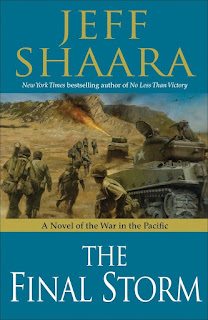
The Final Storm: A Novel of the War in the Pacific by Jeff Shaara


A bit disappointing.

Published in 2011 by Ballantine Books.


Jeff Shaara's European Theater World War II trilogy covered America's participation in that theater completely - from before the invasion of North Africa to the occupation of Germany. All of my reviews of those books can be seen by clicking here. He did a great job of discussing the grand strategies and showing the view from the trenches.

I really was hoping for the same treatment here. Shaara alludes to problems with his publisher in an introduction, but the reader is left with a truncated version of the war in the Pacific Theater. Shaara picks up this story with the dates he left off in his European Theater trilogy - Spring of 1945.So, no Pearl Harbor, Battle of Midway or threat of invasion of Australia. No occupation of the Aleutian Islands. No Bataan Death March.

The B-29 bomber Enola Gay
Instead, we are told the story of one major campaign (Okinawa) and the story of the Enola Gay and the bombing of Hiroshima. Those stories are told well. In fact, they are told brilliantly. The fighting in Okinawa was horrific and so different than the fighting in Europe that I was struck over and over again by how much the whole story needed to be told - not just the end of the story.

Reviewed May 7, 2011.

This book can be found on Amazon.com here: The Final Storm: A Novel of the War in the Pacific by Jeff Shaara.

I rate this book 3 stars out of 5 for failing to deliver the goods as they deserved to have been delivered.

Daddy Dates: Four Daughters, One Clueless Dad, and His Quest to Win Their Hearts by Greg Wright


What a great idea.

Published in 2011 by Thomas Nelson.

In a world where so many kids are disconnected from their families, Greg Wright is determined  to be a large part of his four daughters' lives. The only way to do this is to spend time with his girls - lots of time (I once had a principal tell me that kids spell love T-I-M-E and I have seen nothing in 21 years of teaching to contradict that thought).

The "daddy date" is devoted time just to them as a unique and special person. He achieves this by having "daddy dates" with them. On a daddy date he picks up the girl at home, takes her to a restaurant and/or an activity (not a movie, but an activity that promotes conversation) that she would like. Finally, starts a discussion with her and mostly listens. As a bonus, he is modeling the kind of behavior a special young man should show them when they go on dates (his daughters do not date in high school - they can go out in groups but not paired off dates).


Greg Wright is not a professional expert on children but he does have a firm grasp on the often-confusing interaction between men and women. He offers lots of practical advice on what makes a good "date" with a daughter, several sample date ideas, and even personality profiles to give us clueless dads a place to start with a good discussion on the first "date."

This is a very quick and easy read, but I think it is an important book.

I received a complimentary copy of this book as part of the Booksneeze program in exchange for an honest review.

I rate this book 5 stars out of 5. This book can be found on Amazon,com here: Daddy Dates Four Daughters, One Clueless Dad, and His Quest to Win Their Hearts by Greg Wright

Reviewed May 7, 2011.

Siddhartha by Herman Hesse


Oh! The dangers of reviewing a classic
.


Originally published in 1922.

Siddhartha
has been on my "should read" list for a long time, nearly 20 years.


With all of that build up and anticipation you'd think I'd have more thoughts about it than I do. My one word review of the book is 'lukewarm.'

It is neither a strong book nor a weak book. Siddhartha's spiritual quest is told in such a detached manner that, in the end, I feel detached from the whole exercise. I am uncommitted to the character and I really didn't particularly care where his quest ended up.

Perhaps that was the point of it all - it's his quest, you can do nothing but care about your own.
Hermann Hesse
(1877-1962)


I rate this book 3 stars out of 5.

This book can be found on Amazon here: Siddhartha

Reviewed  on December 6, 2005.

The Prefect (audiobook) by Alastair Reynolds


19 hours, 34 minutes
Read by John Lee
Published by Tantor Audio
Unabridged.

Alastair Reynolds’ The Prefect is a hard-boiled detective novel set in a future in which mankind has moved to new worlds far away from Earth and created any number of new technologies. But, people still find themselves confronted by age-old problems that come from within humanity itself. In the end, despite the all of the glitz of spaceships and high tech weaponry, this is really a book about freedom vs. tyranny, redemption, revenge, justice, revenge and honor.

Set in the year 2427, The Prefect is the fifth novel in the Revelation Space series. Chronologically, it is the first novel (there are short stories and novellas in the series as well) and it can be read as a stand-alone novel. The Prefect takes place in the Glitter Band, a group of 10,000 space stations (called habitats) with a total population of 100 million all in orbit around a planet called Yellowstone about 10 light years from Earth. The Glitter Band is ruled by a single government but internally each space station is independent from the other ones and offer many radically different lifestyles. The Glitter Band is highly democratic – every citizen gets to vote on numerous policy items every day using internal implants and an advanced form of the Internet called Abstraction.

Alastair Reynolds
Tom Dreyfus is a Prefect, an agent of Panoply, a group tasked with protecting the external security of the Glitter Band the voting rights of all of its citizens and protecting the right of every citizen to have access to Abstraction. Drefyus is like many officers in police procedurals – adhering to his own personal rigid code, scarred from a hidden past, leading a team of talented rejects. The other two members of his team are Sparver, a genetically modified pig (known as hyperpigs) who bears the brunt of racial taunts and assumptions with much dignity and Thalia NG, the daughter of a Panoply agent turned traitor who feels the need to redeem her family name.

Dreyfus and his team are sent to investigate the complete destruction of Ruskin-Sartorius, a relatively small habitat. 960 people are dead and all evidence points to an attack by the Ultras, a group of humans that live outside of the mainstream human society of the Glitter Band and specialize in modifying their bodies in a series of human/mechanical physical blends. The Glitter Band and the Ultras have an uneasy truce and clearly do not understand one another’s cultures or technology. Rising tension between the Ultras and the Glitter Band threatens to become open war.

Dreyfus suspects that the Ultras are not guilty but instead they were framed by a very clever entity that may be attempting to take advantage of the chaos and destruction of a war to seize control of the entire Glitter Band. Dreyfus bucks the system and follows his own hunch. Soon, he and his team find more trouble than they had bargained for.  For Dreyfus, this includes a frightening look into that hidden part of himself that makes him the tough detective that he is. 

At first, The Prefect is a difficult book. For the first two hours I found myself on a mental roller coaster, alternating between outright confusion and fascination with the vivid mental pictures Reynolds creates in his little universe of the Glitter Band. Reynolds does little to overtly explain the technology or the politics in this book. He assumes (correctly) that, eventually, the reader will catch on to what is going on in the story. Like I said, it took me about two hours to start catching on. By the end, I was well versed and navigating through Glitter Band technology and politics like an old pro.

John Lee, a winner of the AudioFile Golden Voice Award, does an expert job of not just reading a text with a staggering number of characters and accents but also delivering those voices with an overlay of emotion that does nothing but enhance the story. 

I rate this audiobook 5 stars out of 5

This audiobook can be found on Amazon.com here: The Prefect.


Reviewed on April 21, 2011.

The Civil War: Strange and Fascinating Facts by Burke Davis


Fun to read, but be warned...

Published in 1982.

...you had better be up on your Civil War basics before attempting to read this book. It assumes that the reader is well aware of the main battles, campaigns, personalities and relative strengths and weaknesses of both the North and the South.

Union General
William Tecumseh Sherman
(1820-1891)

As the title suggests, the book is primarily a collection of facts and oddball "did you know?" type of stories that are not really intended to re-tell the story of the Civil War but are mostly aimed at  people who know the story fairly well and are looking for some new stories (in my case, these are new stories I can use to bore my wife in new and different ways with the Civil War).

There's bound to be something new in here for everyone but the hardest of the hard core Civil War aficionados. Well-written, breezy, although oftentimes disjointed and random.

This book is also published under the titles Our Incredible Civil War and The Incredible Civil War by the same author.

I rate this book 4 stars out of 5.

This book can be found on Amazon.com here: The Civil War: Strange and Fascinating Facts by Burke Davis.

Reviewed December 2, 2005.

A Heartbeat Away (audiobook) by Michael Palmer


A political thriller for people that don't know much about politics

Read by Robert Petkoff
11 hours, 42 minutes.

The premise behind A Heartbeat Away is simple and brilliant:  What if terrorists released a biological weapon into the House chamber during the President's State of the Union Address - the one time when just about everybody who is anybody in the Federal government is all in one room together?

The follow through, however, is not so hot.

Palmer's characterization of how a President would deal with this sort of problem shows that Palmer does not understand the one thing that all presidents are - they are politicians. They know how to collaborate, get things done, work with people they cannot stand to get their programs enacted. Even the most difficult President can schmooze and get people to work with them. 

The president in A Heartbeat Away, James Allaire is the most politically tone deaf character I have ever seen. He manages to make the whole thing look like an attempted coup (although most of the Congressmen and women  are placid, like a herd of sheep - I had to wonder if Palmer had ever watched Meet the Press even one time. Those people live to argue. They all think they are the expert of almost everything and just about everything is some sort of scheme)

Anyway, the entire government of the United States is present except for the Designated Survivor - the cabinet member who stays away just in case there is a terrorist act and becomes president. You may remember the many references to Dick Cheney being in an "undisclosed location" during the Bush 43 administration and you then know that Cheney was the Designated Survivor.


A State of the Union address
They are all exposed to WRX3883, a bio-weapon created by the order of the president (who is a "man of the people" despite his dictatorial ways - we see no evidence of this in the book but the author tell us that he is so I guess he is. Oh, he is also a medical doctor - I guess he did not take that Hippocratic Oath thing too seriously, huh? Do no harm unless you're creating a bio-weapon...) and the President does not cede power to the Designated Survivor. Instead, because he is an expert on everything, he goes about working on a secret plan to try to get a cure made, while he lies to everyone and says it is just the flu and everyone is on lockdown on the penalty of death. And - they need to sit down in their assigned seats. Now! Then, a beat down by the Secret Service starts, including a pistol whipping of someone in the upstairs gallery.

The president brings an epidemiologist out of prison where he had been held without trial for 9 months to find the cure in exchange for a pardon. Throw in a number of simplistic characters including a crusading journalist, an evil priest, evil corporate bad guys, an overly-ambitious politician with religiously-tinged political views and a whole lot of talk about the evils of animal testing and you get the idea. This is politics if Michael Savage and Michael Moore ran the two parties.

As I was listening to the audiobook I was wondering where the first family was. They were exposed to the virus in the first pages of the book while sitting in the gallery. They must have taken the order to sit down in their assigned seats very seriously because they don't show up again until the end of the book. Where are they while the president is worrying if his exposure to the bio-weapon is affecting his judgment? Where are they when gunfire erupts, when people start to die of the disease? No where to be found.

This book had all the hallmarks of a contract-filler. There are parts that are actually quite entertaining, but the political story at the center of it all is clumsy, unrealistic and frustrating.

I rate this audiobook 1 star out of 5.

This audiobook can be found on Amazon.com here: A Heartbeat Away by Michael Palmer.

Reviewed on April 29, 2011.

Time for the Stars (audiobook) by Robert A. Heinlein


Originally published in 1956.
Published by Blackstone Audio in 2012.

Duration: 6 hours, 36 minutes
Narrated by Barrett Whitener
Unabridged

Robert A. Heinlein’s Time for the Stars is a true bit of science fiction history and, in a way, embodies all of the “cool” stuff that made me such a fan – a bit of physics, adventure, young people off to explore unseen worlds, and some newfangled technology.

Heinlein (1907-1988) first published Time for the Stars in 1956, during a time period when he had a contract with Scribner’s to produce books that were young people friendly. They were aimed at young adults, although I enjoyed it as well. It is the memoir of the space travels of Tom Bartlett, who is also one half of a very talented set of twins.

The premise of the book is simple enough. The Earth is too crowded and a research corporation called the Long Range Foundation has invested in several ships to seek out new planets that humans can inhabit. There are already colonies throughout the solar system but they are too expensive and can only hold a limited number of colonists. The Long Range Foundation’s specialty is making investments in things that no corporation or government will invest in because the pay-off will be too long in coming to justify the investment. In this case, these spaceships will explore for decades and may not find anything useful.

Robert A. Heinlein 
(1907-1988)
The trick with all of these ships will be communication. The ships and their radio waves will travel slower than the speed of light and the process of finding a new planet, describing its location and the requirements to colonize it will take entirely too long. Instead, the Long Range Foundation has found that some very few people, especially twins, are actually telepathic and can be trained to speak to one another with their minds. They have also discovered that this telepathy is instantaneous – it is faster than the speed of light and the communication problem has been solved.

Pat and Tom Bartlett have this telepathic ability and are chosen to participate. One twin gets to go and one has to stay behind to relay the messages to the Long Range Foundation here on Earth. Several ships, all named for famous explorers, are outfitted with crews of about 200, including several telepaths. Tom Bartlett’s ship is the Lewis and Clark.  What happens is the classic physics discussion question in which one twin travels at near light speed while the other remains on Earth. Time travels much for slowly for the twin in the spaceship (in this case, the ratio can get as extreme as 250 days on Earth is equal to one day on board the space ship).

Of course, as the twin on Earth ages technology and culture on earth keeps on changing. One of the best things about the book is Tom Bartlett’s growing frustration with the change of language on Earth, especially slang, as he travels. The book itself is 55 years old. The language and style of Heinlein was probably very current, but now it is, in and of itself, a bit of a time traveler. This actually helps the storyline because Tom sounds a bit anachronistic with his banter and his conversational style, his ideas about fashion and his attitudes towards the proper roles of women – it reinforces the fact that at the end of the story, Tom Bartlett has indeed become a man outside of his own time.

There is plenty of low complexity discussion of physics, adventure, the nature of duty, danger, an acknowledgement of the value of scientific research for the sake of research and a fact that no amount of research will replace the actual men and women who have and will continue to put themselves at risk for the sake of exploration.

Veteran narrator Barrett Whitener does a great job of creating a voice for Tom Bartlett – a young, naïve-sounding voice that captures Bartlett’s enthusiasm, lack of self-confidence and wonder. There are a variety of accents involved in the story and they are handled well. Most interestingly, Whitener is able to make the identical voices of the identical twins sound just a bit different by changing their attitudes and pacing.

I rate this book 5 stars out of 5.

This book can be found on Amazon.com here: Time for the Stars.

Reviewed on March 23, 2011.

Atlantis and Other Places: Stories of Alternate History (audiobook) by Harry Turtledove


Published in 2010 by Tantor audio

Read by Todd McLaren
Duration: 14 hours, 4 minutes.
Unabridged.

Called a “Master of Alternate History” by Publishers Weekly, Harry Turtledove continues on that track in Atlantis and Other Places with a set of 12 short stories. Topics and eras range from pre-history to the Peloponnesian War to the Byzantine Empire to World War II and two stories set in modern times. All of these stories have appeared in other publications.

This collection begins and ends with two stories about Atlantis, a topic he has explored more deeply in a trilogy. “Audubon in Atlantis” is the first story that Turtledove published about Atlantis. The famed 19th century naturalist John James Audubon has traveled to Atlantis to catalog some of its unique wildlife. Turtledove introduces his alternate world, including basics of the history of Atlantis and he introduces the House of Universal Devotion, a religion that is most analogous to the Mormon Church in regular history. Turtledove’s focus on laying down the ground rules for makes the first half of the story a bit tiresome. It does pick up once Audubon is in the field.

Harry Turtledove
The last story, “The Scarlet Band” is chronologically Turtledove’s last story about Atlantis. In the story, Athelstan Helms and Dr. James Walton, the world famous detective duo (modeled after Holmes and Watson), are summoned to Atlantis to investigate a series of murders of prominent citizens who have been openly critical of the House of Universal Devotion. It is a fine ending to the collection, even if the murder is a bit too easily solved.

As in any collection, the quality varies. “Bedfellows” is a tiresome story once the gimmick is understood in the first minute, but it goes on for another 10 minutes. “News From the Front” is an alternate history of World War II told through headlines and snippets of editorials.  Roosevelt is savaged in the press for failing to foresee the attack on Pearl Harbor and America’s will to fight sags so low that it ends up suing for peace, much like the Japanese Empire had hoped in their original plans for the war in our timeline. The premise is interesting, but the headline/editorial format loses its punch and it tends to drag.

On the other hand, “Catcher in the Rhine” and “Someone is Stealing the Great Throne Rooms of the Galaxy” are both quite fun. “Catcher” is a play on J.D. Salinger’s famed character Holden Caulfield. Caulfield is visiting Germany and he gets caught up in a bit of magical time travel. Turtledove captures Caulfield’s voice perfectly. “Throne Rooms” is a pure comic bit of science fiction (and the only story in the collection that is not alternate history – it is set in the future). A giant sentient hamster is sent by the Star Patrol to investigate a series of thefts of throne rooms (and their accompanying antechambers) providing plenty of laugh out loud moments.

“Farmers’ Law” and “The Genetics Lecture” are middle of the road stories. The former is a straightforward murder mystery set in a rural village in the Byzantine Empire and the latter is a Twilight Zone-esque very short story (about 6 minutes long) that, unfortunately, telegraphed its punch line.

“Uncle Alf” is set in France in 1929. But, in this world, the German Empire has won World War I and a 40-year-old Hitler is part of the German army occupying France. He is dedicated to rooting out socialism and in seducing his 21-year-old half-niece through a series of letters. The story is told through those letters. Although the incestual seduction aspect of the story is based on strong historical supposition, that fact does nothing to ease the creepy feeling that pervades the whole story.

Sokrates
The three strongest stories are all quite different from one another. “The Daimon” is set in the Peloponnesian War and the only difference is that Sokrates decides to participate in the invasion of Syracuse. In history, this campaign turned into a disaster, but Sokrates is able to offer advice to Alkibiades, the mercurial fair-haired young general who led the invasion. This advice causes Athens to win the entire war and, in the process lose their democracy to a tyrannical Alkibiades. Sokrates lives long enough to regret his advice as Alkibiades consolidates the Greek city states under his power in order to launch an invasion of Persia like Alexander the Great did nearly a century later. Those who are familiar with the Peloponnesian War will especially appreciate the ironic comments and situations that arise in this story.

“The Horse of Bronze” is a simple story of centaurs discovering men, but it is so much more. If you are a fan of Aristotle or enjoy thinking about the concepts behind his “Theory of Forms” (Turtledove introduces the theory in the earlier story “Daimon”) you will enjoy this story of the arrival of men in a world filled with Centaurs, Nuggies, Satyrs, Sirens and Sphinxes.

“Occupation Duty” is set in modern day Gaza. The story is about troops going on patrol in an armored personnel carrier in a hostile, conquered territory.  However, this is not about Israel and the Palestinians. Instead it is the “Philistinians” and the Moabites. In this history, Goliath beat David and Israel is nothing but a distant, ancient memory. The fight scenes are first rate and the irony of the same fighting going on in the same territory for the same reasons with different nations is quite good. Throw in a solid description of a world with no monotheistic religions and a tantalizing peek at this new world’s politics and I found myself wishing he had fleshed this story out into a novel.

Todd McLaren’s narration of these stories was exceptional. He delivers a variety of voices and tones – everything from American southern accents to a variety of British accents to Hitler’s German accent. He even catches Alkibiades’ famed lisp and you can hear the treachery in his voice as he crushes his opponents. Very impressive and enjoyable work throughout.

I rate this audiobook 4 stars out of 5.

This audiobook can be found on Amazon.com here: Atlantis and Other Places.

Reviewed March 21, 2011.


The Question of God: C.S. Lewis and Sigmund Freud Debate God, Love, Sex, and the Meaning of Life (audiobook) by Armand M. Nicholi


Fantastic. A most interesting book.

Published by Blackstone Publishing in 2002.
Read by Robert Whitfield.
Duration: 7 hours, 58 minutes.
Unabridged.

The Question of God is a fascinating book. I heard it is an audiobook. I listen to audiobooks as an interesting diversion during my commute to work and I found this book to fit the bill perfectly. It is narrated wonderfully by Robert Whitfield.

Fans of Freud have complained about the book because they think that Lewis comes out of these debates much stronger than Freud. I agree. But, I do not think Freud was disparaged or misrepresented in these "debates."

Large, generous quotes from both men are the main feature. Both men speak for themselves with Nicholi adding relevant supporting information with occasional discussion of his own research. The arguments flow naturally and I cannot recall a time when the discussion seemed forced.

Lots of biographical material is included as well. The reader (or, in my case, the listener) does not need to be an expert on either Lewis or Freud to enjoy the experience.

The audio version lasts about 7 hours, 58 minutes.

I rate this audiobook 5 stars out of 5.

This audiobook can be found on Amazon.com here: The Question of God.
 
Reviewed on March 14, 2009.

Dreams from the Monster Factory: A Tale of Prison, Redemption, and One Woman's Fight to Restore Justice to All by Sunny Schwartz with David Boodell


While not perfect, it is thought-provoking and a quick read


Published in 2009.

Sunny Schwartz is a Chicago-born lawyer who has worked in the San Francisco jail system for 30+ years. Dreams from the Monster Factory is a combination of a personal biography and professional recommendations for our nations overworked, overcrowded and floundering jail and prison systems.

Schwartz is not a hand-holding, excuse-making prisoner advocate. She notes several times that she wants criminals to be punished. She notes: "I completely understand the objections and utter impatience people have with criminals. They have hurt us, our pocketbooks, our souls." (p. 197)

However, practical experience does offer some hard-won wisdom and Schwartz does have some things to suggest that might very well improve the behavior of our prisoners (remember most will become ex-prisoners some day and it would be nice if they were more in step with the rest of us). She focuses on an anti-violence program that is based on Restorative Justice, a program that's been bandied about for more than a decade. However, the team in the San Francisco jail system seem to have found something that works for some of the men and makes them less likely to return to jail due to violent crime.


This book is a quick read because it does not go into any great detail. Rather it is a general introduction to their program and how they decided to go to it. It is interesting, informative and a great place to start any serious discussion of jail and prison reform.

I rate this book 4 stars out of 5.

This book can be found on Amazon.com here: Dreams from the Monster Factory.

Reviewed on March 17, 2009.

Fireproof by Eric Wilson


A great read 


Published in 2009.

No, I don't live in a cave, but I have not seen the movie, nor have I picked up any of the study materials. My wife read Fireproof and recommended it to me. I'm an avid reader but I was really not looking forward to it.

Why not?

Well, let's face it - there's some poorly made/written stuff out there that only sells because it's family friendly or because it is "Christian". So, I reluctantly picked this one up.

Boy, was I surprised. I was hooked from the first chapter and shot through this book in less than 48 hours. I've reviewed hundreds of books on Amazon.com but I am hardly a speed reader - more like a dogged one.

The relationship between the husband and wife characters, Caleb and Catherine, is on the rocks but seems realistic and is not really written in the style of a romance novel. The firefighting scenes are exciting and well-done. Sure, you can see the end coming from 100 miles away but it was still well done.

I did roll my eyes at the "prize" scene at the end of the book - it was too much for my taste, but still a good book nonetheless. Well worth my time.

****Addition - May 1, 2009*****
I have now seen the movie and can definitely say that the book is better. The movie is good, but the book is better.

I rate this book 4 stars out of 5. It can be found on Amazon.com here: Fireproof by Eric Wilson.

Reviewed March 20, 2009.

Character Connections by Robert A. Baggett, Ed.S.


School counseling based on character education with a Christian flavor


Published in 2008.

It has become the flavor of the month in many schools to teach character education. As a teacher in a school corporation that purports to teach character but does not go beyond banners and slogans in the official school letterhead in our effort I found this book to be enlightening.

Baggett is quite open with his religious beliefs throughout the book, which is appropriate - his character is greatly shaped by it. He stresses that it cannot be overtly expressed in his role as counselor at school, but it is present.

Baggett sells the concept of the role of character education in schools quite well. He demonstrates the lack of character in schools and the larger society, identifies several areas that need to be addressed and lays out some general ways to address them along with references to how to address more specific needs.

Throughout the book he includes literally hundreds of inspirational quotes that correspond with each chapter.

I rate this book 4 stars out of 5.

This book can be found on Amazon.com here: Character Connections.

Reviewed on April 10, 2011.

Featured Post

<b><i>BAN THIS BOOK (audiobook)</i></b> by Alan Gratz

Published in 2017 by Blackstone Audio, Inc. Read by Bahni Turpin. Duration: 5 hours, 17 minutes. Unabridged. My Synopsis Ban This Book is t...

Popular posts over the last 7 days