Justinian's Flea: Plague, Empire and the Birth of Europe by William Rosen


This Could Have Been So Much More.


The title of Justinian's Flea: Plague, Empire and the Birth of Europe promises so much - the last great Roman Emperor (or first Byzantine Emperor, if you prefer), the Bubonic Plague, how the plague helped create the series of nation-states that have made up Europe for centuries. Throw in the Silk Road and how Europe was able to get its own silk worms, Justinian's multi-faceted wife Theodora, Belisarius and a discussion of how the Bubonic plague may have paved the way for Islam by weakening a resurgent Roman Empire under Justinian and you should have an amazing book - one that fills a void in most history books - the void left where "ancient" history ends and medieval/Dark Ages history begins.

But, this book will not fill that void except for the most dauntless of readers. Justinian is not dealt with in any organized fashion after the first few chapters - he becomes an office rather than a person. Belisarius is described in one campaign after another but you never get a feel for him. The wordy writing style gets in the way of any chance to have the story told. All historians need to remember that they are telling a story - telling it in one's best dissertation-speak does not necessarily tell it well and certainly makes it less interesting for most readers.

Justinian (c. 482-565)
What Rosen does do well - too well - is tell the story of the Bubonic Plague. For page after page the reader is told about the animals that are the best hosts for the plague, how fleas spread it, what kind of fleas are best to spread it, how fleas bodies work and how they spread the plague when they bite, what kind of fleas like what kind of animals best, how far fleas can jump, how fleas carry the plague in their little flea bellies, and on and on about fleas. There is also an extensive description on the physiology of the plague "bug" itself, including its flagella that it uses to move around. I could tell more but I skimmed a lot of it out of frustration.

Ironically, when the discussion turns to the effects of the plague, such as how it affected the burgeoning Roman re-birth under Justinian and may have enabled Islam to get a secure foothold in Byzantine territory a few years later, Rosen verbose writing style dries up, as if there were a limit to the number of pages he could write.

So, like I said in the title, this could have really been so much more.

I rate this book 2 stars out of 5.

This book can be found on Amazon here: Justinian's Flea: Plague, Empire, and the Birth of Europe.

Reviewed on March 15, 2011.

Holes by Louis Sachar


A literary phenomenon

Published in 2006
Read by Kerry Beyer
Duration: 4.5 hours
Unabridged

I teach high school Spanish and history but even if you don't have much interaction with young people, you'd have to live in a cave not to have noted the literary phenomenon that is the novel Holes. Although my students don't read Holes in my class, they have mentioned it so I decided to listen to it as an audiobook during my drive to and from school.

The plot itself is fairly unique in that there are literally no loose ends. Nothing is introduced that does not have a consequence later on, be it the prison guard quitting smoking and chewing sunflower seeds instead or the references to peach preserves, it all ties together. All of that makes the story less believable, more like a dark fairy tale but all of the more enjoyable.
Louis Sachar


The story itself is pretty solid. There's a mystery, a sense of camaraderie and an awful tale of injustice in the flashbacks. It is dark, but not overwhelmingly so.

The audiobook lasts about 4.5 hours. It was read by Kerry Beyer. A little research shows that this may be Beyer's only foray into audiobook narration. That would be justified. It's not that he did a bad job (he was easily understood), it's just that, as a frequent listener of audiobooks, I know that there are much better readers out there. Beyer had a tendency to make every sentence sound as though he were exclaiming over the most marvelous of things. It was all supposed to sound very exciting but it grated after a while. I suppose it's not the fault of the reader but the fault of the producers who didn't re-direct his efforts.

I rate this audiobook 4 stars out of 5.

This audiobook can be found on Amazon.com here:
Holes by Louis Sachar.

Listening Woman (Joe Leaphorn) by Tony Hillerman


Third in the Leaphorn series and one of the best


Originally published in 1978.

Like most fans of Hillerman, I've read them all. I'm sporadically going back through them and re-reading ones that I read more than a decade ago.

I've grown used to the older Leaphorn, the one that uses his head and thinks through problems and mostly avoids the physical stuff. This one is a younger Leaphorn that uses his head but gets involved in a lot of physical action. This one would make a great movie, but since I've not been happy with the few adaptations that I have seen I guess that I would prefer that no one make the attempt.

Tony Hillerman
(1925-2008)
Lots of Navajo culture is introduced in Listening Woman. This one lays the groundwork for a lot of the future books, including introducing multiple characters and does a lot of exploration into Leaphorn's quirky sense of interested agnosticism in regards to Navajo religious beliefs. The plot centers around a couple of murders and lots of discussion of Navajo witches and a dark family secret.

This one would be a good one for a book discussion group.

I rate this book 5 stars out of 5. This book can be found on Amazon.com here: Listening Woman by Tony Hillerman.

Reviewed on May 2, 2009.

All Clear (audiobook) by Connie Willis


A sci-fi book for lovers of history


Published in 2010 by Audible Studios.
23 hours, 56 minutes.
Read by Katherine Kellgren.
Unabridged.


43 hours of audio listening later (read wonderfully by Katherine Kellgren who handled a wide variety of accents and aging characters with real skill), I am finally done with the Blackout/All Clear saga. These books are intended to be one giant book, not a series, although you would never. ever know that from the audiobook's cover. To her credit, the author, Hugo and Nebula Award winning author Connie Willis introduces the second half of this audiobook with a warning that you had better listen to the first half first. Indeed you should and you should listen to the second installment as soon as you can after hearing the first one because there is no review, no scenes where the characters re-hash everything for the benefit of the listener. This is literally the second half of a very large book and she starts out exactly where she left off.

See my review of Blackout here.

All Clear continues the premise of Blackout (of course) and follows the adventures of late 21st century historians who learn about the past by time travelling. They observe and learn by blending in and becoming part of the past. They operate under the belief that they are unable to actually alter history (and apparently they have never read Jack Finney's Time and Again!) but they should not really do anything to test that theory.

Blackout/All Clear is both science fiction and historical fiction. Its real strength lies in its historical research and the way that it makes the reader experience London during World War II. The bombings, the inconveniences, the rationing, the danger, the weariness, the randomness of death from a bomb dropped from the sky - those aspects of the war come through crystal clear. Some reviewers have complained about the length of the books (and they are a big chunk, believe me, I know).  Certainly, a Reader's Digest type of editing job could easily cut out hours and hours of listening time without much affecting the plot of the story. Scenes could be cut, conversations could be shortened. There are certainly aspects of mind-blowingly stupid behavior on the part of the characters that had me wondering of Willis had gone daft.

Connie Willis
But, Willis has created an experience here. This is not so much a story but an homage to the regular, everyday people that endured the cruel attacks of a dictator, the privations of war, made communities in subway tunnels, survived when they were literally alone in the world. It is a bit of their experience and as such it is priceless. I teach history so nothing about this book really surprised me. I knew the bare facts but Willis has created a chance for the listener to get a taste of what it was like to live the facts, not just know them. For that, I have to thank her.

Throw in a bit of drama, a touch of sci-fi, the lovable completely awful Hodbins and I have to recommend Blackout/All Clear to anyone interested in World War II. Sci-fi fans are bound to be disappointed but I like both and I certainly enjoyed this.

I rate this audiobook 5 stars out of 5.

This audiobook can be found here: All Clear.

Reviewed on March 12, 2011.

Curiosities of the Civil War: Strange Stories, Infamous Characters, and Bizarre Events by Webb Garrison


Too scattered for this student of the Civil War.


Published in 2011 by Thomas Nelson

Webb Garrison's Curiosities of the Civil War: Strange Stories, Infamous Characters, and Bizarre Events is a well-researched , hefty book that does deliver what it promises - a collection of odd things about the Civil War.

I read a lot of history and it seems to me that there are two main ways to organize a book about history. You can go with the more traditional timeline approach - tell the story in the order that it happened (narrative history). Or, you can go with themes - study the themes of the history as the writer sees them. For example, a Civil War historian can look into the evolution of military technology and techniques or focus on civil rights in the North and the South. Most historians try for a combination of the two and pick several themes and follow them as they tell a narrative history.

Curiosities of the Civil War goes with the less popular "bathroom reader" style. It is literally a collection of facts, interesting as most of them are, with only the barest of themes to hold them all together (for example, the theme "Supporting Members of the Cast" consists of several chapters about non-famous Civil War personalities such as John Wilkes Booth's one-eyed horse (and nearly everyone else's horse), soldiers, wives and various weird animals that became regimental pets.

For me, the randomness was too much. I like a story to be told as I am learning my odd and interesting facts. This style just could not hold my interest for more than two or three pages at a time.

This is not a book for the Civil War novice - this book will teach you nothing but a series of facts with no analysis, no interconnecting themes, no narrative (It does, however, have a very nice index). If you are looking for a book to pick up, read a couple of pages and then put back down, this is it. Otherwise, well, find something else.

I reviewed this book in conjunction with Thomas Nelson's BookSneeze program. I was not compensated for this review. The opinions expressed are mine.

I rate this book 3 stars out of 5.

This book can be found on Amazon.com here: Curiosities of the Civil War

This book was reviewed on March 9, 2011.

The Corruptible: A Ray Quinn Mystery by Mark Mynheir


Interesting Characters. So-so mystery.


Published in 2011 by Multnomah.

The Corruptible is the second in the Ray Quinn mystery series. It is written by now-retired police officer Mark Mynheir who adds a touch of authenticity to his work (although he misses the most obvious clue at the beginning of this mystery).

Ray Quinn is a former Orlando police officer turned Private Investigator who was forced to retire due to disability as a result of being shot through the hip. His replacement hip is painful and he needs to walk with a cane and he often deals with the pain (physical and emotional) with a few stout shots of Jim Beam. He has a support team of sorts: a partner named Crevis who is trying to pass the entrance exam to be a police officer and a business manager who works during the daytime hours as a parochial school teacher.

In this story, Quinn is hired by an investment company to recover stolen client information by downloading it onto a portable hard drive. The number one suspect is a an acquaintance of Quinn, an employee of the company who was former Orlando narcotics undercover officer who had been forced off the police force.

Quinn delves into some of his own difficulties with alcohol and unresolved issues of his own forced retirement and his new physical limitations as he follows the trail to the missing data.

Mark Mynheir
As I noted in the title of this review, the strength of this book, and of the series so far, is the characters. The mysteries are so-so, but the real-life struggles of the three principal characters and the fact that Ray Quinn is not a superman that can punch out all of the bad guys makes the story more interesting.

There is a second story involving those annoying e-mail scammers who claim they are trying to "smuggle" money out of Africa into America while in reality they are trying to scam the elderly out of their hard-earned cash. Also, there is an undercurrent of Christian themes written into the story.

Follow this link for my review of the first book in the Ray Quinn series.

I rate this book 4 stars out of 5 and it can be found on Amazon.com here: The Corruptible: A Ray Quinn Mystery.

Reviewed on March 7, 2011.

The Confessions of Nat Turner by William Styron


The controversial winner of the 1968 Pulitzer Prize for fiction


Here we are, decades years later and The Confessions of Nat Turner is still in the news. Recently, Henry Louis Gates, Jr made comments (positive ones, now. Originally negative impressions, years ago) about the book. The primary controversy is quite simple - how can a white man, a southerner, and the descendant of slave owners write a novel about one of the few slaves who actually stood up and demanded his freedom by leading a rebellion? Some have even asserted that he did not even have the right to write the book in the first place - after all, it is not HIS history.

But, is Nat Turner to be forever held apart? Is African-American history to be held apart? Can an African-American write about the Japanese Shogunate? Can an Asian-American write about the Alamo? Of course and of course. Gates makes this point in his comments (correctly). History is human history.


Nat Turner (1800-1831)
Styron's fictionalized Turner is based on research and a book written by Nat Turner's defense attorney, Thomas Ruffin Gray entitled The Confessions of Nat Turner: The Leader of the Late Insurrection in Southampton, Virginia.

The controversy over Styron's portrayal of Nat Turner and his failed slave rebellion in 1831 Virginia would not be nearly as furious if not for the sheer power of Styron's writing. He drags you into Turner's tortured mind and you can feel Turner's rage, religious fervor and lust. In my case, it pulled me in so tightly during some scenes that the rest of the world was lost to me. All was a breathless rush until that little piece of this tragedy was over and I was able to breathe again.

William Styron (1925-2006)
 I am not entirely pleased with some of the liberties that were taken with Nat Turner. As a general rule, I am more a fan of historical fiction that makes characters out of people who are witnessing the history rather than making it. I am especially doubtful about books that take known historical figures and purport to get into their minds and figure out what drove them.

However, the writing displayed in this book is really quite exceptional and it merits 5 stars. It takes the information we have about Turner, throws in a healthy bit of supposition and mixes in a plausible way to come up with one of the more profound books about American history, religion and race to have been written in the last 50 years.

This book can be found on Amazon.com here: The Confessions of Nat Turner.

Originally reviewed on October 27, 2005. Updated on March 6, 2011.

Update February of 2022: The Confessions of Nat Turner was listed on a 2021 list of 850 books that a MAGA Texas state legislator wants to ban from schools in Texas: see article here. It is now included in my tagged list of books that MAGA members of the GOP want to ban from schools.

School Days by Robert B. Parker


A throwback to the early days of 'Spenser'

Published by Putnam Adult in 2005

This edition of Spenser reminded me of the early days of the series - the days before Spenser would assemble a gigantic posse of bad guys and policemen (ie, Potshot) in order to get the job done. Thankfully, this one is also basically Susan Silverman-free (not that I mind Susan, it's all of the repeated conversations about their relationship - it just gets old!)

Unfortunately, School Days is also Hawk-free, so the experienced reader of Spenser books will definitely miss the witty banter the two often share. However, Spenser manages to get in a few good lines without the extra help and he does get a bit of outside help from some unusual sources from the past.

I rate this book 4 stars out of 5.

This book can be found on Amazon here: School Days (Spenser)

Reviewed October 9, 2005.

Icon by Frederick Forsyth


This is my first Forsyth novel and for the first 250 pages...


Originally published in 1996.

...I had determined that it would be my last.

Forsyth spends the first half of of the 500+ page Icon just setting the reader up for the real plot of the novel. Unfortunately, the setup consists of a series of disjointed flashbacks interspersed with seemingly unrelated tales of what is going on in the present of the novel (1999-2000 in the old USSR, now Russia).

Suddenly, once the flashbacks work their way up to the present time the real story starts and it is a great adventure story! The meandering story redeems itself. There is a lot of action, intrigue and a bunch of frustrated Nazis. Unfortunately, the ending is just too neat - it ends the book with everything too well resolved.

I rate this book 4 stars out of 5.

This book can be found on Amazon.com here: Icon by Frederick Forsyth.

Reviewed on October 9, 2005.

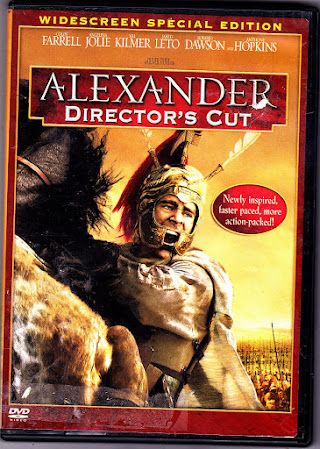
Alexander - Director's Cut DVD


YIKES!


Released in 2005.

NOTE: this is a review of the 1st re-cutting of this movie - the "director's cut." Stone has since re-cut it into a "final cut" and an "ultimate cut"

20 minutes into this movie I was thinking that it had real potential. We get to see the ugly details of Alexander's childhood. We get an understanding of his need to conquer, the need to achieve more than his father and his fascination for the non-Greek world (thanks to his mother).

An hour into the movie I was confused and disappointed. Confused because of the incessant flashbacks. I knew what was going only because I teach this stuff for a living.

How could the average movie-goer possibly understand why Alexander invaded the Persian Empire based on the feeble information supplied by Stone? Stone has an oblique reference to Phillip's murder, but the average movie-viewer does not know even know who Alexander the Great is, let alone that his father was murdered(he shows it in detail in a flashback - at the end of the movie - so the uninformed viewer will stay confused for nearly 2 more hours). A casual viewer might think that Alexander invaded Persia because he was following an eagle, since it was used so much in this battle scene (and mostly dropped for the rest of the movie).

On an historical note, I think it is disingenuous to blame the entire invasion on Alexander's need for revenge when the Greeks and the Persians had been fighting off and on again for nearly 2 centuries before Alexander's invasion finally put an end to it. Stone ignores all of that history and puts it all on Alexander (In my opinion, Stone is looking for conspiracies again -shades of 'JFK')

My disappointment stemmed from the casual skipping of most of Alexander's campaigns - from the destruction of the Persian navy to the conquering of the unconquerable Tyre to the Egyptians and their declaring him a god - all was covered in one paragraph from Ptolemy. One of the greatest military campaigns in all of history - possibly the greatest of all - dismissed like it was just so much garbage in the way of the true story.

***Note to Oliver Stone - the difference between Alexander the Great and every other mentally disturbed egomaniac with a Messiah complex, an abusive father and an over-protective mother with a snake fetish is those battles. They made him 'The Great!' Dismissing them with a wave of Ptolemy's hand over an ancient map is disrespectful to the story and to the viewer!

Stone's battle sequences are busy, noisy and confusing. Those are appropriate adjectives for any movie's battle scenes. However, they are also cold, distant and fail to convey the true genius that Alexander had as a battlefield commander. This is where it would have been useful to include those early campaigns - to show the viewer that Alexander was flexible, ruthless, personally brave and in many ways the ideal of a soldier and a general. He comes close when he shows Alexander speaking to the men before the Battle at Granicus. He alludes to a common history, but the viewer knows nothing of it and really cares very little for the people involved. Mostly, it's 10 minutes of Alexander riding his horse very fast.

Oliver Stone's re-creation of Babylon is very nice. He does a good job of showing Alexander's fascination with Asian culture and of demonstrating the tension between his desire for a united Greek-Asian empire and his men's desire to just take Asia's riches and return home to Macedon.

However, there's almost no development of the supporting cast of Macedonian characters. Alexander's male love interest has one main scene while they are in Asia and otherwise lurks in the shadows with sultry looks for Alexander. His men just become a part of the scenery so there is little emotional punch when Alexander starts to kill them off for mutiny.

The constant flashbacks were irritating. Some might think that they are sophisticated. I think they were insulting. Stone shows Phillip accusing his men of disloyalty in a flashback and then show Alexander doing the same. He shows Phillip bringing in a second wife in a flashback and then shows Alexander ignoring his wife in favor of his boyfriend. Phillip's second wife is dealt with as is the boyfriend. Phillip is assassinated as is Alexander (historically shaky...) Are we too stupid to make these connections without having them paired up for us in back-to-back scenes?!?

For those that blame the failure of this movie on Alexander's bisexuality and America's prudishness I would say that as a history teacher in America, not 1 American in 100 knows who Alexander the Great was, let alone knowing his sexual preferences. Rather, what everyone heard was that it was a long, bad movie.

Too bad that Oliver Stone took this topic that was so rich in potential for a great movie and ruined it for this generation of movie-goers. I suppose we'll have to wait for 20 more years before someone will be able to get the financing to try again and do it right.

I rate this DVD 1 star out of 5.

Reviewed on  October 8, 2005.

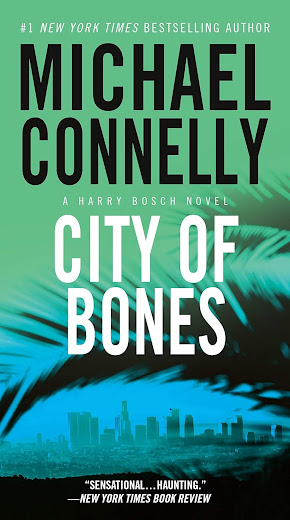
City of Bones (Harry Bosch #8) by Michael Connelly


Not the strongest of the series but very, very good


Winner of the 2003 Anthony Award.

Published in 2002 by Little, Brown. 

Michael Connelly is one of the two best living detective writers, in my opinion, the other being Robert Crais. Having noted in the title for this review that City of Bones is not the strongest in the series, I must also note that it makes this book receive a grade of merely an "A" rather than the normal "A+."

Michael Connelly
Bosch's books are gritty but not over the top. He is principled but not a boy scout. This particular Harry Bosch novel, City of Bones, deals with an old homicide uncovered in the hills surrounding Los Angeles. Bosch finds romance, has a major career shift and it has a surprise ending. No other plot details to avoid spoilers.

You can join the Bosch novels at any point but I'd recommend starting at the beginning.

I rate this book 5 stars out of 5.

This book can be found on Amazon.com here: City of Bones by Michael Connelly.


Reviewed on May 3, 2009.

The Dangerous Book of Heroes by Conn Iggulden and David Iggulden


Oh, how I wanted to be able to recommend this book!


Published in 2010 by William Morris

As a history teacher I often decry the politically and factually correct, but dreadfully dry and boring history textbooks. I was hoping that this book, The Dangerous Book of Heroes, could be a popular antidote and a return to the famous Landmark books series that I grew up reading. Mostly, The Dangerous Book of Heroes is just that - a collection of biographies - some just a few pages, some longer. They are illustrated with the same kind of line drawings that I remember from the Landmark books.

But, this book does have a danger to it, and not the tongue-in-cheek kind suggested by the title. The publisher markets this as a book for children with the phrase "here are amazing stories of heroism that parents can share with their children." 

Captain Sir Richard Francis Burton
(1821-1890)
One of the authors claims it is aimed at 14 year olds and above. That may be so, but the series is promoted for pre-teens and some of the topics discussed are just not appropriate for the great majority of elementary school students, especially in the story about "Captain Sir Richard Francis Burton."

Due to the Burton biography, I recommend the book for 14 years and older, like the author recommends. The Burton entry is full of references to drug experimentation, frequenting prostitutes, male and female brothels, spousal murder, the Kama Sutra - unnecessary references in a biography that was already so laden full of facts that it had bogged down and became an endless list, much like a bad PowerPoint presentation with an endless supply of bullet point entries.

Note, I am not squeamish when it comes to teaching kids history. When I teach world history, we discuss, among other things, facts like Alexander the Great's sexual orientation(s), how Nero kicked his wife to death, slave owners abusing their female slaves in America (and throughout time) and the slaughtering of thousands in the fall of Jerusalem and Constantinople. But, there is context in that presentation. In this book, it seems to glorify the negatives of Burton's personality - he's a hero so let's look at everything he did and celebrate all of it, the good and especially the bad.

Other issues that really are small compared to the issue of the Burton entry:

-These heroes are all part of Western Civilization, and heavily centered on Great Britain. Most of these choices are great choices, but it could use a bit of diversity.

-Multiple references to the "sneak attack" on the "small British garrisons at Lexington and Concord." The way it is worded seems to imply that the Colonial militia attacked 2 forts rather than noting that 700 British regulars secretly marched out of Boston to take the munitions depot of the Colonial militia in Concord and were turned back by militia who were informed by spies (like Paul Revere) that the British army was on the move.


-He incorrectly notes that the Indians remained Loyalist and neutral in the Revolutionary War. Loyalist is a questionable concept - they were not pro-British so much as they were in favor of the British policy of not developing the Ohio River valley. For the Igguldens to comment that Indians did not work in conjunction with the British in the George Washington entry is to disagree with their own article on Daniel Boone. For those that doubt that the British worked in concert with Indians in the Ohio River Valley, read about Henry Hamilton the "Hair Buyer" Lt. Governor of Detroit who was believed to have paid bounties for white scalps in an effort to destroy the settlements in Kentucky.

-The "Forks of the Ohio" near Louisville were actually the "Falls of the Ohio". They are no longer there due to flood control dams.

-The atomic bombing of Japan was actually done with atomic bombs, not hydrogen bombs. Hydrogen bombs are much bigger than the atomic bombs and, more importantly, hydrogen bombs were not even tested until 7 years after World War II ended.

I rate this book 2 stars out of 5 - too many factual errors, the entry about Francis Burton, and the decision to only include heroes from Western Civilization. 

Reviewed on February 26, 2011. Edited on January 25, 2025.

This book can be found on Amazon.com here: The Dangerous Book of Heroes by Conn Iggulden and David Iggulden.

Free To Choose: A Personal Statement (audiobook) by Milton and Rose Friedman


A prototype of the current crop of approachable books on economics


Originally published in 1980.
Duration:12 hours, 15 minutes

Read by James Adams
Unabridged.

Free To Choose: A Personal Statement is the manifesto on the power of capitalism and freedom (and how they go hand in hand) that was designed to be read, digested and discussed by the common man, not the economist. In fact, this is the book that was designed as a follow-up companion to a 10 part PBS mini-series that fleshed out the ideas in the series and addressed issues and further questions that came up in the making of the television program.

Milton Friedman won the Nobel Prize for economics in 1976 (he always credited his wife for helping develop his theories so I would imagine he considered it a shared prize).

The audiobook follows the lead of the mini-series and has 10 broad areas that it covers, including:

-The Power of the Market;
-The Anatomy of a Crisis (an in-depth study of the Great Depression);
-Created Equal;
-What's Wrong With Our Schools;
-Who Protects the Consumer;
-Who Protects the Worker;
-How to Stay Free

The Friedmans were very much an advocate of the free market. For example, in a topic not discussed in the book, Friedman is famous for advocating the all-volunteer army we have now. It uses incentives rather than the draft to get people to join and that seems to have worked out quite well.

Rose Friedman (1910/11-2009)
and
Milton Friedman (1912-2006)
I will comment in detail on the only topic that they discuss that I know intimately: Education. I have been a teacher for 21 years in tiny rural schools and large urban systems and now I am in a suburban system that is becoming more urban every day.

The Friedmans rightly decry the gigantic bureaucracy that sucks money right of the system, all of the way from the Secretary of Education to his 50 counterparts in the various states and all of their myriad ways of creating even more positions to look over the shoulder of school corporations, school boards, superintendents, assistant superintendents, principals, department heads and all of their office assistants. You would be amazed how many people it takes to make sure I have chalk and staples in my class. Actually, I have almost always had to buy them for myself.

So, just what do all of these non-teachers do anyway?

I take great issue with the Friedmans' assertion that bad schools create bad neighborhoods and crime rather than bad neighborhoods and crime creating bad schools.

The Friedmans also too quickly dismiss the costs of private schools and parochial schools. They claim that they are cheaper for any number of reasons than public schools. They blithely comment that they are cheaper because they have to compete and they move on.

But, are private and parochial schools really cheaper? My church has a new school. It was built at a cost of several million dollars, almost none of which is passed on to the consumer because this is looked upon as a mission for the church. We also provide absolutely no transportation in any way - not to and from school, not for field trips, not for sporting events. That is a cost borne by the parents and not typically figured into the bill (but public schools MUST provide transportation to and from school). My church's school has contracted with a caterer to provide meals, but the costs are not subsidized. Subsidized meals are part of the cost you always see when you hear how expensive public schools are. Private and parochial schools also rarely deal with severely mentally or physically handicapped students. That is an expensive part of any school and public schools are required to educate all students - even those who have little or no hope of ever learning how to write their names and require aides to help them do the simplest of tasks.


Anyway, I have done a lot of complaining about what was a pretty solid economics book. Some of it is dated, some is a little arcane and jargon-filled but most of it is presented in plain, easy to understand English. This is the grandfather of more recent and more accessible books like Naked Economics and Freakonomics, and for that it has to be respected.

I rate this audiobook 4 stars out of 5.

Reviewed on February 25, 2011.

This audiobook can be found on Amazon.com here: Free To Choose: A Personal Statement by Milton and Rose Friedman.

Aftermath (abridged audiobook) by LeVar Burton


Published in 1997
Read by LeVar Burton
Approximately 3 hours
Abridged.


Have you ever read a book in which the author takes a premise that would, at most, fill about 150 pages and yet he or she stretches it out to 400 pages? This is not one of those books.

Aftermath has the opposite problem - an awful future is described and peopled. The cure for cancer and brain disorders is discovered, stolen and recovered with lots of gunfights, chases, psionic warfare, attempted child rapes, attempted suicides, kidnappings galore, slavery and people being skinned alive. However, none of it is fleshed out - we are left with the skeleton of an epic story - a framework of what could have been. Think Stephen King's The Stand told in less than 300 pages. I just wish he'd added more.

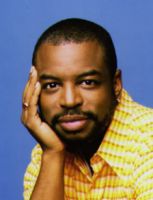
LeVar Burton
I am reviewing this as an abridged audiobook (no doubt the abridgment is part of the problem as well. Too often, too much is taken out). LeVar Burton, well-known television actor, read it, as would be expected - he has a fine voice and lots of experience due to his well known PBS show Reading Rainbow and, of course, Star Trek: The Next Generation

Sometimes, however, his tone of voice just isn't quite right. He uses the same tone and quality of voice that he uses when discussing a children's book of Reading Rainbow (earnest and happy) when reading about the plight of hundreds of African Americans who have been kidnapped, chained and drugged and are waiting to have their skins forcibly removed. It was more than a little too much dissonance.

So, in short, the relatively low score is a reflection of Burton's failure to follow through with the potential of the book.

I rate this audiobook 3 stars out of  5, mostly based on the strong premise rather than the anemic follow through. 

This audiobook can be found on Amazon.com here: Aftermath by LeVar Burton.

Reviewed September 30, 2005

Alternate Gettysburgs by various authors


Published in 2002 by Berkley

It's a collection, and like all collections Alternate Gettysburgs suffers from the fact that it was written by a dozen different authors. Some are very good, most are decent. Two are awful.

The gimmick in this alternative history is, of course, 'What if the Battle of Gettysburg had turned out differently?' It is inspired by this Faulkner quote:

Confederate Major General
George Pickett (1825-1875)
'For every Southern boy fourteen years old, not once but whenever he wants it, there is the instant when it's still not yet two o'clock on that July afternoon in 1863, the brigades are in position behind the rail fence, the guns are laid and ready in the woods and the furled flags are already loosened to break out and Pickett himself with his long oiled ringlets and his hat in one hand probably and his sword in the other looking up the hill waiting for Longstreet to give the word and it's all in the balance, it hasn't happened yet, it hasn't even begun yet, it not only hasn't begun yet but there is still time for it not to begin against that position and those circumstances which made more men than Garnett and Kemper and Armistead and Wilcox look grave yet it's going to begin, we all know that, we have come too far with too much at stake and that moment doesn't need even a fourteen-year-old boy to think This time. Maybe this time with all this much to lose and all this much to gain: Pennsylvania, Maryland, the world, the golden dome of Washington itself to crown with desperate and unbelievable victory the desperate gamble...'

Is it worth reading? If you're a Civil War buff and don't mind 'slumming' by reading an alternative history rather than a normal history book - yes it is worth your time. Personally, I don't think of it is as slumming - I think of it as nice little foray into what-may-have-been. However, alternative histories are often looked down on by more than a few serious readers of history.

I would recommend if you are not very familiar with the facts of the Civil War and general and the Battle of Gettysburg in particular that you read the Appendix (the last section) first - included are the 'Gettysburg Address', three good short histories of the war and the battle and one interesting essay (controversial, but also my favorite) that tells you why the Confederacy never could have won anyway, no matter the outcome of the battle.

I rate this collection 4 stars out of 5.

This book can be found on Amazon.com here: Alternate Gettysburgs.


Reviewed September 19, 2005.

Ring of Truth by Nancy Pickard


This Edgar Award nominee does it again!


Originally published in 2002.

I've regularly read Nancy Pickard's 'Jenny Cain' series and have been heartened by the growth I've seen in her work. Pickard's detective stories have slowly been growing in power and complexity. This novel, however, may very well mark Pickard's arrival as a true master of the detective story.

I admit that I have not read another of this series, but I was struck by the simple cleverness of Ring of Truth. The writer of a 'true crime' novel becomes unnerved by doubts concerning the outcome of the trials and criminals that she has recently written about. Her own private investigation, interspersed with chapters from her recently completed 'true crime' book that fill the reader in on the backstory, causes a great deal of distress and irritation among both the police and the real criminals.

Very well done. Very clever. I'll be looking for more in the series.

I rate this book 5 stars out of 5 and it can be found on Amazon.com here: Ring of Truth by Nancy Pickard.

Reviewed on September 12, 2005.

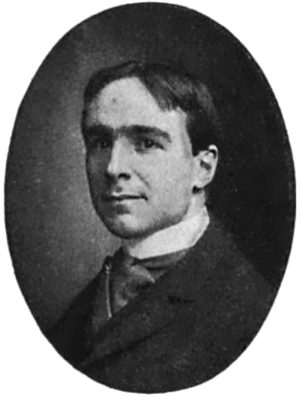
An Essay on the American Contribution and the Democratic Idea (kindle edition) by Winston Churchill


An interesting piece of history


Note: this is not written by "THE" Winston Churchill. This one was written by an American novelist and essayist with almost the same name who lived from 1871-1947. Sir Winston Churchill signed his works Winston S. Churchill in order to differentiate between the two.

The essay is inspired by a 1917 visit to the battlefields of Europe during World War I.

Churchill's essay is an interesting bit of history in that it appeals to old ideals of the old Progressives of the late 19th and early 20th centuries. There are many comments that hold to all of the hallmarks and ideals of the movement, including an obsessive faith in science and psychology (line 200) and a belief that human nature is basically good but just needs to be re-educated (line 228).

He advocates a new political party based on the teachings of modern social science (line 290), a centralized economy in order to be more efficient (line 360) and he proposes that "incomes are to be taxed above the necessary cost of family maintenance (line 367) and the "progressive elimination of the private capitalist" (line 368).
Winston Churchill (1871-1947)


Interestingly, he argues that the solution to all of society's ills comes from centralized economic power in the form of a democratically elected central government that will be led by people who have been properly educated with our newly-discovered scientifically-based methods that will get rid of the dangers of greedy human nature. (lines 395 and 462)

I rate this essay 4 stars out of 5. It can be found on Amazon.com here: An Essay on the American Contribution and the Democratic Idea.

I rate this essay 4 stars out of 5.

Featured Post

<b><i>BAN THIS BOOK (audiobook)</i></b> by Alan Gratz

Published in 2017 by Blackstone Audio, Inc. Read by Bahni Turpin. Duration: 5 hours, 17 minutes. Unabridged. My Synopsis Ban This Book is t...

Popular posts over the last 7 days