GOD BLESS YOU, MR. ROSEWATER by Kurt Vonnegut


Originally published in 1965.

After a steady stream of science fiction books, Kurt Vonnegut delivers a straight out social commentary with God Bless You, Mr. Rosewater

Synopsis:

Eliot Rosewater is the heir to a family fortune built on selling munitions in the Civil War and every war after that. The family fortune was built in Indiana but the family has moved to Providence, Rhode Island where it has a family mansion along with all of the others along the waterfront. His father is one of the senators from Rhode Island.

The Rosewater family avoids paying income taxes on this vast fortune by funding the Rosewater Foundation. Generally speaking, the foundation has been a legal way to not pay taxes and instead pay Eliot a whole lot of money to do nothing but supervise a foundation that does next to nothing.

A mural of Vonnegut in his
hometown - Indianapolis.
Photo by DWD
Eliot is suffering from PTSD (called "combat fatigue" in this book) from his experiences in World War II and drowns in troubles in bottle after bottle of alcohol. His only interests are science fiction and volunteer fire departments. He often gets black out drunk and comes back to his senses in a new town. He checks out the nearest volunteer fire department and sees if they have any new techniques or if they need any new equipment. Either way, he gives them something with foundation money.

Eliot is convinced to settle down in Rosewater County in southern Indiana. This is where his ancestors came from. He moves the foundation headquarters to Rosewater, Indiana and becomes the de facto caretaker of the people in this small town. People come to him with their problems and he listens. Sometimes, they need a little money to get over a rough patch or to help with a medical expense. It's all tedious, but the town needs him - even if it is to be someone to yell and scream at. 

The problem is, a lawyer at the law firm that handles the foundation business has found a different Rosewater from another branch of the family. The lawyer thinks he can remove Eliot as the head due to insanity. He will replace him with this other Rosewater and then make a fortune by representing him...

My review:

Vonnegut's report card
I am reading the Vonnegut novels in order of publication. This one is my favorite so far. Eliot is both a great man and a terrific loser. In a way, he is an imitation of Jesus and in a way he's a pathetic drunk that reads too much science fiction. This book is also the introduction to Vonnegut's literary alter-ego, Kilgore Trout.

Vonnegut famously graded his own books in the essay collection Palm Sunday. He gave God Bless You, Mr. Rosewater an A and I agree. 

I rate this book 5 stars out of 5. It can be found on Amazon.com here: God Bless You, Mr. Rosewater.

TIGER CHAIR: A SHORT STORY (kindle) by Max Brooks


Published in 2024 by Amazon Original Stories.

The premise of Tiger Chair is that it is a frank letter from a mid-level Chinese officer to a friend back home. World War III has been going on for a while. It started over the invasion of Taiwan and has now spread around the world. Chinese forces are active on many fronts, including India.

China has also attacked the United States in the mistaken belief that America's racial diversity and political animosities would cause American resolve to crumble and it would be a short war.

This has turned out to be wrong and the invasion has turned into occupation duty and occupation duty has always been terrible. 

I think Brooks has an actual agenda with this book and it is a warning. It is not a warning about China. It is a warning about over-dependence on technology and the foolishness of war. On top of that, it is so easy for one country to think that they have a realistic take on another country's internal politics and culture when they really have no idea at all.

Max Brooks
Brooks lectures in military circles about successful military organizations developing blind spots and becoming incapable of conceiving of strategies that will defeat them (or make it too costly to stay.)

It is an easy thing to observe in recent history. Americans have seen it in Iraq and Afghanistan. In both situations, their governments were deposed and it was assumed that new governments would be formed and the political differences would be worked out. Instead, the different rivalries fought one another with amazing ferocity. But, they also fought the Americans because there was one thing they all agreed on - they didn't want a bunch of outsiders telling them what to do.

It is the same in this story. I'd say that it's been this way forever.

I rate this short story 5 stars out of 5. It can be found on Amazon.com here: TIGER CHAIR: A SHORT STORY by Max Brooks.

MARCH: BOOK THREE (graphic novel) by by John Lewis and Andrew Aydin


Published in 2016 by Top Shelf Productions

Written by John Lewis and Andrew Aydin.

Illustrated by Nate Powell.

2016 National Book Award Winner for Young People's Literature

2017 Printz Award Winner

2017 Coretta Scott King Author Award Winner

2017 Sibert Medal Winner

2017 YALSA Award for Excellence in Nonfiction Winner

2017 Walter Award Winner

Congressman John Lewis (1940-2020) continues his life story in book three of the March series, focusing on his struggles in the Civil Rights Movement. The book starts with the 16th Street Birmingham Church Bombing in September of 1963 and ends with the signing of the Voting Rights Act in August of 1965.

These were, by any account, much like the famous Charles Dickens line from A Tale of Two Cities: "It was the best of times, it was the worst of times, it was the age of wisdom, it was the age of foolishness, it was the epoch of belief, it was the epoch of incredulity, it was the season of light, it was the season of darkness, it was the spring of hope, it was the winter of despair..."

It was the best of times in that the Civil Rights Act of 1964 and the Voting Rights Act of 1965 were passed. It was the worst of times because of these landmark laws were passed due to great sacrifices. As noted on page 91, in the state of Mississippi in the summer of 1964 during an attempt to mobilize and register black voters there were "more than 1,000 arrests, 80 beatings, 35 church burnings, and 30 bombings."

A theme that runs throughout the trilogy is that every success is soured by a violent response. I was particularly struck by an act of pointless violence at the end of the book. When the march from Selma, Alabama to Montgomery, Alabama finally happens (it had been turned back on other attempts by violence and by court order) there is a rally, there are speeches, and a concert given by an amazingly diverse crowd of artists - diverse in race and in musical styles. What should have been a beautiful moment is marred by the murder of a volunteer driver named Viola Luzzo from Detroit. She was shuttling people back to Selma. She was heading back to Montgomery to pick up more people when a car pulled alongside. A single shot was fired and she was killed (see picture.)

This is an excellent trilogy and an excellent way to tell this history. I rate this book and the entire trilogy 5 stars out of 5. 

This book can be found on Amazon.com here: MARCH: BOOK THREE (graphic novel) by by John Lewis and Andrew Aydin.

Click here for March: Book One.

Click here for March: Book Two.

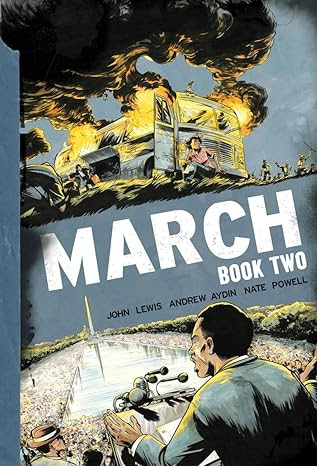
MARCH: BOOK TWO (graphic novel) by by John Lewis and Andrew Aydin


Published in 2013 by Top Shelf Productions.

Written by John Lewis and Andrew Aydin.

Illustrated by Nate Powell.

Congressman John Lewis (1940-2020) continues his life story in book two of the March series, focusing on his struggles in the Civil Rights Movement. The book starts in November of 1960 and ends with the 16th Street Birmingham Church Bombing in September of 1963.


The story includes some very harsh responses to attempts to integrate restaurants in Tennessee, the freedom riders (young African Americans were attempting to desegregate bus lines after a court ordered them to be desegregated), and the bus boycott campaign in Birmingham. 

The violent response is horrible and shocking

Infamous segregationist lawman Bull Connor of Birmingham figures prominently throughout the middle of the book. I am pretty well-versed in the major points of the Civil Rights Movement but I was still moved by the portrayal of the Children's Crusade.

The book includes all of the negotiations, concerns, and demands before the famed March on Washington. Lewis spoke at the march, followed by the world-famous "I Have a Dream" speech by Martin Luther King. 

And, as often happens in this history, a giant step forward is followed by tragedy. In this case, the book ends with the death of 4 girls in the terrorist bombing of a church in Birmingham. 

I rate this book 5 stars out of 5. It can be found at Amazon.com here: MARCH: BOOK TWO (graphic novel) by by John Lewis and Andrew Aydin.

Click here to see my review of March: Book One.

Click here to see my review of March: Book Three.

HOW the SOUTH WON the CIVIL WAR: OLIGARCHY, DEMOCRACY, and the CONTINUING FIGHT for the SOUL of AMERICA by Heather Cox Richardson


Originally Published in 2020.
Published by Oxford Press in 2022.


Historian Heather Cox Richardson has made herself into a name brand historian with her near-daily first drafts of history in which she writes up the day's political news and ties in similar historic themes or long-running trends. 

How the South Won the Civil War follows along those lines. 

The book looks at two long-standing trends in American points of view in American history that are in constant tension with one another.

This quote from page xv of the introduction gets the thesis of the book pretty well:

America began with a great paradox: the same men who came up with the radical idea of constructing a nation on the principle of equality also owned slaves, thought Indians were savages, and considered women inferior. This apparent contradiction was not a flaw, though; it was a key feature of the new democratic republic. For the Founders, the concept that "all men are created equal" depended on the idea that the ringing phrase "all men" did not actually include everyone."

She continues: "So long as these lesser people played no role in the body politic, everyone within it could be equal. In the Founders' minds, then, the principle of equality depended on inequality."

That is the heart of the thesis - some think that everyone should be able to participate, others think that only the best people should participate because some people cannot handle the responsibility (or just want to do all of the wrong things with the power.)

Richardson goes through history and shows how this has played out over the decades. A big theme is that, in general, the South has believed that not everyone should participate. The North has gone back and forth, but consistently more on the side on equality than the South. 

The Civil War was obviously a major flare up in this ongoing struggle and seemed to end the paradox once and for all. But, the same issues migrated west and the Western states generally joined the South as time went on, especially as the Democrats stopped being the conservative party when it came to race relations after the elections of 1964, 1968, and 1972. Movement Conservatives discovered that racists liked it when they said things like letting states keep their own rules about who gets to vote and being able to create special public schools so that they stay segregated.

Not every Republican followed this line of thought and the mainstream Republican Party denied that this line of thought even had a popular foothold. But, the Tea Party Movement followed by MAGA and Christian Nationalism has pushed the radicals (the old John Birch Society types) into the forefront. Trump didn't create it, but he found it and exploited it.

The MAGA movement and Christian Nationalism continues this cementing of the West and the South and the belief that some people should not have a say. Nowadays, it is not slavery or Jim Crow or forcing people to be IN the closet, but MAGA shows spend an inordinate amount of time on gay marriage, trans people, and the bogeyman of CRT. It's not the same old thing (well, it oftentimes is for the LGBTQ+ folks, especially for trans people) but it certainly rhymes.

The only complaint I have about the book is that the author fails to see that the same type of elitism exists in both parties.  Examples include FDR and his brain trust, a center-left media that laid out a certain world view for 40 years and still tries to (I mostly agree with that view, but I also acknowledge that it existed and still exists in a much weakened state.)

I rate this book 4 stars out of 5. It can be found on Amazon.com here: HOW the SOUTH WON the CIVIL WAR by Heather Cox Richardson.

WINGS of HONOR (Forgotten Fleet Book 1) (audiobook) by Craig Andrews

The premise of this book is not particularly original, but it still enjoyable.

Originally published in book form in 2021 by My Story Productions.

Audiobook published in March of 2024 by My Story Productions.
Read by Shamaan Casey.
Duration: 9 hours, 16 minutes.
Unabridged.


Synopsis:

In Wings of Honor, humanity is at war with an alien insectoid species, much like in the book Ender's Game, the movie version of Starship Troopers, and the 1990's Fox Tv show Space Above and Beyond. In this novel, the bad guys (the bugs) are called the Baranyk. 

The fight ebbs and flows - sometimes humanity is winning, but currently humanity is losing. Humans used to use a fighter/carrier system in which fighter space ships launch from carrier space ships to engage the enemy - much like another classic show and its reboot, Battlestar Galactica. The death rate for fighter pilots were atrocious so the fleet developed a sophisticated fleet of drone fighter ships. If the drone ship gets destroyed the pilot just loads up another drone and rejoins the fight.

That system worked out great and was used to push back against the Baranyk - literally turning the tide of the war in favor of the humanity. That is until the the Baranyk developed a jamming system to block out the signals to the drones, leaving the space fleet without its first and best line of defense. 

This book is about the plan to convert the best drone pilots into fighter pilots and all that it entails. There are lots of clashes between pilots with big egos, a demanding commanding officer, and the difficulty of moving from a video game type of system to really being out in the flight vehicle.

My Review:

As I stated in the title, the premise of this book is not a unique science fiction concept. That being said, the author took it and decided to really delve into the characters of the trainees and the nature of the training. I found the book to be interesting and engaging if not always riveting.

The audio reader was Shamaan Casey. His voice was perfect for the commander of the "Forgotten Fleet" - the new squadron of manned space fighters. He did a very good job and helped to make this an enjoyable audiobook. I would be interested in continuing on with this series.

I rate this audiobook 4 stars out of 5. It can be found on Amazon.com here: WINGS of HONOR (Forgotten Fleet Book 1) by Craig Andrews.

My review of the second book in this trilogy can be found here: Wings of Mourning.

Note: A copy of this audiobook was provided to me by the publisher in exchange for an honest review.


LIFE AFTER POWER: SEVEN PRESIDENTS and THEIR SEARCH for PURPOSE BEYOND the WHITE HOUSE (audiobook) by Jared Cohen


Published by Simon and Schuster Audio in 2024.
Read by Kevin R. Free.
Duration: 14 hours, 4 minutes.
Unabridged.

In Life After Power Presidential historian Jared Cohen looks into the post-Presidential lives of seven Presidents and their quests for some sort of meaning after having one of the most important jobs you can have.

Some Presidents fade away due to health reasons, like Reagan. Others are eager to resume their former lives, like Washington. But, others still feel like they have something more to offer or have unfulfilled goals.

The seven Presidents he looked at are: Thomas Jefferson, John Quincy Adams, Grover Cleveland, William Howard Taft, Herbert Hoover, Jimmy Carter, and George W. Bush.

I have enjoyed hearing about John Quincy Adams' post-Presidential life ever since I first read John F. Kennedy's Profiles in Courage 30+ years ago. I've read more than one book about him and this re-telling is quite good. 

A photo of John Quincy Adams 
taken in 1844.
Jimmy Carter's lengthy post-Presidency is remarkable for how amazingly hard-headed he has been. Carter follows his conscience and lets the political consequences be damned. Cohen notes that Carter did not actually found Habitat for Humanity - he just joined it early on and is easily its most famous and perhaps longest term volunteer.

George W. Bush has done almost the opposite. He lived a very public life for years and has since retreated into more solitary pursuits such as painting. He has said almost nothing about politics in the almost 16 years since he left office.

Each of these men had a different reaction to leaving office. Some left after 2 successful terms, some after experiencing disappointment and 4 of them were defeated after just one term (this is what inspired Cleveland's determination to run again - and win.) I found some to be more interesting than others but, taken a whole, this is a solid set of mini-biographies.

I rate this book 4 stars out of 5. It can be found on Amazon.com here: LIFE AFTER POWER: SEVEN PRESIDENTS and THEIR SEARCH for PURPOSE BEYOND the WHITE HOUSE by Jared Cohen.


PRINCESS DIANA: A LIFE from BEGINNING to END(BIOGRAPHIES of BRITISH ROYALTY) (kindle) by Hourly History


Published in 2022 by Hourly History

This was a very odd choice for me to read for a couple of reasons:

1) I don't normally enjoy the gossip magazine type of stories.
2) I don't follow the modern English royal family - I find them to be annoying.
3) I don't really follow the English royal family in the history books, either.

Here's how we got here. Hourly History offers several free e-books every weekend and I picked up the book on Princess Diana for some unknown reason. And, six months later I accidentally picked the Princess Diana book with my fat thumb while using my e-reader app on my phone. I could have removed the download, but I decided to just go with it. Turns out, this was a happy accident.

I am not going to go over Diana's life story in this review. I will just say that this rather short biography (the publisher intends that its books take about an hour to read) was interesting and pleasant to read. A lot of it was information I remember just from being alive when all of this story was going on, but it was well-written.

I rate this e-book 4 stars out of 5. It can be found on Amazon.com here: PRINCESS DIANA: A LIFE from BEGINNING to END(BIOGRAPHIES of BRITISH ROYALTY) by Hourly History.

WONDER CITY (graphic novel) Written by Victor Fusté. Illustrated by Jared Cullum


Published by Insight Kids in 2022.

Synopsis:

Teenager Alex Riley and her older sister Elizabeth are very different kinds of people. They are the daughters of a adventurous married couple who turned their adventures as archaeologists into a TV action adventure cartoon. Think of them as the archaeologist versions of Steve Irwin (the Crocodile Hunter) and his wife.

Their mother passed away a while back and their father recently died in mysterious circumstances working on a secret project in the subway tunnels under New York City. Now they are having to depend on each other.

The good guys sneaking into the network of tunnels
and sewers under New York City
When Mafia-type thugs show up to their place and try to steal notes their father had written while working on his secret project in the subway they know someone has been lying to them about their father's project...

My review:

I liked Wonder City well enough, especially at first. There are strong characters, interesting art, and There is an ongoing issue with the speech balloons. There were smushed together words, misspellings, and strangely divided words that made me wonder if they were electronically inserted and no one bothered to check on the results. 

The final climactic scene was a bit too much for me. It didn't quite make sense and there were times when the art didn't quite make it clear what was happening - kind of blurry with weird magic tossed in to make it all work out in the end even if it makes no sense. 

Final verdict:

Pretty good (if not super original) story marred by unclear art and writing at the end. The weird typos in the speech balloons made it seem like no one cared at the publishing house.

I rate this graphic novel 3 stars out of 5. It can be found at Amazon.com here: WONDER CITY. Written by Victor Fusté. Illustrated by Jared Cullum.

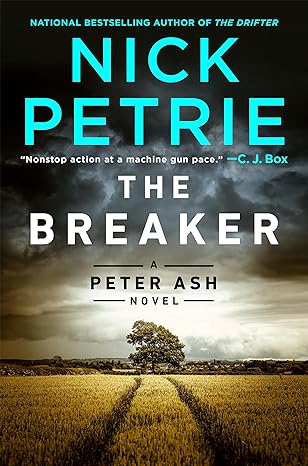
THE BREAKER (Peter Ash #6)(audiobook) by Nick Petrie


Published by Penguin Audio in 2021.
Read by Stephen Mendel.
Duration: 12 hours, 10 minutes.
Unabridged.


Synopsis

Fugitive good guy Peter Ash is hiding out in the open in the city where his adventures began in book number one of the series - Milwaukee. In The Breaker Peter Ash has an assumed identity with very good fake papers. His girlfriend June has joined him, resuming her career as a reporter with the local Milwaukee big city paper. Of course, his friend Lewis is around as well.

In the previous books Peter Ash is dealing with untreated PTSD from his time as a soldier in Iraq and Afghanistan. Too many searches in too many small confined areas has left him with severe claustrophobia.

Peter is working on the claustrophobia, though. Peter, Lewis, and June are at the Milwaukee Public Market for lunch. It is indoors, but it is very open concept with a lot of open space above. He's been eating there to get used to being inside. 

The Milwaukee Public Market

Lewis and Peter notice a figure carrying a hidden weapon entering the crowded Market. That's bad enough - but there's also a bus full of elementary school children unloading for a lunch field trip. 

Lewis and Peter leap into action and things get very complicated very quickly...

My Review

This book was the weakest in the series so far. There was plenty of action - almost non-stop action.

*****Spoilers******

June became a much less nuanced character in The Breaker. Most of her lines consist of her yelling, "Marine!" at Peter and then ranting about how much she loved him and how he needed to take care of himself and how he needed to neutralize the threats facing them without creating any fuss that would bring unwanted attention to him. That was cute at first but it got old.

It also makes zero sense for June, a woman who owns a tech research company and owns an entire mountain valley to put Peter Ash (and herself) at legal risk by letting him wander around Milwaukee all day. Hide that man away until you can figure out how to get Peter out of his predicament.

There is a police stop early on in the book for a burned out tail light that seemed needlessly petty. It was designed to introduce a grizzled old cop character who might see through Peter Ash's elaborate paperwork disguise. But, instead of giving the impression of an experienced cop who has hunches that pay off, I got the impression of a petty man who likes to push people around and make them search for electrical shorts in their tail lights by making them crawl around their vehicles in the rain and get soaking wet and dirty first thing in the morning. 

The book almost approaches sci-fi, with giant hydraulic-powered machines adapted to a wheelchair-bound man, scientifically talented orphans seeking revenge, hundreds of armed robots powered by revolutionary long-lasting batteries, and self-driving vehicles that can travel anywhere on any road.

Throw in a secret government agency and its seemingly all-knowing mysterious representative and it was just too much.

*****end spoilers*****

If this had been the first book in this series, it would have been my last. Hopefully, the next one is much, much better.

I rate this audiobook 2 stars out of 5. It can be found on Amazon.com here: THE BREAKER (Peter Ash #6) by Nick Petrie.

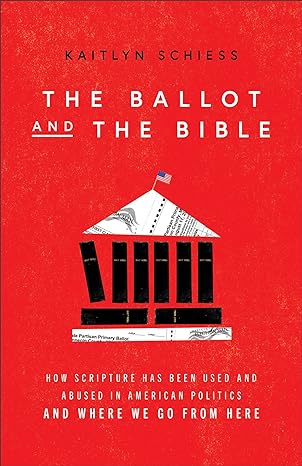
THE BALLOT and the BIBLE: HOW SCRIPTURE HAS BEEN USED and ABUSED in AMERICAN POLITICS and WHERE WE GO from HERE (audiobook) by Kaitlyn Schiess


Published in 2023 by ChristianAudio.com.
Read by the author, Kaitlyn Schiess.
Duration: 6 hours, 27 minutes.
Unabridged.


I first heard about Kaitlyn Schiess on one of my favorite podcasts: The Holy Post. She is one of the three regular hosts of the show and often serves as their in-house theologian. She is well-suited for this role because she offers well-considered answers and she thinks them through before she answers, rather than just shooting her mouth off - all the more impressive when one considers that she is by far the youngest member of the podcast.

I was drawn to The Ballot and the Bible because: 1) I am concerned the rise of Christian Nationalism in America and the damage it does to the Christian witness; 2) I knew that Schiess would give thoughtful answers.

The intermingling of Christianity and politics is not a new phenomenon in the United States (or in the rest of the world - but that is not the focus of this book.) Schiess looks at the intermingling of faith and politics in the Revolutionary Era, the pre-Civil War and Civil War eras and in our modern times (1970s to now.)

Schiess spends special attention on how Romans 13:1-7 has applied in these situations. Attorney General Jeff Sessions brought this verse to the forefront in June of 2018 when he defended the policy of separating children from their illegal immigrant parents.

If you remember that controversy, you realize how much bad will could be created by this book if it were written by a less talented writer. 

Worth your time.

I rate this book 4 out of 5 stars. It can be found on Amazon.com here: THE BALLOT and the BIBLE: HOW SCRIPTURE HAS BEEN USED and ABUSED in AMERICAN POLITICS and WHERE WE GO from HERE by Kaitlyn Schiess.


ILLEGAL (graphic novel) Written by Eoin Colfer and Andrew Donkin. Illustrated by Giovanni Rigano.


Published in 2018 by Sourcebooks Young Readers.

Illegal is the fictional story of two young brothers from Ghana: Ebo and Kwame. While it is fictional, it is based on lots and lots of true stories.

Most Americans are very aware that immigrants/refugees are fleeing from their native countries and arriving at the border of the United States and are not aware that a similar thing is happening in Europe. 

Europe has a similar refugee/immigrant situation. People are fleeing from the wars in Syria, Sudan, and Yemen. There are also refugees fleeing the brutal poverty and political situations in sub-Saharan Africa. Like in the United States, these immigrants/refugees depend on very shady people to move them closer to their goals.

In this story, two young brothers named Ebo and Kwame live in a village in Ghana. They are orphaned and living with a useless, drunken uncle. They have an older sister that has already crossed the Sahara Desert and the Mediterranean Sea to look for work but they don't know anything about where she ended up or how it is going. 

Kwame is the older brother and he has decided to sneak away and try to get to Europe. He doesn't want to bring along his little brother because he is concerned about his safety, it will cost twice as much if they both go, and there is a superstition that says only one family member should make the trip at a time because it is so dangerous that it just seems all the more likely that there will be a loss in the family.

Ebo will have none of this. He immediately sets off to find his brother at his first stop - Agadez, Niger. Agadez is a city of a little more than 100,000 and serves as the launch point to try to cross the Sahara Desert.

The Sahara is too big to cross on foot so migrants trying to cross it have to have money to pay unscrupulous smugglers (much like Mexico's infamous coyotes.) This is not cheap.

If a migrant is lucky enough not to be robbed and dumped in the desert they arrive in Libya and pay smugglers for a boat ride across the Mediterranean Sea and try to land in Italy or Sicily. This is also not cheap.

Ebo and Kwame work various menial, under the table manual labor jobs while living on the streets and avoiding the police. Life is cheap, hard, brutal, and dirty - yet no one talks about turning back.

My review:

This is an excellent graphic novel. The parallels with the American refugee crisis are striking and equally heartbreaking. I learned a lot and I enjoyed the easy to follow art work as well.

I rate this graphic novel 5 stars out of 5. It can be found on Amazon.com here: ILLEGAL - Written by Eoin Colfer and Andrew Donkin. Illustrated by Giovanni Rigano.

INCREDIBLE HULK: PLANET HULK written by Greg Pak, illustrated by Carlo Pagulayan, Aaron Lopresti, Juan Santacruz, Gary Frank, and Takeshi Miyazawa.


Originally published by Marvel Comics from 199-2007.

Synopsis:

Hulk is banished from Earth after helping The Avengers, The Fantastic Four, and others defeat a common enemy by using Hulk's brute strength. Hulk has been rendered unconscious and placed on a spaceship. Reed Richards (Mr. Fantastic) leaves a video message for Hulk to find on the spaceship when he arrives at his destination - a planet with no intelligent life. Reed knows that it is a wish of both Dr. Banner and Hulk to be someplace where Hulk cannot hurt anyone and no one can hurt Hulk. 

But, a wormhole opens up and sucks Hulk's spaceship to a different destination - the planet Sakaar.

Sakaar is ruled by a despotic, deranged emperor. He rules a planet with multiple species - all of them hate each other because he pits them against them against one another. He has discs attached to their bodies to control their impulses and allow him to deliver pain at will. He wears a suit of armor that Iron Man would envy and he runs a giant gladiator contest to punish anyone who dares stands up to his regime.

That is, until Hulk arrives...

My Review:

Planet Hulk has a reputation of being THE ultimate Hulk story arc. This story is also part of the inspiration for the Marvel movie Thor: Ragnarok

*********Spoiler alert*********

While this graphic novel has a great reputation, I found it to be very repetitive. Hulk meets a danger, he nearly dies but he wins by just brute forcing everything. Every new confrontation makes him stronger until it just gets to the point of ridiculousness. Every time Hulk turns around there is a new species with new traditions, new prophecies, and new attacks on the Hulk that make him stronger. Eventually, he gets so strong that he can literally tear apart the planet from the inside - it just became tedious for me. The whole plot is something attacks, Hulk mad, Hulk smash, Hulk get stronger, Hulk finds peace of mind, something new attacks, Hulk mad again, and on and on and on.

*********End Spoilers*********

The art is very beautiful, though.

I rate this graphic novel 2 stars out of 5. I had to force myself to finish it, even if it is a classic. 

This graphic novel can be found on Amazon.com here: INCREDIBLE HULK: PLANET HULK written by Greg Pak, illustrated by Carlo Pagulayan, Aaron Lopresti, Juan Santacruz, Gary Frank, and Takeshi Miyazawa.

VANISHING EDGE (National Parks Mysteries #1) (audiobook) by Claire Kells


Published by Dreamscape Media, LLC in 2021.
Read by Natalie Naudus.
Duration: 9 hours, 13 minutes.
Unabridged.


Synopsis:

Felicity Harland is a former FBI agent just turned investigator for the Investigative Services Branch (ISB.) ISB is the criminal investigation unit for the National Park Services. They investigate serious crimes that happen in National Parks. 

Harland has been called to Sequoia National Park because 2 customers of an ultra-glamping camping service has disappeared in a remote mountainous location called Emerald Lake. No one knows if they are dead, have intentionally gone missing, or have simply wandered off into the wilderness. No one will say anything about who the supposed victims are because this service is ultra-exclusive and treats the names of its customers like its a national secret.

Harland, along with an old crusty park ranger, and an ex-Navy SEAL who has just joined the park service search for the missing pair. What they discover next leads them to one suspect after another and no real obvious answers...

My Review:

Emerald lake in Sequoia National Park
I really liked this first entry in a new series. Felicity Harland is far from perfect and she has her own personal demons that the reader learns about as the book progresses. She's flawed, but trying to rebuild her life and learn a new job at the same time. Setting her cases in the National Parks means that she can literally travel the country investigating different cases and the reader gets to see a lot of different parks along the way. For example, at the end of this book she was off to Gates of the Arctic National Park in Alaska.

I rate this audiobook 4 stars out of 5. I will be moving on to the next book in the series.

This book can be found on Amazon.com here: VANISHING EDGE (National Parks Mysteries #1) by Claire Kells.

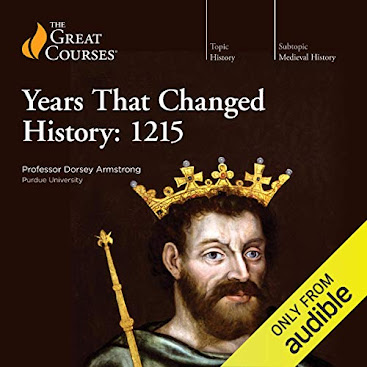
YEARS THAT CHANGED HISTORY: 1215 (The Great Courses)(audiobook) by Dorsey Armstrong


Published in 2019 by The Great Courses.
Lectures by Dorsey Armstrong.
Duration: 12 hours, 29 minutes.
Unabridged.


The Great Courses offers a lecture series by college professors that the average person can listen to on their own time. 

In this case, Purdue University history professor Dorsey Armstrong is focusing on the year 1215 as a pivotal year. 

1215 is well-known to Americans as the year of the Magna Carta, but it is also the year of the Fourth Lateran Council of the Catholic Church. The rest of the lecture series is about general things that were going on around 1215. These include the crusades, a brief look at the Americas, a look at the Islamic world, Japan, and an extended look at Genghis Khan and the Mongol Empire.

This is a lecture series that could have used a bit of editing. If two hours were removed, that would have been good. Three hours would have been great. This was especially true in the section about Genghis Khan. Armstrong admitted that she was excited about this topic and she really just laid on the details - way too many details for even this history teacher. It just got bogged down in the early details of his life and scooted through the height of the Mongol Empire and its eventual collapse.

I rate this audiobook 3 stars out of 5. I don't really blame Armstrong for this - this series tends to like 20+ half hour lectures and I don't think this was a rich enough vein of information for her to mine.

This audiobook can be found on Amazon.com here: YEARS THAT CHANGED HISTORY: 1215 (The Great Courses) by Dorsey Armstrong.

DIFFER WE MUST: HOW LINCOLN SUCCEEDED in a DIVIDED AMERICA (audiobook) by Steve Inskeep


Published by Penguin Audio in 2023.
Read by the author, Steve Inskeep.
Duration: 8 hours, 57 minutes.
Unabridged.


It's been said that no American has been the subject of more biographies than Abraham Lincoln. I don't know if that it is true, but I do know that it is pretty tough to come up with a new angle on the 16th President. In Differ We Must, NPR reporter/host Steve Inskeep has managed to do just that.

Inskeep follows through Lincoln's life and sees how he dealt with people that he had disagreements with. Some of them were major, some were minor. Sometimes, Lincoln responded to these disagreements by befriending the people he disagreed with, sometimes by patiently arguing his point of view, sometimes by appearing to accommodate them only to slowly change their minds, and sometimes by arguing fiercely against his opponent.

And, sometimes, as in the case of Frederick Douglass, Lincoln realized he was wrong and changed his mind as was the case with Frederick Douglass (and other black dignitaries) and black men serving as soldiers and him dropping his insistence on sending freed slaves to Africa.

One is left to wonder, as always how Lincoln would have reacted to the end of the Civil War and Reconstruction - the ultimate test of his ability to work with people that he disagreed with. We know that his successor, Andrew Johnson, failed that test in a spectacular way, but we will always have to wonder how Lincoln would have done.

While this was a unique entry into the collection of Lincoln biographies, I found it to be merely an "okay" biography. I listened to the audiobook and Inskeep's pleasant reading voice didn't hold my attention particularly well. I rate this biography 3 stars out of 5. It can be found on Amazon.com here: 
DIFFER WE MUST: HOW LINCOLN SUCCEEDED in a DIVIDED AMERICA by Steve Inskeep.

THE JOURNEY in BETWEEN: THRU-HIKING EL CAMINO de SANTIAGO (Thru-Hiking Adventures book 1) (kindle) by Keith Foskett


E-book Published by Amazon Digital Services in 2010.

I have a real soft spot for books about travel - especially travel in odd ways. I have read a book about a guy who backpacked across Europe, a man who hiked across Afghanistan in 2002, a man who biked from England to India, two women who biked from Turkey to China, a man who hiked from Mexico to the Darien Gap in Panama, the same man hiked the length of the Nile River, a man who found a little dog while in a hiking competition in the Gobi Desert, a man who hiked all 48 mountains in New Hampshire with his little schnauzer dog, and more.

One of these travel stories was by this author, Keith Foskett. Last year, I read the story of his trip up the Pacific Crest Trail - from Mexico to Canada and almost all in the mountains.

This hike was much more sedate and featured less extremes in the weather. The Camino de Santiago is a well-established route. It has been an pilgrimage route for more than 1,000 years and in the last 30 years or so France and Spain have really promoted this trail for tourists.

Foskett was determined to do this event properly so he began it at a traditional place to begin in France. That surprised me because I have always heard of this pilgrimage as being entirely in Spain but at least 25% of this book takes place in France.

Foskett is not taking this pilgrimage as a religious endeavor. Instead, he is looking for adventure and an escape from the workaday grind and this hike fits the bill perfectly.

As I noted, this is the 2nd hike I've done with Foskett (in spirit.) I enjoyed the book about the Pacific Crest Trail more, but this one was interesting. I learned a lot about the Camino de Santiago and Foskett makes for an unusual but lively travel companion. 

I rate this e-book 4 stars out of 5. It can be found on Amazon.com here: THE JOURNEY in BETWEEN: THRU-HIKING EL CAMINO de SANTIAGO (Thru-Hiking Adventures book 1) by Keith Foskett.

FAHRENHEIT 451 (audiobook) by Ray Bradbury


Originally published in 1953.

I listened to the Tantor Media audio version published in 2010.

Read by Stephen Hoye

Duration: Approximately 5.5 hours

Unabridged

Synopsis: 

Guy Montag is a fireman in a future United States. Firemen in the future do not fight fires. Instead, they burn books, newspapers, magazines that people have hidden away. If you hide forbidden media in your home your home will be burned to make sure all of the books are gone and to serve as a warning to rest of the neighborhood. 

Montag is great at his job, but he has his doubts. Every once in a while he takes a book home. He hides them in the ventilation system of the house. No one knows, not even his wife. Those doubts are accelerated when his team witness a woman die in the fire with her books rather than live without them...

My review: 

This book has an interesting history. Bradbury started building the world that this book is set in with some short stories of a dystopian future where everyone is absorbed by personalized television screens. His publisher urged him to expand the ideas into a book. Bradbury knocked out Fahrenheit 451 in just 9 days on a rented typewriter that cost him 10 cents per half hour.

The book itself has action but it oftentimes felt like essays attached by plot points. It seems to me that the speed in which the book was written probably led to this sort of construction. The essays took the form of extended trains of thought by Montag or long speeches/rants from Montag's boss, Captain Beatty. These "essays" make all of the arguments of the story such as the justifications for mass censorship, the arguments against it, and the lack of human contact in a mass media world.

Bradbury accurately predicted a lot of the modern world in this book. When it comes to technology, he predicted the ATM, giant screen televisions, and earbuds. Culturally, he predicted the rise of sports TV, the inane reality TV shows like The Real Housewives, and the addiction to pop culture and electronic media that may be a factor in the high rates of depression among young people nowadays.

This has to be considered Bradbury's masterpiece. It is such a powerful manifesto against censorship. 

NOTE: If you appreciate irony, please read this bit about how THE anti-censorship novel of the 20th century was edited to remove or change controversial and offensive words and scenes without the knowledge of the author - FOR TWELVE YEARS!

NOTE: Also on the "if you appreciate irony" category - Fahrenheit 451 was put on a book ban list in Tennessee. The article has a searchable database because the list has more than 1,100 unique titles.


I rate this book 5 stars out of 5. It can be found on Amazon.com here: FAHRENHEIT 451 by Ray Bradbury.

Featured Post

<b><i>BAN THIS BOOK (audiobook)</i></b> by Alan Gratz

Published in 2017 by Blackstone Audio, Inc. Read by Bahni Turpin. Duration: 5 hours, 17 minutes. Unabridged. My Synopsis Ban This Book is t...

Popular posts over the last 7 days