ON FASCISM: 12 LESSONS from AMERICAN HISTORY (audiobook) by Matthew C. MacWilliams


Published in September of 2020 by Macmillan Audio.

Read by Kevin Stillwell.
Duration: 4 hours, 18 minutes.
Unabridged.


MacWilliams is a sociologist who studies authoritarianism. He has done a number of surveys over American attitudes towards the Constitution and the freedoms of their fellow citizens and there are areas of concern that he outlines in On Fascism.

For example, "31% of Americans agree that having a strong leader who does not have to bother with Congress and elections is a good way of governing the United States" and "30% of Americans agree with the statement 'I often find myself fearful of other people of other races.'"

Other stats of concern are:

"44% of Americans agree that increasing racial, religious and ethnic diversity represents a threat to the security of the United States"

When you break down the numbers about "18 percent of Americans are highly disposed to authoritarianism. Another 23 percent or so are attitudinally just one step below them on the authoritarian scale." He goes on to explain that people who are disposed to authoritarianism value "authority, obedience and uniformity over freedom, independence  and diversity" and when they grow fearful or are manipulated by an autocrat they will not defend the freedoms of the minority - the freedoms enshrined in the Constitution. 

MacWilliams argues that this is not a new phenomenon. There are some old surveys he can access but there is also the historical record, which is spotty. He didn't have to look very deep - most of these items are in every school child's American history book. For example, the Alien and Sedition Acts of 1798, the Trail of Tears, The Dred Scott decision, the Japanese Internment camps and the McCarthy hearings. 

Lesson 1: American Enlightened or Authoritarian?
Lesson 2: Fomenting Fear
Lesson 3: All Lies Matter
Lesson 4: Gagging the press, Quashing Dissent
Lesson 5: Taking What is Rightfully Ours
Lesson 6: Using Fear and Violence to Control and Subordinate Others
Lesson 7: The Driving Out
Lesson 8: Fear as a Path to Power
Lesson 9: Galvanizing Group Identity
Lesson 10: Silence of the Law
Lesson 11: Fear Breeds Repression; Repression Breeds Hate; Hate Menaces Stable Government
Lesson 12: The Surveillance Society and the Big Lie


I found this short audiobook to be engaging and thought-provoking. I just kept wondering what MacWilliams would have thought about everything from Election Day up to January 6.

Highly recommended.

I rate this audiobook 5 stars out of 5. It can be found on Amazon.com here: On Fascism: 12 Lessons from American History.

STARMAN JONES (audiobook) by Robert A. Heinlein


Originally published in 1953.

Digital Audiobook version published in 2008 by Blackstone Audio, Inc.
Read by Paul Michael Garcia.
Duration: 8 hours, 29 minutes.
Unabridged.

Legendary science fiction author Robert A. Heinlein (1907-1988) wrote a set of novels for the Scribner's publishing house early in his career as a novelist starting in 1947. Scribner's published 12 of them. One of his most famous works, Starship Troopers, was rejected as a volume in this series, but it was fully intended to be a part of it.  A 14th and final book featuring a female lead character was also rejected.  They all share a theme of space exploration moving roughly from humanity's first steps away from Earth to contact with massive alien empires in far and distant places.
Robert A. Heinlein (1907-1988)

Starman Jones falls right in the middle. It is the seventh novel in the series and humanity can travel to far and distant places and has met alien species, but it is exceedingly tricky. 

Max Jones is a teenager in the Ozarks on a future Earth. Times are tough and people with pull, connections or money are moving off-planet. Max has no pull, maybe has a connection and certainly has no money. When his widowed step-mother marries the neighborhood bully and lets him sell the family farm without warning Max runs away from home to find his own way.

As you can tell by the title, Max eventually makes it to space. The problem is that Heinlein spends a lot of time explaining the bureaucracy of the various space guilds (every profession has its own guild and its own obscure rules) and then goes on to explain in excruciating detail the formal and informal rules of a ship - how the galley works, how discipline is maintained, how to run an illegal still on board, how the crew relates to the passengers, how the crew relates to the officers, how the officers relate to the passengers, how the bridge officers relate to the other officers, how the bridge officers relate to each other and how the captain can help or hinder the ship's morale. It reminded me quite a bit of the extended descriptions of military life in Starship Troopers

If all of the "explaining" were edited out, or at least cut back, this book would probably come in 3 hours shorter and be all the better. 

I rate this audiobook 3 stars out of 5. It can be found on Amazon.com here: Starman Jones by Robert A. Heinlein

HARRY POTTER and the HALF-BLOOD PRINCE (Harry Potter #6) by J.K. Rowling


Originally published in 2009.
Published by Pottermore Publishing in 2015.
Read by Jim Dale.
Duration: 18 hours, 32 minutes.
Unabridged.


The Half-Blood Prince is the book that one of my daughters complained about several years ago when she read it. She said it was too much talking and not enough action. Certainly when compared to the previous two books, there is a lot less action and a whole lot more talking. Rowling changed up the narrative and tells the back story of the villain of the series, Lord Voldemort, by way of an investigation by Dumbledore and Harry.

The pace is certainly slower, but the information was valuable. Perhaps it might have been delivered differently, but I was glad to have it. 

The last two hours of the audiobook were full of nothing but action and consequential moments. 

Jim Dale continued to do a great job with the book, with the exception of the voice of Hermione. 


This is my favorite cover of the entire series. Once you get done with the book you can see that it covers the major points of the story in one picture. Well done.

I rate this audiobook 4 stars out of 5 and I look forward to the last book of the series.

This audiobook can be found on Amazon.com here: HARRY POTTER and the HALF-BLOOD PRINCE (Harry Potter #6) by J.K. Rowling.

Note: this entire book series has been on banned book lists multiple times since it was originally published due to complaints from religious conservatives. Check out this website for more info.

LINCOLN and the FIRST SHOT (Critical Periods of History Series) by Richard N. Current


Originally published in 1963.

27 years ago I took a night class about the Civil War offered by Ball State University in a middle school off campus. It was a great class and Lincoln and the First Shot was the first book that we discussed. The book covers the two month period from the day that Lincoln arrived in D.C. after he was elected President and the day that P.G.T. Beauregard opened fire on Fort Sumter at Charleston, South Carolina.

When the Confederate states seceded they took over all Federal property, including forts and military bases. Two forts were not surrendered - Fort Pickens in Pensacola and Fort Sumter. Fort Sumter was always the most argued over because of the symbolism of being smack in the middle of the main port of the first state to secede. 

Lincoln refused to give up the fort because he refused to give up any of the seceded states. South Carolina demanded the fort because they insisted they were part of a new country and they did not want a foreign power to have a fort blocking a port in their new country.

South Carolina was ready to fire on the fort but did not want to look like they were provoking a fight. A peaceful separation might still be possible. Lincoln was preparing to reinforce the fort if he could - but without provoking a fight. After all, the country might be peacefully reunited. 
Fort Sumter immediately after its surrender
to South Carolina troops in April, 1861.

Neither side wanted to fire the first shot, but both sides could foresee the rush of patriotism that follow if their side were fired upon.

Historian Richard N. Current's description of the situation faced by both the North and the South at the beginning of the crisis was excellent and well done. But, his description of all of the plotting, fake peace proposals and sometimes outright confusion felt like he was stretching out the story to fill the pages of this book - like there was a minimum number of words he had to reach to fulfill his book contract.

So, I rate this book 3 stars out of 5. It can be found here on Amazon.com:  LINCOLN and the FIRST SHOT (Critical Periods of History Series) by Richard N. Current.


SOLDIER BOY by Michael Shaara


Published in 1982 by Pocket Books (a Timescape book)

Back in the 1980's Simon and Schuster had a division called Pocket Books that specialized in paperback books. Pocket Books had an even smaller division called Timescape. Timescape published sci-fi books, including some of the earliest of the Star Trek novels so they were quite a successful line. Soldier Boy is part of that Timescape line.

Michael Shaara (1928-1988)
Michael Shaara won the Pulitzer Prize for his 1974 novel about the Battle of Gettysburg, The Killer Angels. Shaara had knocked out a few novels before then, but none were about the Civil War. Instead, a great deal of his writing was sci-fi. He started out selling stories to magazines in 1951. This book is a collection of 14 of those short stories.

If you read this book, I recommend reading the Author's Afterword first. He wrote commentary on every story and I used those notes as an introduction to each one.  Like all short story collections, they vary in quality. The book is named after the first story in the collection. Shaara really likes the story, but I found it so-so. But, I enjoyed most of them. There were a lot of them with a Twilight Zone gotcha moment at the end. I really enjoyed those.

This collection was an enjoyable read. I rate it 4 stars out of 5. It can be found on Amazon.com here: Soldier Boy by Michael Shaara.

Note: Amazon is selling all of these short stories as individual Kindle stories. Be careful if you buy the one named "Soldier Boy" - it is not this book, it is just the first story. 

THE BITTERROOTS (Cassie Dewell #4) (audiobook) by C.J. Box


Published in 2019 by Macmillan Audio.

Read by Christian Delaine.
Duration: 9 hours, 49 minutes.
Unabridged.


In The Bitterroots, Cassie Dewell has left her career in law enforcement and is now a private investigator in Montana. This is perhaps the first series featuring a private investigator in Montana because there can't be that many private investigators in Montana. Box notes that she is actually doing quite well for herself because there are so few private investigators in Montana.

A lawyer who is also the daughter of a man she owed a favor to contacted her to do some investigating work. The attorney had been hired to defend a man who was accused of raping his niece. His case had been moved away from his home county due to pre-trial publicity and Cassie Dewell soon discovers that his home country. That county, despite being physically large, feels like small because everyone knows everyone else and one family runs everything through a combination of physical and financial intimidation.

The problem is that Dewell's client is a member of this family - the oldest son. He is the black sheep that moved away and made it big and came back home with a plan to sell the family ranch since the family patriarch is close to death. The will states that the oldest will inherit the whole ranch so long as he has never committed an act of moral turpitude - which is why the client says he was set up.

Dewell goes off to investigate expecting to find trouble and she finds even more than she expects...

I listened to The Bitterroots as an audiobook. Christian Delaine did a fantastic job of actually performing the book rather than simply reading it. She made the story better than it would have been if I had simply read it.

I rate this audiobook 4 stars out of 5. It can be found on Amazon.com here: The Bitterroots (Cassie Dewell #4) by C.J. Box.

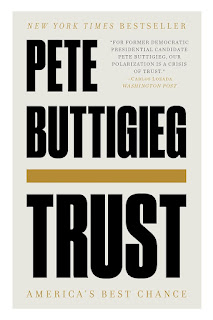
TRUST: AMERICA'S BEST CHANCE (audiobook) by Pete Buttigeig


Pete Buttigeig was, for me, the most interesting Democrat that sought the 2020 nomination. The first I ever heard of was a lengthy interview he gave on NPR when no one on the national level had ever heard of him. I found him to be thoughtful and serious and open to new ideas and discussion. 

This book is a short discussion on how politics (and life in general) depends on a certain level of trust to proceed. There is nothing really new here, but it is a worthwhile discussion and it is good to hear it reiterated in a time when trust is so short. To his credit, Pete Buttigeig doesn't feel the need just to stretch out a book just to pad the number of pages.

At the end of the audiobook is a recording of Mayor Pete's speech where he announces that he is ending his Presidential campaign.

I rate this audiobook 4 stars out of 5. It can be found on Amazon.com here: TRUST: AMERICA'S BEST CHANCE  by Pete Buttigeig.

THE RED PONY by John Steinbeck


John Steinbeck
(1902-1968)
The Red Pony is a standard novel to be read at the middle school level across the country. I remember I read the first third of the book as a part of my 7th grade literature class textbook, but the rest of the book was new to me.

As I mentioned, The Red Pony is split into sections - three of them. In actuality, they are 3 coming-of-age short stories about Jody, a boy growing up on a northern California ranch. 

Being Steinbeck stories, they are well-written, brutally realistic and every one has a sad twist.  I like Steinbeck, but it has to come in small doses.

I rate this book 4 stars out of 5. It can be found on Amazon.com here: The Red Pony by John Steinbeck.


CITIES of the ANCIENT WORLD (The Great Courses) by Steven L. Tuck


Published in 2014 by The Great Courses.

Read by the author, Steven L. Tuck
Duration: 11 hours, 48 minutes.
Unabridged.

The publishers of The Great Courses offer college level lecture classes (100 or 200 level) as audiobooks and/or videos. 

Cities of the Ancient Word begins with a discussion of the earliest cities and then moves on to significant cities that came along later. To be a significant city it had to start a new pattern - cities built on rivers, cities built on defensive hills, cities built to take advantage of sea trade, cities with a clear plan, cities built with a plan to mix to allow people of different ethnicities to live together (separately) and so on.
The Roman Colosseum

I very much enjoyed the first part of these lectures. But, once we got to Tuck's specific areas of expertise (Greek, Hellenistic, Roman) the audiobook got bogged down. His last lecture about some of the lessons of ancient cities that have been adopted by modern cities or are becoming popular again was interesting.

My primary problem of the book was that its title says it is about "cities of the ancient world" but it only includes cities in the Mediterranean basin and the Near East - the farthest away is on the border of India and Pakistan.  T

The youngest city he discusses is Constantinople and he discusses it through the 500's A.D. That is late enough that he could have easily have included cities from Asia, the Americas or Africa and I find it odd that he did not considering that he was discussing universal concepts that transcend all cities. Rather than dealing with cities that were influencing each other (a point that he makes over and over again), he could have skipped to an entirely new region of the world and shown that these principles truly are universal.

I rate this audiobook 3 stars out of 5. It can be found on Amazon.com here: CITIES of the ANCIENT WORLD (The Great Courses) by Steven L. Tuck.


SAVAGE RUN (Joe Pickett #2) (audiobook) by C.J. Box


Originally published in 2002.

Published in 2010 by Recorded Books.
Read by David Chandler.
Duration: 8 hours, 48 minutes.
Unabridged.

I have been reading the Joe Pickett series for the last 10 years and I have been reading them all out of order. I started with book number one, went on to number thirteen and so on...

So, here I am ten years later with a review of Savage Run (book number two.)

The book starts out from the perspective of a radical environmentalist who leads a national organization. However, he is tired of using lawsuits to fight for the environment. He likes to get his hands dirty by spiking trees and cutting fences. While he is out doing that he gets blown up by a bomb that was strapped to a cow. 
Photo by DWD

Joe Pickett gets called out to the explosion site because there may have been wildlife injured or killed. He finds a horrible mess and soon enough gets sucked into another, much larger situation...

This is Box's sophomore effort and there is evidence of a sophomore slump here. It's not a bad book, it's just not as good as the rest of the series usually is. It has some very compelling parts, but the tension of what should have been the biggest moment of the chase scene is deflated by from comments that appear in the first part of the book.

I rate this book 3 stars out of 5. It can be found on Amazon.com here: SAVAGE RUN (Joe Pickett #2) by C.J. Box.

CITY of WINDOWS (Lucas Page #1) by Robert Pobi


Published by Macmillan Audio in 2019.

Read by Stephen Graybill.
Duration: 11 hours, 5 minutes.
Unabridged.

City of Windows features Lucas Page, a certified genius (an astrophysicist) with a special talent - he can envision the relations between the stars as they rotate in the sky above and predict where they will go mathematically. It is a natural talent, one he's had since he was a little boy. He can apply this skill to crime scenes as well. He can eyeball a crime scene and tell from what direction and angle a shot came from without having to take all of the steps that Crime Scene Investigators usually have to take. 

But, he was seriously injured while on the job with the FBI several years ago. The incident took an eye, a hand and part of a leg. He gladly walked away from the FBI and became a college professor.

But, when his old partner is killed by a sniper with a very long-range shot on a busy road in New York City in the middle of a snowstorm, Lucas Page is reluctantly called back into duty. He easily figures out the angles for the shooting, but the secrets he uncovers along the way in his investigation aren't nearly as easy to deal with...

City of Windows had a lot of positives going for it, including an interesting back story for the Lucas Page, supporting characters that you want to root for and a grown up discussion of guns and violence in America.

*****SPOILERS*****

The book has a lot of discussion of militias and "patriot" movement groups. People who follow these topics, even on a superficial level will recognize the parallels to Ruby Ridge siege of 1992 in Idaho involving the FBI and the U.S. Marshals. It starts out very unsympathetic to their arguments, but then takes a turn that shows that sometimes they have a point. It does not end up supporting them, but makes an interesting discussion.

The book also has an interesting discussion of guns. It never advocates getting rid of them, but readily acknowledges that groups like the NRA (I am a former member) and its ever-active spokesman Wayne LaPierre whip up a lot of outrage no matter whether it makes sense or not and how this interacts with the politics of militias and patriot movement groups.

*****END SPOILERS*****

I ended up rating this book 3 stars out of 5. The mystery was very solid but the author's writing style was often overdone. Too many times he added an extra metaphor that didn't need to be there. For example, I clearly remember a reference to a rope ladder hanging from a house window being compared to a disconnected spinal column. It struck me as the author trying too hard. 

On top of that, the main character, Lucas Page, was more than a little hard to take. Would I want him working on a murder case if I were the FBI? Of course - he's talented and who cares about his manners?

But, I am not working with him - I am choosing to spend 11 hours with him in an audiobook and I don't think I will choose to spend another 11 hours with him in the next book since I wouldn't want to spend 11 hours with him in real life.

Bottom line: This book has some good points, a solid mystery but not enough for me to say it was more than "just okay" and certainly not enough for me to go on with the rest of the series.

This book can be found on Amazon.com here: CITY of WINDOWS (Lucas Page #1) by Robert Pobi.


ULYSSES S. GRANT: A VICTOR, NOT A BUTCHER by Edward H. Bonekemper III


Originally published in 2010.
Re-published in 2017 by Regnery History.

Do you remember back in school when you would get a topic to argue for in an essay? That's pretty much what this book is. The topic is "Grant has the reputation for wasting his men in useless attacks. Is Grant's reputation as a butcher justified?"

Ulysses S. Grant: A Victor, Not a Butcher might be mistaken as a biography of Grant, but it is not. What it is is a fantastic defense of Grant's record in the Civil War.

Bonekemper was a federal government regulatory attorney for 34 years before he started writing books, delivering lectures, hosting discussions and teaching classes on the Civil War as a second career after he had retired. All that practice of 34 years of digging through books and digging through stats and regulations shines through this book.


You would think that what I just described is a boring book, but it is well-written and flows smoothly from one campaign to the next. Very readable.

Ulysses S. Grant (1822-1885)
Bonekemper digs through all of the stats and shows that Grant consistently inflicted a greater percentage of losses than he suffered. Only 4 armies surrendered during the Civil War. Sherman took one. Grant took the other 3 - in 1862, 1863 and 1865. Grant has a reputation of being a hard charger that just made his men charge headlong into the enemy. But, if you just look at the Vicksburg campaign you hardly see any headlong charges (sadly, they happened in every theater under every commander because they were sometimes very effective) and you do see a lot of different, creative strategies that resulted in an entire army surrendering and a second army defeated, retreating and its commander removed.

Grant gets a bad rap for his time as the commander against Lee (May 1864-April 1865). The Army of the Potomac suffered more losses from all of the previous commanders combined than under Grant and were no closer to beating Lee then when they started. Grant had more losses per day, but he finished it in less than a year. 

To be honest, I am surprised that Regnery History publishes Bonekemper's books. They usually feature a lot of books that go wholeheartedly with the "Lost Cause" tradition of Douglas Southall Freeman and Bonekemper's certainly do not. But, I am not going to look a gift horse in the mouth. I am just glad they're being published. 

I rate this book 4 stars out of 5. This book can be found on Amazon.com here: ULYSSES S. GRANT: A VICTOR, NOT A BUTCHER by Edward H. Bonekemper III.

HARRY POTTER and the ORDER of the PHOENIX (Harry Potter #5)(audiobook) by J.K. Rowling


Originally published in 2003.
Published by Pottermore Publishing.
Read by Jim Dale.
Duration: 26 hours, 29 minutes.
Unabridged.


Harry Potter has verified that the Lord Voldemort has returned - but the Ministry of Magic (the UK government for the Wizarding World) officially denies it. A team of wizards and witches have secretly formed a group called The Order of the Phoenix featuring a mixture of characters from the other books. Their purpose in Harry Potter and the Order of the Phoenix is to protect Harry Potter and try to figure out what Voldemort intends to do next. 

At Hogwarts, things are going poorly. The Ministry of Magic has created a new position (the High Inquisitor) and her job is to root out anyone who disagrees with the official Ministry of Magic position on Lord Voldemort (meaning that he has not returned) and end the independent nature of the Hogwarts teaching staff. 

The reader, Jim Dale
Jim Dale's reading is always a mixed bag for me because his characterization of Hermione Granger comes off as whiny and annoying. However, his reading 
of the most memorable and most hated character of the entire series for me, the High Inquisitor Dolores Umbridge, was magnificent. Man, I wanted to smack that woman every time he read her lines, which is exactly what was intended when it was written.

Luna Lovegood was a welcome addition to Harry Potter's circle of friends and the scene with Neville Longbottom in the hospital is completely heartbreaking. 

This lengthy book could have been edited a bit (the night bus scene comes to mind), but this book was the best book in the series. Simply excellent. 

5 stars out of 5.

This book can be found on Amazon.com here: HARRY POTTER and the ORDER of the PHOENIX (Harry Potter #5) by J.K. Rowling.

Note: this entire book series has been placed on banned book lists multiple times since it was originally published due to complaints from religious conservatives. Check out this website for more info.

THE HOUSE of DANIEL: A NOVEL of WILD MAGIC, the GREAT DEPRESSION, and SEMIPRO BALL by Harry Turtledove


Published in 2016 by Tom Doherty Associates (A Tor Book)

Harry Turtledove specializes in alternate histories. Usually, he has a big twist - what if the South won the Civil War? What if Atlantis were a real continent? What if the Colonies lost the Revolutionary War? What if MacArthur actually dropped atomic bombs during the Korean War?

The House of Daniel is a different kind of story, with a twist.

To be perfectly honest, I read the description of this book, with its references to The Great Depression, baseball, "hotshot wizards" and zombies and missed the fact that it was actually referring to actual wizards and zombies, not metaphorical wizards (the whiz kid experts that FDR hired) and zombies (the unemployed masses who are desperate for work). I really thought that Turtledove had just written a straight book about semipro baseball in the Great Depression.

And, basically he has. 85% of this story is about baseball.

Jack Spivey does odd jobs, plays semipro baseball for a few bucks a game and a little muscle work for a local mobster-type named Big Stu in Enid, Oklahoma. He is contracted to go to a neighboring town to give a beating to the sibling of a client that is behind on his payments. When the sibling turns out to be a beautiful young woman, Jack can't do it. Instead, he takes a position with a traveling semipro baseball team called "The House of Daniel" and hits the road.

If you don't like baseball, this book will bore you to tears. Jack tells about his life on the road and about dozens of baseball games - sometimes in great detail, with play by play and even pitch by pitch descriptions. 

But, the world that they live in is a little off from our world. Major League Baseball exists, but none of the names are recognizable. Magic exists - regular magic, dark magic and even religious magic. So do vampires. And zombies. And magic carpets. And mystery creatures like chupacabras. 

I really enjoyed this book, despite my original confusion. 

I rate this book 5 stars out of 5. It can be found on Amazon.com here: THE HOUSE of DANIEL: A NOVEL of WILD MAGIC, the GREAT DEPRESSION, and SEMIPRO BALL by Harry Turtledove.


THE GOOD KILLER (audiobook) by Harry Dolan


Published in 2020 by Highbridge, a division of Recorded Books.

Read by James Patrick Cronin.
Duration: 9 hours, 15 minutes.
Unabridged
.

In The Good Killer, Sean Tennant and Molly Winter are living under assumed names around Houston, Texas. They are in hiding (the story eventually lets the reader know why) and live off of the grid as much as possible. 

Tennant is a retired soldier who served a very rough tour in Iraq. He still has the skills that helped him survive: he is hyper-vigilant and always carries a weapon and tourniquet. On a trip to the mall to buy a new pair of boots a man attracts his attention. When he moves away, Tennant is relieved. When the man opens fire in a clothing store, Tennant leaps into action. He kills the shooter and saves a mother's life with his tourniquet. 

And he runs because he knows he will be on the news and the people who desperately want to find Sean and Molly will be coming...

I am a big fan of what I call "the chase book." That is a book where the hero (protagonist) is being chased by evil forces or police who will stop them from achieving some important goal to stop the evil forces.

A critical component of this formula (for me) has to be a likable set of protagonists. In this book, I found Sean and Molly to be nowhere near the most likable characters. I even found one of the bad guys to be more likable than them.

The reader, James Patrick Cronin, has an excellent reading voice even though he struggled with the pronunciation Midwestern place names. That wasn't necessarily his fault - his producers should have caught it and corrected it.

I rate this audiobook 3 stars out of 5. It can be found on Amazon.com here: The Good Killer by Harry Dolan.


GREENLIGHTS (audiobook) by Matthew McConaughey


Published in October of 2020 by Random House Audio.
Read by the author, Matthew McConaughey.
Duration: 6 hours, 42 minutes.
Unabridged,

Oscar-winning actor Matthew McConaughey's memoirs are a unique blend of life lessons, reminiscing and bumper stickers that he admired. The title, Greenlights, refers to life giving you opportunities to move forward that you need to take.

The life lessons and bumper stickers are laid out as he tells his life story. He decided to acknowledge his 50th birthday by going through his diaries and notebooks full of observations that he has kept for decades. It is not a true biography, but it is not a true philosophical discussion.
What he ends up with is a rambling, yet endearing story.

Some observations:

-His childhood was more than a little concerning.

-I loved his decision to go on the road for a year. 

-John Mellencamp. He's a fan - he quotes his songs several times. I get it. 

I rate this audiobook 4 stars out of 5. It can be found on Amazon.com here: Greenlights by Matthew McConaughey.

THE STORY of HUMAN LANGUAGE (audiobook) by John McWhorter


Published in 2004 by The Great Courses.

Lectures delivered by the author, John McWhorter.
Duration: 18 hours, 15 minutes.
Unabridged.
 

The idea behind The Great Courses is a simple one - take a college lecture course given by an expert that knows how to give an interesting lecture and package it up as an audiobook that anyone can listen to.

John McWhorter is probably the most famous linguist in America after Noam Chomsky. He takes the listeners on a very thorough introduction to the topic of human language. We learn about proto-languages, language families, tonal languages, sounds that are likely to disappear over time, and how English became the interesting mess that it is and why it's actually easier to learn than most English speakers think.

I come at this being sort of a language nerd - I teach Spanish. McWhorter's lectures were usually informative and entertaining. But, editing out or consolidating 5 or 6 lectures out of this 35+ lecture series would have improved it. 

Nonetheless, it is still a worthwhile listen.

I rate this audiobook 4 stars out of 5. It can be found on Amazon.com here: THE STORY of HUMAN LANGUAGE by John McWhorter.

OUR LINCOLN: NEW PERSPECTIVES on LINCOLN and HIS WORLD edited by Eric Foner


Published in 2008 by W.W. Norton and Company.

This series of essays was most likely compiled to be the text for college-level classes by Eric Foner, a historian well-known for his expertise on the Civil War, the Underground Railroad, American Slavery and Reconstruction. Lincoln, of course, sits astride all of these issues.

There are 11 essays covering four broad topics: 

-Lincoln as "The President", looking at such things as how he acted as commander-in-chief and how Lincoln protected (and failed to protect) civil rights during the war.

Abraham Lincoln (1809-1865)
-Lincoln as "The Emancipator", focusing on his view of slavery, citizenship for African Americans, his zeal for colonizing freed slaves and his hot and cold relationship with abolitionists. 

-Lincoln "The Man" with essays about his writing style (and how it changed as the war went on), his views on religion (and how it also may have changed as the war went on) and his family life (his birth family and his married life).

-Lincoln in "Politics and Memory". This is the shortest section and the most politically charged. The author's comments on the Bush administration only make me wonder what he would have said about the Trump administration.

On the whole, this was a solid collection, but like all collections, not all of the items in the collection are equal. One essay was about Lincoln's control of how his physical image was shared through paintings, sculpture and photographs and I found it to be so tedious that I started skimming it and finally just skipped to the next essay. The three essays on the Lincoln as The Emancipator were all excellent, but they also had a lot of overlap. 

I rate this collection 4 stars out of 5. It can be found on Amazon.com here: OUR LINCOLN: NEW PERSPECTIVES on LINCOLN and HIS WORLD edited by Eric Foner.

THE LAW of INNOCENCE (audiobook)(Mickey Haller #6) by Michael Connelly


Published in November of 2020 by Little, Brown and Company.

Read by Peter Giles.
Duration: 12 hours, 27 minutes.
Unabridged.


I am an enthusiastic fan of Michael Connelly's books, but to me the Mickey Haller/Lincoln Lawyer series has always been a lesser series than the related Harry Bosch series. It is never bad - just not quite as good.

I am pleased to say that The Law of Innocence is much better than the typical offering in this series. In fact, this is one of the best fiction audiobooks I have listened to in quite a while.

Mickey Haller is known to many as The Lincoln Lawyer. He has that nickname because he works out of the back of his car (always a Lincoln) rather than have an actual office in traffic-plagued Los Angeles. He has wi-fi, a printer and access to his digital files. His office manager works from her home office and sort of acts as his "air traffic controller" by setting up his schedule and arranging places to meet his next appointment. His drivers are typically former clients, some of whom are driving to work off their attorney's fees. 

The book begins with Mickey Haller hosting a party at a downtown bar celebrating a not guilty verdict. Haller is not partaking because he has been clean and sober for the past several years. This is an important point as he drives home and gets pulled over. Certain that this is a bad stop for drunk driving, Haller is surprised to see that he has a missing license plate. He is even more surprised to see a liquid dripping from the back of his car. The officer is sure it is blood, cuffs Haller and opens the trunk to find the body of a former client.

Haller is, of course, innocent. Haller goes from being a defense attorney to being the defendant in a murder trial and the case against him is very strong...

Note: The Law of Innocence has a lot of ties to the fourth novel in the series, The Fifth Witness

I rate this audiobook 5 stars out of 5. It can be found on Amazon.com here: THE LAW of INNOCENCE (audiobook)(Mickey Haller #6) by Michael Connelly.


THE ORIGINAL (audiobook) by Brandon Sanderson and Mary Robinette Kowal


Published in September of 2020 by Recorded Books.

Read by Julia Whelan.
Duration: 3 hours, 30 minutes.
Unabridged.

Brandon Sanderson is one of the go-to names in science fiction and fantasy in the 21st Century. He has been nominated for or has won just about all of the major awards. Mary Robinette Kowal has similar credentials. Together, they created this audiobook-exclusive novella.

This audiobook clocks in at 3 hours and 30 minutes, but it is an action-packed 3 hours and 30 minutes that takes the listener into an all-too-plausible (mostly) and creepy world.

Mary Robinette Kowal
The Original begins with Holly Winseed waking up in a hospital. She has no idea why she is there and gets very confusing answers from the staff. Soon, she realizes that she is a cloned copy of herself.

Winseed lives in a future filled with nano-technology, including in the human bloodstream. The tiny robots keep people healthy and young. 

It also allows the government to access your mind. Then, they can clone the body and, if things go well, unite the new body with the old mind. This is rarely done, though. The government reserves the right to do this when the original person has committed a heinous crime and needs to be tracked down. The idea is simple - who knows how you think better than you? 

The plot is interesting, but for me the setting was even better. This imagined world takes CGI to another level - enabled by the nano-technology in their bloodstreams. It is well worth your time to listen to this audiobook just for that - the story within their created universe is a bonus.

I rate this audiobook 5 stars out of 5. It can be found on Amazon.com here: THE ORIGINAL (audiobook) by Brandon Sanderson and Mary Robinette Kowal.


HOW to THINK: A SURVIVAL GUIDE for a WORLD at ODDS by Alan Jacobs


Published in 2017 by Random House Audio.

Read by P.J. Ochlan.
Duration: 4 hours, 21 minutes.
Unabridged.

Alan Jacobs is a professor and expert on the human mind. This short work is essentially a treatise on how to keep an open mind and not get stuck in a mental rut - meaning not simply rejecting new ideas out of hand. He also addresses the concept of how to reach out to people to make new ideas more appealing to them.
Alan Jacobs

Jacobs fills the book with a lot of anecdotes - they were usually interesting in and of themselves, but not particularly enlightening. For me the last part of that sentence pretty much describes the book. It was pleasant enough but it really didn't teach me anything and a lot of the time I was wondering where the author was going with yet another story.

I rate this audiobook 3 stars out of 5. It can be found on Amazon.com here: HOW to THINK: A SURVIVAL GUIDE for a WORLD at ODDS by Alan Jacobs.

DEATH WITHOUT COMPANY (Longmire #2) (audiobook) by Craig Johnson


Originally published in 2006.

Published by Recorded Books in 2007.
Read by George Guidall.
Duration: 9 hours, 48 minutes.
Unabridged

Walt Longmire's mentor as the Sheriff of Absaroka County is Lucian, a long-retired and extra-cranky one-legged man. Lucian lives in an assisted living home and he calls in Walt when a resident passes away. Nursing home residents passing away isn't normally an event that draws a lot of suspicion, but Lucian insists it was murder. Longmire decides to listen to Lucian and soon enough Walt uncovers a lot more than anyone was expecting...

I am coming to the Longmire book series after seeing the entire Longmire TV series. This is technically my third book. I listened to number 3, the first book and now the second book. 


And...I am going to give this series a rest for a while. I liked the interesting characters, but the book has serious pacing issues. As I said, I watched the series. My least favorite part of the series was the sequences when Walt would get visions. This book had way too many visions - they slowed the book and did little for me.

I rate this audiobook 3 stars out of 5. It can be found on Amazon.com here: DEATH WITHOUT COMPANY (Longmire #2) (audiobook) by Craig Johnson.


ANCIENT CIVILIZATIONS of NORTH AMERICA (The Great Courses) by Edwin Barnhart


Published in 2018 by The Great Courses.

Lectures by Edwin Barnhart.
Duration: 12 hours, 19 minutes.
Unabridged.

The idea behind The Great Courses is a simple one - take a college lecture course given by an expert that knows how to give an interesting lecture and package it up as an audiobook that anyone can listen to.

Edwin Barnhart is an archaeologist working out of University of Texas - Austin. This course is the completion of a trilogy of courses on Native American civilizations (South America, Mesoamerica, North America). Barnhart's area of true expertise is Mesoamerica, but he has a wealth of practical experience on digs throughout the Southwest. He also clear has a love for the various mound builder civilizations that arose in North America. 

Barnhart takes both chronological and regional approach to this history. The early history section generally is chronological because it is the most unclear. It is also the most technical section of the book, with long discussions of the pros and cons of various techniques to date artifacts. This part was pretty dry, to be honest.

 Monks Mound at Cahokia, easily the largest mound in North
America and one of the larger pyramids in the world.
The rest of the book moves from one region of the country to the next looking at the distinctive features and accomplishments of the various peoples. That part was very interesting to me. I have been to a few of them (most recently, Cahokia) and took a few notes of some great sites that I had never heard of. 

This is my fourth or fifth Great Courses audiobook. It was the first one where I felt that the presenter was actually presenting for a video course rather than an audio course. I kept thinking that I was missing some slides or visual aides as he was speaking. Turns out, this course is also available on DVD and streaming video. I enjoyed the audio presentation, but it might be better as a video. 

I rate this audiobook 4 stars out of 5. It can be found on Amazon.com here: ANCIENT CIVILIZATIONS of NORTH AMERICA (The Great Courses) by Edwin Barnhart.

Featured Post

<b><i>BAN THIS BOOK (audiobook)</i></b> by Alan Gratz

Published in 2017 by Blackstone Audio, Inc. Read by Bahni Turpin. Duration: 5 hours, 17 minutes. Unabridged. My Synopsis Ban This Book is t...

Popular posts over the last 7 days