FOR LIBERTY and GLORY: WASHINGTON, LAFAYETTE, and THEIR REVOLUTIONS by James R. Gaines


Published in 2007 by W.W. Norton and Company.

First a bit of traditional blogging. I was going through some old receipts because I had plenty of time on my hands thanks to the Coronavirus lockdowns. This pile of receipts was 12 years old. It included some golden oldies like a Blockbuster receipt. I also found a receipt for this book. I had gotten a great deal on For Liberty and Glory - and it sat in my To-Be-Read pile for 12 years.

I had no idea it was in that pile for that long. If you had asked me before I found the receipt, I would guess it had been 4 or 5 years at most. At that moment, this book moved to the top of my To-Be-Read pile. I should have read it long before now - it was an excellent read.

Originally, I picked up this book because I simply didn't know much about Lafayette. I've read plenty of biographies of Washington and histories of the American Revolution. Lafayette always comes into the story somewhere in the middle. There's always a build up, with the Stamp Act, the Boston Massacre, Paul Revere and Patrick Henry and so on and then this kid from France comes over. He and Washington bond, Lafayette makes a good showing and he helps bring the French military in to help fight the English. And, at some point Lafayette goes away and doesn't come back until 1824.

I knew Lafayette was involved with the French Revolution, but my interest in the French Revolution is not strong (to me, it's a story that starts out well and then, all of a sudden, mobs are carrying heads and body parts around screaming for more blood and ends with a dictator that attacks every country in Europe, parts of Africa and even Haiti). So, I simply lost track of him. I asked someone who was a French Revolution buff what happened to Lafayette and the short answer was: "It didn't go well for him" with no elaboration.

So, this book looked like it would answer that question. It is a double biography of Washington and Lafayette as well as a double history of the American Revolution and the French Revolution. It is certainly not the definitive biography of either man or the definitive history of either revolution. But, it is immensely readable. I enjoyed it.

Turns out that I learned a lot about Lafayette. For example, his first name is Gilbert. Yeah, that seems trivial, but I've never heard him referred to as anything but Lafayette or the Marquis de Lafayette (almost like "Marquis" was his first name).

Lafayette was in love with the concept of the American Revolution from the

moment he heard of it. This teenager was so excited by the prospect of assisting in the war that he came here against the orders of the King's advisors - they had ordered all of the potential volunteers to stay in France. But, Lafayette and a few others crossed the border to Spain. Lafayette bought his own ship, sailed to South Carolina and eventually became an American hero - a Founding Father of sorts with more than 400 towns named after him. In my own state (Indiana) we have two cities and one county named after him.

Lafayette returned to France and was caught up in the French Revolution. The phrase "caught up" makes it sound like he was passive. Hardly. He co-wrote the most famous document of the French Revolution - the Declaration of the Rights of Man and of the Citizen. He created the modern French flag by combining the flag of Paris with the flag of the King of France. He helped save Louis XVI's life at one point and ended up languishing in a foreign prison for five years because of his role in the Revolution. He was offered the chance to be dictator at one point, and like his friend and hero George Washington, he turned it down. Bonaparte would not turn it down when he was offered that chance. But, Lafayette had a hand in Bonaparte's political demise in 1815 (after Waterloo). The luster of his name helped to carry the day.

Speaking of Bonaparte, Lafayette knew him personally. He knew so many big names in his life - George Washington, Victor Hugo, Marie Antoinette, Thomas Jefferson, Benjamin Franklin, John Adams, Victor Hugo, Louis XVI, Andrew Jackson, Alexis de Tocqueville, James Monroe, James Madison, Alexander Hamilton, and more.

I rate this book 5 stars out of 5. A must read if you are a student of the American Revolution and the early years of America's independence. Gaines has made this very approachable and writes in a lively manner.

It can be found on Amazon.com here: FOR LIBERTY and GLORY: WASHINGTON, LAFAYETTE, and THEIR REVOLUTIONS by James R. Gaines.

GOD IS NOT ONE: THE EIGHT RIVAL RELIGIONS THAT RUN the WORLD - and WHY THEIR DIFFERENCES MATTER (audiobook) by Stephen Prothero


Published in 2010 by HarperAudio.
Read by Paul Boehmer.
Duration: 14 hours, 37 minutes.
Unabridged.


Stephen Prothero is a professor of religion at Boston University. The purpose of God Is Not One is to inform the reader of the eight greatest world religions, their philosophies and their way of looking at the world.

Prothero is very aware that choosing just eight religions is fraught with problems. How do you choose? Is it based on influence? Number of adherents? Importance of the countries it is in? He went through all of those questions again once again when he chose the order he would present the religions he picked.

The religions he profiled are: Islam, Christianity, Buddhism, Hinduism, Confucianism, Judaism, Yoruba religion, and Daoism. He spends about 90 minutes discussing each religion and includes nearly an hour on Atheism at the end, on the theory that militant Atheism (Richard Dawkins, Christopher Hitchens) behaves much like a religion, complete with evangelistic movements and a coherent worldview.
Prothero takes great pains to point out that these religions do not approach the world in the same way. He is pretty irritated at the "all religions are basically the same - they answer the same questions in different ways" view of religion. He thinks it is intellectually lazy. For example, Christianity teaches that the main problem with the world is sin. Daoism doesn't even have that concept - they think the main problem is society polluting people and making them unhappy by making them take on roles that go against their nature. Confucianism thinks the biggest problem is people not knowing their place in society - embrace the role given you and you will be happy. Yoruba religion is all about power, including spiritual power and leveraging it to your advantage. Atheism think religion itself is the problem - but they are usually most vocal against the three monotheistic religions (Islam, Judaism and Christianity). They might be okay with Daoist and Confucian philosophy and some Buddhist sects. Of course, all of those summaries are super-simplistic.

Prothero is not making this point in order to say that the religions of the world can't get along. Rather, he is making this point in order to say that if we are going to get along, we actually have to know what the other religions are saying and where they are coming from.

Prothero's explanations include Western cultural references to movies and books. If you are a well-read person these can be quite helpful.

I rate this audiobook 5 stars out of 5. It can be found on Amazon.com here: GOD IS NOT ONE: THE EIGHT RIVAL RELIGIONS THAT RUN the WORLD - and WHY THEIR DIFFERENCES MATTER by Stephen Prothero.

"I LOVE PAUL REVERE, WHETHER HE RODE or NOT" by Richard Shenkman


Originally published by HarperPerennial in 1991.

Richard Shenkman has written several books that show that many of the commonly-held beliefs about history are not quite true and some are absolutely false. The title comes from a quote from President Warren G. Harding when he was asked about a popular newspaper article that asserted that Paul Revere did not actually make his famous ride. Ironically, Paul Revere only gets two mentions: once on page 10 and the other on page 192. The mention on page 192 is simply the complete quote from Harding that inspired the title of the book. So, if you were thinking this was going to be a book about Paul Revere, you will be disappointed. 

Instead, Shenkman's I Love Paul Revere, Whether He Rode or Not is a reminder that there are always multiple views on history. Anybody that tells you that a certain group all believed a certain thing or they all did something for one reason is simplifying things and losing some of the nuance of how it really happened. 

The Boston Tea Party
Shenkman explores several different areas in 12 chapters including patriotism, religion, business, alcohol/drugs, and women. Typically, he brings up a "fact" that people commonly believe, such as the Puritans living in a theocracy, and then demonstrates that they the common belief is, at best, an exaggeration (government often told the ministers to mind their own business and ministers told the government to do the same -even early on. He cites an example from 1639 - just 19 years after Plymouth colony was founded).

But, sometimes he takes things too far in order to make a point. For example, on page 66-67 he discusses the common belief that the Civil War laid the foundation for a post-war explosion of growth. He looks at railroad expansion and notes that "Before the war, railroad track increased at a rate of about 200 percent a decade. In the decade afterward, the rate barely reached 75 percent." Comparing rate of growth to actual growth is a game people play with statistics but does not deal in absolute growth.

His discussion of the Boston Tea Party is similar in that it is completely factual, but does not include all of the facts in order to make a point about the men who led it. It's a valid point, but it is certainly not the only point.

This is an extremely readable book that makes the valuable point, as I've already noted, that history is seldom as simple as we tell one another. It's not always as simple as Shenkman makes it out to be, either. I do recommend this book, however. It teaches that the reader needs to do his or her own research and provides plenty of places to get started.

I rate this book 4 stars out of 5. It can be found on Amazon.com here: "I LOVE PAUL REVERE, WHETHER HE RODE or NOT" by Richard Shenkman.

SEMICOLON: THE PAST, PRESENT, and FUTURE of a MISUNDERSTOOD MARK by Cecilia Watson


Published by HarperAudio in July of 2019.
Read by Pam Ward.
Duration: 3 hours, 47 minutes.
Unabridged.


Cecelia Watson is a historian whose research has made her an expert on the semicolon. Why the semicolon? She describes herself as a reformed member of the grammar police and really enjoys looking at how authors use punctuation in their writing.

I did learn some interesting (albeit trivial) facts about the origins of the semicolon and I as a world language teacher and I did appreciate Watson's de-emphasis of grammar in favor of meaning. But, sometimes this short book sometimes felt like it was slowing to a crawl as the focus went on to how various grammar books explained semicolons (and other points of grammar) over the years.
The author, Cecilia Watson


Personally, I avoid semicolons. My theory is that in most cases it would be better to make two smaller sentences than having one longer unwieldy sentence held together by a semicolon, although Watson does point out a brilliant sentence from Martin Luther King's Letter from Birmingham Jail.

If you are a fan of grammar, this may well be your book. I rate this book 3 stars out of 5. Semicolon: The Past, Present, and Future of a Misunderstood Mark by Cecilia Watson


FRONT ROW at the TRUMP SHOW (audiobook) by Jonathan Karl


Published by Penguin Audio on March 31, 2020.
Read by the author, Jonathan Karl.
Duration: 10 hours, 16 minutes.
Unabridged.


Jonathan Karl has had a long relationship with Donald Trump. Karl is a reporter
Jonathan Karl and Donald Trump in 1994 and nowadays.
(The New Republic, The New York Post, CNN and ABC) and he first met Donald Trump in 1994. Michael Jackson and Lisa Marie Presley had just gotten married and were staying in Trump Tower for their honeymoon. Karl convinced Trump to do an interview about why celebrities would want to stay in his building. Trump personally led Karl on a tour of the building.

Over the years, Karl interviewed Trump multiple times for multiple reasons. Because of this relationship, Karl was called on to interview Trump when he toyed with the idea of running for president before 2016 (5 times).

Karl moved on to be the White House correspondent for the Obama administration for ABC and stayed when Donald Trump was elected.

This book will not change a single mind about President Trump, for or against him so I am not going to even delve into his stories. I thought Karl made a series of fair points.  He was also critical of other administrations and their dealings with the press. But, he didn't go into detail on those because
 it is a book about the "Trump Show".

The book is very listenable. Karl reads his own audiobook and does a great job, which is to be expected considering what he does for a living.

I rate this audiobook 5 stars out of 5. It can be found on Amazon.com here: 
FRONT ROW at the TRUMP SHOW by Jonathan Karl.

THE HESSIAN by Howard Fast


Originally published in 1972.

Howard Fast (1914-2003) was a prolific author with a particular love of historical fiction. He is most famous for the novel Spartacus, the book that the famous movie is based on.

The Hessian is set in rural Connecticut late in the Revolutionary War. The war has moved on south of Connecticut. The main character is Dr. Feversham, a veteran of the Revolutionary War and wars in Europe who is sick to death of war. He is not a particularly pleasant man. He is a lapsed Catholic while most of his neighbors are Protestants. There is also a scattering of Quakers in the area.

A British ship dropped off a squad of 16 Hessians who cause a panic. Hessians are German soldiers hired by the British to help supplement their soldiers during the Revolutionary War. They were particularly hated and feared because they were mercenaries (and they fought very well). The Americans could understand why the British fought, but what was the motivation of soldiers who were rented out by their lord back in The Holy Roman Empire?

The reason for this mission by the Hessians is never discovered, but they do hang a local man during their march. He was a simpleminded fellow who barely knew how to speak. He was following them because they were new and interesting. The Hessians seem to have killed him because he might be a spy, but it was just as likely that they did it because he was annoying and this was a war zone.

The local militia forms up to go after them and, using their superior knowledge of the countryside, they successfully surprised them and wiped out the whole force - except for the teenaged drummer boy who ran away.

The drummer boy shows up at a Quaker home in need of medical care. The Quakers do what all Quakers would do - they assist him and bring in the doctor. Being pacifists, they are not part of the war, but they do help those in need.

And that is the problem - is he a boy or a soldier? Is he lost and in need of help or is he a soldier looking to rejoin the rest of his army? Is he responsible for the murder of the mentally disabled man?

This book has moments of greatness in it. The premise is a powerful one and worthy of a book. But, there is annoying subplot about the doctor's marriage and his attraction to another woman that distract from the issue at hand. 


Also, in this book Howard Fast has a really bad habit of having long threads of dialogue without identifying who is speaking. Multiple times I had to go back and re-read these passages just to figure out who was saying what to whom. Even worse, sometimes he ends such a conversation and with a short sentence goes right into another one. At one point I was wondering why the doctor was having an argument about his love life with the family gardener until I realized that the conversation had changed with very little warning.

So, I am sorry to say that the book does not live up to its potential. I rate it 3 stars out of 5. It can be found on Amazon.com here: THE HESSIAN by Howard Fast

A SHORT HISTORY of RECONSTRUCTION: 1863-1877 (audiobook) by Eric Foner


Originally published in book form in 1990.
Published in 2017 by Blackstone Audio.
Read by Paul Heitsch.
Duration: 12 hours, 33 minutes.
Unabridged (see below)

Clocking in at 12 and one-half hours, A Short History of Reconstruction: 1863-1877 is an abridgment of a larger work about Reconstruction that Foner published in 1988.  Still, it is plenty long enough to reveal the scope of the tragedy that was the post-Civil War Reconstruction.

Abraham Lincoln often thought about the conditions necessary to bring the seceded states back into the Union. He called that plan Reconstruction because the separate state governments would be rebuilt and then the Union itself would be reformed.

There were certain ground rules, including not letting power players in the Confederate and seceded state governments return to power. Most importantly, slavery had to be ended in the areas under the authority of the Emancipation Proclamation that was effective on January 1, 1863.

When Lincoln was assassinated, Vice President Andrew Johnson was forced to take the lead in Reconstruction. However, he was not nearly the politician that Abraham Lincoln was and soon enough, the Congress took the lead in Reconstruction. Their disagreements over Reconstruction was one of the reasons Johnson was impeached.

But, there were still promising results. African Americans voted and started schools and their own churches and went to Congress and became sheriffs and city council members and more.

Grant's eight years as President were a mixed bag. The KKK flared up again only to be squashed by outright military intervention. But, the North was tired of dealing with the South and its issues. If you start counting at the start of the Civil War, by the time the election of 1877 came along, they had been dealing with the those issues for 17 straight years. To get a contemporary 21st century analogy - think about how strong the American public feels about the war in Afghanistan in the year 2020. So, when the election of 1876 was too close to call, a deal was made and Reconstruction came to an end under Rutherford B. Hayes.

Foner details how almost everything fell apart and so many fell into the near-serfdom of sharecropping and Jim Crow laws. Interestingly, the GDP of the South was the same in 1900 as it was in 1880 - absolutely no economic growth at all over 20 years.
President Andrew Johnson (1808-1875)


Foner does point out that things weren't a whole lot better for African Americans in the North and that organized labor of any sort in general struggled in the North (and was practically non-existent in the South).

The audiobook was read by Paul Heitsch whose reading style reminded me (too often) of the automated voice you get when you call a bank or an airline. Also, he mispronounced several words. For example, he consistently mispronounced the word "lien" (used throughout the sharecropper section) lee-un.

This was not a pleasant book - no one likes to hear about the almost complete failure of the country to protect the civil rights of its people. But, this is an important piece of our history.

I rate this audiobook 4 stars out of 5. It can be found on Amazon.com here: A Short History of Reconstruction: 1863-1877.


THE SCARECROW (Jack McEvoy #2) by Michael Connelly


Published in 2009 by Hachette Audio.
Read by Peter Giles.
Duration: 11 hours, 15 minutes.
Unabridged.


The Scarecrow is a sequel to one of Michael Connelly's earliest books - 1996's The Poet. In The Poet, newspaper reporter and FBI agent Rachel Walling solve a murder mystery and defeat a serial killer.

Since that time, McEvoy wrote a book about his experiences, moved from Colorado and took a job with the LA Times. Now, 12 years later, he is being let go as the Times is going through a round of lay-offs. He has been given two weeks notice and told to train his younger replacement on the crime beat.

Meanwhile, a parent calls to complain to McEvoy about an article he wrote saying that her teenaged child had killed a woman and stuffed her body in the trunk of a car. McEvoy decides to look into the case and he and his reporter-in-training uncover some interesting facts that make it clear that the boy didn't do it. Instead, McEvoy is on the trail of another serial killer...

Generally speaking, I am not a fan of serial killer books or movies, especially if the serial killer is a main character in the book. I don't enjoy exploring the psyche of a serial killer. Connelly does a bit of this, but doesn't revel in it like some authors do.

That being said, I am going to rate this book 4 stars out of 5. It's a good story.

This book can be found on Amazon.com here:  THE SCARECROW (Jack McEvoy #2) by Michael Connelly.

THE FAMOUS FACES of INDY'S WTTV-4: SAMMY TERRY, COWBOY BOB, JANIE and MORE by Julie Young


Published in 2013 by the History Press.

If you were a kid in central Indiana in the 1960's, 1970's and 1980's you knew the local kid's TV show stars of Channel 4: Janie, Cowboy Bob, and Peggy. If your parents let you stay up late to watch scary movies, you also know Sammy Terry and his evil laugh.

Famous Faces of Indy's WTTV-4 tells the story of how these characters came to be, why the television landscape favored these types of shows at the time and why they are no longer around nowadays.

Getting to know a little about each of the actual people behind the TV characters

was a lot of fun. Sammy Terry - an all-around TV guy and the owner of a music store. Janie - an elementary school teacher. Cowboy Bob - a musician and a TV cameraman who got a big break.

Besides the big names, the book also tells about Brian (Jerry) Reynolds who started at WTTV while he was still in high school and soon enough was writing and producing for the various live action shows on WTTV. It was a small station and everyone had multiple jobs. That could be a burden, but Reynolds looked at it as a lot of opportunities.

Other personalities featured are Peggy of the "Popeye and Peggy" show and "Peggy and the Vantastics" (on WTHR) and the three different young ladies that played the role of Commander KC - the last of the WTTV characters.

This was an enjoyable read, if not a particularly deep one. 


I rate this book 4 stars out of 5. It can be found on Amazon.com here: THE FAMOUS FACES of INDY'S WTTV-4: SAMMY TERRY, COWBOY BOB, JANIE and MORE by Julie Young.

WHY LIBERALS WIN the CULTURE WARS (EVEN WHEN THEY LOSE ELECTIONS): THE BATTLES THAT DEFINE AMERICA from JEFFERSON'S HERESIES to GAY MARRIAGE by Stephen Prothero


Published in January of 2016 by HarperAudio.

Read by Tristan Morris.

Duration: 10 hours, 42 minutes.

Unabridged.


Stephen Prothero takes a look at American history in Why Liberals Win the Culture Wars. Culture wars, for Prothero, are more than the typical left-right discussion  - they are a left-right discussion with serious religious overtones.

Prothero's thesis is that the major debates in American history have been those types of debates.

He looks at 5 areas:

1) The fight over who would run the country after George Washington - the
John Adams (1735-1826)
inheritors of the Calvinistic Puritans (John Adams) or those with a vaguely defined faith (Thomas Jefferson);


2) Catholics vs. Protestants;

3) Everyone vs. Mormons;


4) Fundamentalism vs. Modernism as commonly typified by the Scopes Monkey Trial (which only gets a passing mention in this book);

5) Jerry Falwell and the Moral Majority types vs. abortion, gay marriage, the Equal Rights Amendment and more.

While his discussions were interesting and make a lot of good points, I don't think they live up to the thesis named in the title. These 5 points are really more like 2 points. The first 3 are basically the same point - mainline Protestants (even as that definition evolves) vs. other takes on Christianity. The last two are also basically the same point as well, a point made in the book as it easily moves from point 4 to point 5.

And, defining America as mainline Protestantism vs other religions and cultural traditionalists vs variations on the traditional family (women working outside of the home, gay marriage, etc.) limits a lot of discussion. For example, where does slavery fit into this mix? How about Native Americans? Or, how about the social safety net? Defense policy? States' Rights vs. Federal power? Internal improvements? Rights vs. safety in the post 9/11 world?

So, in short, this is an interesting book and a good discussion, but it does not live up to what it promises.

I rate this audiobook 3 stars out of 5. It can be found on Amazon.com here: WHY LIBERALS WIN the CULTURE WARS (EVEN WHEN THEY LOSE ELECTIONS): THE BATTLES THAT DEFINE AMERICA from JEFFERSON'S HERESIES to GAY MARRIAGE by Stephen Prothero.

FOR the COMMON DEFENSE: A MILITARY HISTORY of the UNITED STATES of AMERICA by Allan R. Millett and Peter Maslowski


Originally published in 1984 by The Free Press.

Note: This is a review of the original version of this book, published in 1984 and ending with the first Reagan administration. It has been expanded and updated to include events up to 2012.

Way back in my undergrad days at Indiana University I took a class called American Military History. It was taught by a visiting professor from West Point and FOR the COMMON DEFENSE: A MILITARY HISTORY of the UNITED STATES of AMERICA was an excellent choice for the text for the class.

For 30+ years I have carried this book around with me - through 5 different moves and who knows how many book shelves this book was the anchor of my history section because it is quite beefy. But, I decided it was time to clear out some books. Technically, this book was a re-read but I didn't really remember anything from all of those years ago so...

The book starts with colonial defense and moves along with the same format up through the early 1980's. There is a chapter about a war or conflict followed by a chapter on the interwar years followed by a chapter on the next war or conflict. 
Soldiers in the Korean War in 1950.
Each chapter is about 30 pages with a bibliography, with the exception of World War II and the Civil War - they are each covered by two chapters. 

Generally speaking, the war chapters are more interesting than the interwar chapters. The interwar chapters can get bogged down in detailed discussion of the upper level command structure of the military (Joint Chiefs of Staff, the role of the Secretary of War/Defense, etc.) , but I found the interwar chapter that covered Reconstruction and the Gilded Age to be one of the best in the book. 


It is striking to read how American defense policy changed radically after World War II and the book provides little discussion of those changes, it just notes that they happened.

I rate this book 4 stars out of 5. It can be found on Amazon.com here: FOR the COMMON DEFENSE: A MILITARY HISTORY of the UNITED STATES of AMERICA by Allan R. Millett and Peter Maslowski.

SWITCHBLADE (short story) (audiobook) (Harry Bosch #16.5) by Michael Connelly


Published in 2014 by Hachette Audio.
Read by Len Cariou.
Duration: 50 minutes.
Unabridged.


This short story was the closest thing to a straight out police procedural that I have read from Michael Connelly. By that, I mean that although Harry Bosch is the main character in this story, it really is just the story of how a police officer reviews a cold case and figures out who the bad guy is based on one new clue. Any police officer could have been the main character because Harry Bosch was just sort of along for the ride.

Len Cariou read the book. Cariou used to read a lot of Connelly's books. Now
The narrator, Len Cariou, at the dinner
table on his TV show.
Cariou is best known as the grandfather on the TV show Blue Bloods and I kept imagining that he was reading it to me at the dinner table from the TV show, which kind of ruined the mood of the story (not that it was much of a story).

I rate this short story 2 stars out of 5. It can be found on Amazon.com here: Switchblade by Michael Connelly.

I rate this audiobook 2 stars out of 5

PATRIOTIC FIRE: ANDREW JACKSON and JEAN LAFITTE at the BATTLE of NEW ORLEANS (audiobook) by Winston Groom


Published in 2006 by Tantor Media.
Read by Grover Gardner.
Duration: 10 hours, 10 minutes.
Unabridged.


Winston Groom, best known as the author of Forrest Gump, is also a historian of sorts. He has written 14 non-fiction books, using his research skills he honed as a journalist to investigate a historical topic.

In this case, the topic Patriotic Fire is the Battle of New Orleans. Most people know everything they know about the battle from the catchy Johnny Horton song:

In 1814 we took a little trip, 

Along with Colonel Jackson down the mighty Mississip
We took a little bacon and we took a little beans
And we caught the bloody British in the town of New Orleans.


I knew a little bit more, having read a little about the battle. I didn't know much, however, not really being a fan of the War of 1812 or Andrew Jackson. But, I am a fan of Winston Groom so I decided to give it a try.

Groom is skilled at telling a narrative history and at the end, I had a much better idea of how the Battle of New Orleans was fought. He also is excellent at fleshing out the historical figures and making them feel more like real people.

For example, Jean Lafitte. I knew Lafitte's home base was in the islands in the
Jean Lafitte (1776-1823)
swampy river delta south of the city, but since he has always been described as a pirate, I assumed it was some sort of gang headquarters. Instead, Lafitte was a privateer and a smuggler. A privateer is, to be generous, a legal pirate, getting permission from various governments at war to attack the commerce of their enemies.

I was surprised that Lafitte's island was less of a pirate headquarters and more of a warehouse selling items he regularly smuggled and special items he captured as a privateer. Lafitte wasn't really a pirate king so much as a pirate businessman who often lived out in the open in New Orleans. His life was hardly that of a hardened criminal on the run - it was much more like that of a mafia don rather than a wild-eyed pirate with a dagger clenched in his teeth.

The audiobook was read by veteran reader Grover Gardner. Whenever I listen to one of his audiobooks, I start out hating his folksy reading style. But, as it goes along, I find myself really enjoying it, almost like comfort food.

I rate this book 4 stars out of 5. It can be found on Amazon.com here: PATRIOTIC FIRE: ANDREW JACKSON and JEAN LAFITTE at the BATTLE of NEW ORLEANS by Winston Groom.

HARRY POTTER and the CHAMBER of SECRETS (Harry Potter #2) (audiobook) by J.K. Rowling


This book was originally published on paper in 1998.

Re-mastered audiobook version published in 2015 by Pottermore Publishing.

Read by Jim Dale.

Duration: 9 hours, 3 minutes.

Unabridged.


Harry Potter returns for his second year at Hogwarts. Volume 2 follows a similar pattern as the first one in that we begin with Harry enduring a summer with his horrible muggle (non-magical) family, going off to Diagon Alley to shop for back-to-school shopping and then having an eventful trip to school with his supplies. We hear about his classes, quidditch, his teachers, his friends and some foul goings on at the school that threaten everything.

But, there are plenty of differences and that make this book much more enjoyable than the first book. There is much less macro "world building" going on because the general parameters have already been set. Instead, interesting details are fleshed out. For me, as an adult first-time reader, the relationship between those who can do magic and the muggle world and the controversy in the wizarding world over how inter-related these worlds should be.

Jim Dale read this audiobook. Jim Dale's reading is a mixed bag. His take on Lockhart, Dobby and Hagrid are fantastic. But, his voices for the Malfoys, and snake and Voldemort all sound essentially the same. I get it - Slytherin and snakes. Do other characters sound like the animal that represent their houses? His characterization of Hermione always sounds like she is whining.

I rate this audiobook 5 stars out of 5. It can be found on Amazon.com here: HARRY POTTER and the CHAMBER of SECRETS (Harry Potter #2) by J.K. Rowling.

Note: this entire book series has been on banned book lists multiple times since it was originally published due to complaints from religious conservatives. Check out this website for more info.

DOWN the RIVER unto the SEA (audiobook) by Walter Mosley


Published by Hachette Audio in 2018.
Read by Dion Graham.
Duration: 7 hours, 44 minutes.
Unabridged.


Edgar Award-Winning author.

Down the River unto the Sea features Joe King Oliver, a private detective in New York City. He used to be one of the best detectives in the NYPD, but he was set up for a crime he did not commit. He had a consensual sexual encounter with a woman he was supposed to arrest, but it was videotaped and made to look like a rape - a sexual favor in exchange for not being arrested. He lost his job, he lost his wife and he lost his daughter. He spent a 90 days in the lock up at Rikers Island and it broke him.

Oliver gets his life together with the help of a friend on the force and builds a respectable business. His daughter is in high school now and works as his receptionist in the afternoons.

One day a case comes in his door that changes everything and might offer a chance at redemption...

This is my first Walter Mosley book. You can't be a fan of detective books and not know his name - he is a staple.

But, I didn't like this book much for one simple reason - I didn't like a single character in the book. No one had much going for them except for Oliver's daughter, and I was pretty neutral about her.

And there were a lot of characters in this book. Every chapter seemed to add another character and the audibook listener is given a choice - keep notes or just try to guess who the character is when they come back into the story. Even worse, Oliver has multiple aliases that he uses throughout the book and when a name gets mentioned, I had to wonder if it was an alias or a new character or an old character that has returned.

Mosley turns several clever phrases in this book, but I just didn't care for it.

I rate this audiobook 2 stars out of 5. It can be found on Amazon.com here: DOWN the RIVER unto the SEA by Walter Mosley.

1942: THE YEAR THAT TRIED MEN'S SOULS by Winston Groom


Originally published in 2004.


Winston Groom is best known as the author of Forrest Gump. He is also the author of 14 different non-fiction books and shows a real talent for writing narrative history.

1942: The Year that Tried Men's Souls focuses on the year that Groom considers to be the crisis year for the Allies and America in particular in World War II - 1942.  He starts his story just before World War II with the attack of Pearl Harbor on December 7, 1941 and ends it in February of 1943 with the ending of the fighting on Guadalcanal.

This was a bad time, especially early in 1942 when Japan conquered one territory after another and American forces were seemingly caught off guard or under-prepared everywhere.

Groom focuses primarily on the Pacific Theater in this book (75 % or more), although he does offer a decent look at the North African campaign. His look at the fall of the Philippines and the Bataan Death March was very compelling.

Groom has no problem pointing out incompetent leadership when he sees it. He also looks at the American home front, describes in detail the work to figure out Japan's secret code and how that successful effort affected the war.

Claire Phillips (1907-1960)
Groom likes to point out the stories of individuals in the middle of the war. He looks at a couple of pilots who took part in an extraordinary escape from a Japanese prison in China and eventually worked their way all of the way to India. He also looks at non-military people, like Claire Phillips, a night club owner in the Philippines who provided information to anti-Japanese forces and helped to sneak food and clothing into a Japanese-run POW camp of American soldiers. She believed her husband was in the camp, but continued to help after she discovered he had been dead for months. Her nickname was "High Pockets" because she used her bra to store money and useful information.

Very readable, informative and well-done.

I rate this book 5 stars out of 5. It can be found on Amazon.com here: 1942: THE YEAR THAT TRIED MEN'S SOULS by Winston Groom.

THE CHRISTMAS SCORPION (Jack Reacher #22.5) (kindle) (short story) by Lee Child


Published in 2018 by Delacorte Press.


In this 26 page short story, Reacher is near Barstow, California. He always heads south for the winter and he assumed that Barstow would be south enough to avoid the winter cold. But, a once-in-a-lifetime blizzard hits the area, the power is cut off, the phones are down and Reacher is walking through three feet of snow along an impassable highway (to cars, at least).

He stumbles upon a bar and inside finds a bartender an older couple and two

British soldiers...

The Christmas Scorpion
is exclusively published as an e-book. Lee Child was a prolific author (he has since retired) and it is not uncommon for him to generate additional short stories featuring Jack Reacher. These short stories are a mixed bag, at best.

I don't know Lee Child's writing process. Some authors plan out every detail meticulously before they start writing, others claim to make up the entire story as they go along - they are finding out what happens as they write. If Lee Child writes uses the second model, many of his short stories feel like novels that he started but just didn't build enough momentum to become full-fledged novels.

This short story would not be a good place to start with Jack Reacher. If you are a big fan of this series, you might consider reading it just to check it off of your list. It only costs $1.99 of Amazon. I borrowed from my local library on its e-book platform.

I rate this book 2 stars out of 5. I think it could have been expanded into more, but it wasn't so there it is - an interesting start with a hurried ending.


It can be found on Amazon.com here: The Christmas Scorpion by Lee Child.

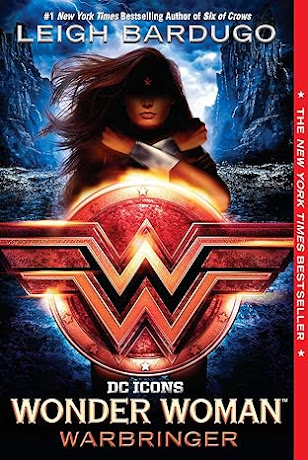
WONDER WOMAN: WARBRINGER: DC ICONS (audiobook) by Leigh Bardugo


Published in 2017 by Listening Library.
Read by Mozhan Marno.
Duration: 11 hours, 56 minutes.
Unabridged.

D.C. Comics' DC ICONS series creates a new YA version of their flagships character's origin stories. DC went out and found established YA authors and let them do their thing in books like Wonder Woman: Warbringer.

Leigh Bardugo is an established YA fantasy author and she brings that vibe to

the story of Princess Diana of Themyscira, the character who will eventually be better known as Wonder Woman.

Diana is a teen that lives on the island of the Amazons - female warriors who died in battle but were reborn on Themyscira, where they can no longer intervene in the lives of mortals. Her mother is the queen of the island. Diana witnesses an explosion of a ship off the coast of Themyscira and breaks the rule of non-intervention by rescuing the sole survivor, a teenage girl and brings her back to the island.

And then everything started to fall apart...

This book borrows a lot on themes of Greek mythology without feeling the need to be beholden to it. It has a nice surprise twist at the end but it moves a little slow at about the 1/3 mark. That makes for a rating of 4 stars out of 5.

Mozhan Marno read the audiobook and she did a great job of creating different voices and creating a sense of drama. The action scenes had a lot of zing and she helped create that.

This audiobook can be found on Amazon.com here: WONDER WOMAN: WARBRINGER: DC ICONS (audiobook) by Leigh Bardugo.

CLEANING the GOLD: A JACK REACHER and WILL TRENT SHORT STORY by Karin Slaughter and Lee Child


Published in 2019 by HarperAudio.
Read by Eric Jason Martin and Jeff Harding.
Duration: 2 hours, 4 minutes.
Unabridged.


The title says this is a short story, but the print version of Cleaning the Gold is 129 pages and I would call that a novella.

Karin Slaughter's Will Trent character works with the Georgia Bureau of Investigation. He is working on a cold case murder based on the activities of the very first Jack Reacher novel, The Killing Floor. Trent is looking for Jack Reacher based on a 20 year old DNA sample.

Reacher is working in Fort Knox and Trent assumes an undercover identity to
Pallets of gold in Fort Knox - they are featured
in the audiobook.
find him...

The book is all written in third person with Slaughter writing the Will Trent sections and Child writing the Reacher sections.

Lee Child is one of my favorites, but Karin Slaughter is certainly not. In fact, she's one of the few authors I refuse to read any longer. Just to compare, including this review I have reviewed 26 Jack Reacher books or short stories and just 3 Karin Slaughter books. This novella suffers from being mostly written by Karin Slaughter.

The readers were okay. One read for Will Trent, the other for Jack Reacher. The reader for Jack Reacher was doing his best to sound like Dick Hill, the reader that has read most of Lee Child's audiobooks.

In the end, this wasn't much of a story. There were amusing observations about Jack Reacher, but the story wasn't much. Reacher did most of the work and even then they made leaps of deduction that I couldn't fathom.

I rate this audiobook 2 stars out of 5 (mostly because of the aforementioned observations about Reacher and the fact that I learned a few things about the gold reserves at Fort Knox. I can only recommend it if you are trying to round out your Jack Reacher or Will Trent collection. This audiobook can be found on Amazon.com here: CLEANING the GOLD: A JACK REACHER and WILL TRENT SHORT STORY by Karin Slaughter and Lee Child.

AMERICAN HERITAGE: GREAT MINDS of HISTORY interviews by Roger Mudd


Published in 1999 by Wiley and Sons.

Roger Mudd, formerly of CBS and NBC news, interviewed five historians about their special topics of expertise. They are all solid interviews that allow the historians to tell why their topics are important. Mudd does a great job of letting the interviews flow along a natural conversational path, but he does interrupt with questions that ask for clarification or challenge a point.

The historians are: Gordon Wood discussing the American Revolution; James McPherson discussing the Civil War; Richard White discussing Westward Expansion; David McCullough discussing the Industrial Era; and Stephen Ambrose discussing World War II/Eisenhower/Nixon.

This was a lot like sitting down with a talented professor in a coffee shop and letting him/her go on about their favorite topic. They weren't lectures, but more like a conversation. I know the work of four of these five historians and have read quite a bit of McCullough, Ambrose and McPherson.

McPherson is my favorite of these three since he and I share a deep interest in the Civil War. I was surprised to learn that he came to study the Civil War later than I thought. McCullough's interview is interesting because of his wide-ranging interests. He discussed the Industrial Era, but he has done a lot of work outside of that time as well, including a great biography of Truman and a history of just the year 1776 during the American Revolution. Ambrose's interview very much felt like my previous impressions of Ambrose - great historian, occasionally a prickly personality.

I rate this book 5 stars out of 5. Very enjoyable read. It can be found on Amazon.com here: AMERICAN HERITAGE: GREAT MINDS of HISTORY interviews by Roger Mudd.

LIVING DOLLS: THE RETURN of SEXISM by Natasha Walter


Published in 2010 by Virago Press.

Natasha Walter is an English feminist who is looking at how modern culture treats women. She has two main points in Living Dolls: The Return of Sexism. I will reverse the order of their presentation in my review.

Her second main point is the new belief in biological determinism, meaning men and women have areas that they are naturally better at - and that fact overrides everything.

She notes that the scientific studies that this belief is based on have never really
The author, Natasha Walter
been scientifically proven, meaning that they were limited and not replicated on a regular basis. Some have never been replicated even once.

The danger is that people just assume things like "girls aren't good at math" and "men can't take care of babies or children" and they become reality. I see it in the classroom all the time - parents tell their kid they struggled with a certain class and they understand if the kid struggles and the kid struggles. It's a self-fulfilling prophecy.

The main point that she presents at the beginning of the book is more complicated and controversial. She laments that modern Western culture's willingness to affirm female sexuality has, all too often, been appropriated by men to promote male sexual fantasies. She interviewed a lot of women for this book and makes a compelling argument that men have co-opted this idea to encourage women to strip, pole dance, make porn movies and basically do over thing that used to be considered damaging to women -all in the name of feminism.

Her argument is not that female sexuality is a bad thing, but rather that it has become, for too many, the only tool that women have to get ahead. Or, going back to that theme of a self-fulfilling prophecy, too many women think that sex is their only way to get ahead in the world.

She hints at, but never quite labels another way these two thoughts go together. Could it be that the biological determinism theme is reinforcing her argument from the beginning of the book by taking options away from women so that they feel that they have to fall back on sex to get ahead?

This was an interesting book, even if I am reading it as an outsider (being a male). I flew through it. I rate it 5 stars out of 5. It can be found here: LIVING DOLLS: THE RETURN of SEXISM by Natasha Walter.

THE STORY of the CHEROKEE PEOPLE by Tom B. Underwood


Originally published in 1961.


According to the price tag on this book, I picked it up at a souvenir store in The Great Smoky Mountains National Park. I couldn't tell you when for sure, but my best guess is that it was about 45 years ago. This is a small book, almost like a large children's book, so it just moved along with me wherever I went and I never read it until now.

The cover of the book is deceiving. The cover looks like it was written for small


children (that is most certainly how I acquired it) but the pictures in the book are much more detailed and complicated, much more like those found in an old-fashioned encyclopedia or an old-style museum. The text is certainly not written for small children, although it does have a slightly paternalistic tone. It feels dated.

The one really strong feature to this book is a seven page testimony about the Trail of Tears from Private John Burnett. Burnett was ordered to accompany the Cherokee because he could speak their language. The inclusion of his story brings the rating for this book up to 3 stars out of 5.

This book can be found on Amazon.com here: The Story of the Cherokee People by Tom B. Underwood.

Featured Post

<b><i>BAN THIS BOOK (audiobook)</i></b> by Alan Gratz

Published in 2017 by Blackstone Audio, Inc. Read by Bahni Turpin. Duration: 5 hours, 17 minutes. Unabridged. My Synopsis Ban This Book is t...

Popular posts over the last 7 days