PERSUADER (Jack Reacher #7 ) by Lee Child


Originally published in 2003.

Note: Lee Child wrote his books out of chronological order. In chronological order, this would be book #10.

This book starts out with a very different sort of introduction. I don't want to spoil it so I will skip ahead a bit.

Reacher is out to get a man who he thought he killed years before. He has some sort of business arrangement with a family with underworld connections in Maine that lives in a castle-like mansion on the coast. Reacher works his way inside the organization and waits for his opportunity. Also, he is on the lookout for a missing DEA agent who is thought to have been kidnapped by the organization and is being held somewhere.

Reacher is not sure who he can trust as he tries to figure out what is really going on...

This story is more complicated than most Reacher stories. The action is ridiculous, as always - but that's one of the reasons you read a Jack Reacher book.

I rate this book 4 stars out of 5. It can be found on Amazon.com here: Persuader by Lee Child
.

THE MARROW THIEVES (audiobook) by Cherie Dimaline


Published by Kobo Originals in 2018.
Read by Meegwun Fairweather.
Duration: 7 hours, 11 minutes.
Unabridged.


In The Marrow Thieves, it is the latter half of the 21st century and the world has had a series of literal upheavals. Earthquakes sheared off California, global warming has changed the weather. Droughts occur in former wet spaces and dry places have become swamps. Sea levels have risen and drowned out many cities. Many animal species have died off and others are in severe decline. On top of that, the nations of the world have gone to war and most cities were destroyed, people have fled to the remaining cities. The entire world map has been re-drawn.

In the future there is also another problem. Almost everyone in the world has
The author, Cherie Dimaline.
lost the ability to dream. Everybody except the indigenous population of the Americas - Native Americans. However, their bone marrow can be harvested for a substance that lets other people dream. The government and the Catholic Church have joined together to "recruit" people for this project. That sounds harmless enough in theory, but in practice it means hunting them down, capturing them and taking them off to concentration camps.

Frenchie is a teenager. He and his family fled the city to go north to their people's original homelands. On the way, Frenchie lost everyone in one way or another. Alone, he stumbled into the camp of survivors who were also pushing north. An old woman, a middle-aged man, a smattering of young men and women and a little girl. This is their story.

I liked this book quite a bit. The characters were great and the ups and downs are truly roller coasters for the listener. Meegwun Fairweather did a great job with the reading.

The only problem I had with the book was the reason why the Native American populations were being hunted in the first place. There is no reason giving for almost everyone losing the ability to dream and no explanation for how the government is able to distill a substance from Native Americans, but somehow not able to chemically replicate this substance. This could have been a fatal flaw, but the strength of the characters carried it past this problem.

I rate this audiobook 4 stars out of 5. It can be found on Amazon.com here: THE MARROW THIEVES (audiobook) by Cherie Dimaline.

This book was placed on a massive book ban list in Florida, a place well-known for banning books. Ugh.

SUPERMAN: DAWNBREAKER: DC ICONS (audiobook) by Matt de la Peña


Published by Listening Library in 2019.
Read by Andrew Elden.
Duration: 7 hours, 28 minutes.
Unabridged.

Set in modern America, Matt de la Peña's Superman: Dawnbreaker: DC Icons delivers a traditional Superman origin story with a little bit of a twist. This book follows along the line of the Smallville TV show, with Metropolis being within driving distance of Superman's Kansas hometown instead of basically being a stand-in for New York City.

Big things are going on in Smallville. A tech firm has moved in, bringing in lots of jobs and a new corporate headquarters. They also are buying up farm land. And, a new smaller company has come in as well. Also, LexCorp is sniffing around. Smallville is considering passing a law requiring people suspected of being illegal immigrants (there is a burgeoning Hispanic population who serve as farm workers and work in a meat processing plant) to produce papers on sight and Hispanic men are disappearing.


Clark Kent has always been amazingly strong, but that could be passed off because we all know people that seem to be freakishly strong. But, Clark noticed something was radically different when he played on his Freshman football team. He dominated with an unprecedented number of touchdowns, but decided to quit football when he severely injured a teammate during a practice. 

When this book begins, Clark has no idea that he is not from Earth. His powers are starting to manifest now that he is getting older, often to his dismay, but they are intermittent. So, unlike in most Superman stories, those formidable powers are not dependable - and things are coming to a head in Smallville...

I really liked this audiobook. Matt de la Peña is an experienced YA author and you can tell. DC made a great choice when they chose to hire an experienced author to tell a coming of age story of their most iconic superhero. The story would be a good story if you removed all of the Superhero elements, which is a great place to start.

Andrew Elden did a good job as reader with the voices and the few accents that would be found in Smallville, Kansas.

I rate this audiobook 5 stars out of 5. It can be found on Amazon.com here: 
SUPERMAN: DAWNBREAKER: DC ICONS by Matt de la Peña.

HARRY POTTER and the SORCERER'S STONE (Harry Potter #1) (audiobook) by J.K. Rowling


Originally published on paper in 1997 by Scholastic.
Originally published as an audiobook in 1999.
Published in 2015 by Pottermore.
Read by Jim Dale.
Duration: 8 hours, 18 minutes.
Unabridged.


Truth time. This was my first time with the book form of Harry Potter. I'd seen the first movie and maybe the second, but never actually read or listened to any of them. This is a big deal for me because I am generally a fan of the wonderful world of nerd stuff. 

I will dispense with the plot stuff since just about everybody, even me, knew the bare outline - orphaned wizard boy with no friends and hated by his relatives that took him in, special magic school, Quidditch, and a creepy bad guy that killed the boy's parents.

So, what did I think?

This book is so adored and so talked up that it couldn't possibly live up to the hype. But, I liked it. I am looking forward to the other books. It is my understanding that they get more complicated and I certainly don't know the plots of the other books (beyond the annual attack by Voldemort).

Jim Dale read the audiobook version I listened to because it was the American version. The British version is read by Stephen Fry. Jim Dale's voices were all solid except for Hermione. She consistently sounded shrill and whiny.

I rate this audiobook 4 stars out of 5. It can be found on Amazon.com here:  HARRY POTTER and the SORCERER'S STONE (Harry Potter #1) (audiobook) by J.K. Rowling.

Note: this entire book series has been on banned book lists multiple times since it was originally published due to complaints from religious conservatives. Check out this website for more info.

I CONTAIN MULTITUDES: THE MICROBES WITHIN US and a GRANDER VIEW of LIFE (audiobook) by Ed Yong


Published by HarperAudio in 2016.
Read by Charlie Anson.
Duration: 9 hours, 52 minutes.
Unabridged.


Ed Yong takes his readers (or, in my case, listener) into the tiny world of microbes in I Contain Multitudes. Traditionally, we think of microbes as tiny invaders that make us sick and, as I sit at home after yet another day of social distancing, it is easy to see it that way.

But, Yong takes us into a more complicated world. A world where microbes actually benefit their larger hosts - where microbes can help produce scents or colors for attracting a mate, help guts break down leaves or nuts and even help their hosts survive poisons. In many cases, these microbes and their hosts co-evolved and have become dependent on one another. They have created their own microbiome.

But, it's not that simple, either. Sometimes the microbes affect their host's behavior - and not in a good way. They can turn insects into virtual zombies, they can make mice hyperactive or depressed. They can even make mice suicidal (there is a microbe that resides in the guts of cats. It makes mice confuse the smell of cat with the smell of a mouse that is ready to mate. The mouse runs to the cat, gets eaten and the microbe is happily deposited in the gut of a cat. )

Yong's real message is that there are no good microbes or bad microbes. There are microbes that are good in some places and horrible in others. Your gut microbes, for example, are usually great, but if you have a leak in your gut, those microbes can kill you - and do it in a hurry.
Yong does explore relatively new ideas, such as the idea that gut microbes can change mental attitude, weight, cravings for certain types of food and more. It is true, but it is also true that it is certainly not as easy as it sounds. Some combinations of microbes work with some people with some foods in some situations. All of these combinations make it tricky.

Also, those probiotic yogurts that are so popular do nothing to help. It's not because they aren't helpful, but that you would have to eat A LOT of yogurt and keep doing it to actually change your gut biome.

I was intrigued by a discussion of the traditional concept of infection and how to avoid it. Turns out, if you use a medicine or a cleaner that kills all microbes, it can allow infection because the proper microbes aren't present to crowd out (or even kill) the microbes we consider dangerous. Also, if you want to build a strong immune system in your kids - get a dog.

This book was full of interesting information. At times, it was tremendously interesting. But, at two different times in the book, I seriously considered quitting the book. It has a slow start and a big lull about a third of the way through. For that reason, I am rating this audibook 4 stars out of 5. It can be found on Amazon.com here: I CONTAIN MULTITUDES: THE MICROBES WITHIN US and a GRANDER VIEW of LIFE (audiobook) by Ed Yong.

FUNNY, YOU DON'T LOOK AUTISTIC (audiobook) by Michael McCreary


Published by Annick Press in 2019.
Read by the author, Michael McCreary.
Duration: 3 hours, 37 minutes.
Unabridged.


Michael McCreary is a pretty unique thing in this world - a stand-up comic who is on the autistic spectrum. He uses the word Asperger's to describe himself in promotional materials.

But, one of McCreary's points in this book and in his shows is that he is not all that unique. People on the autistic spectrum are not necessarily like the Dustin Hoffman character in Rain Man. McCreary cautions his readers not to assume too much and think that everyone is on the autistic spectrum. He has compulsive behaviors that are more than the average person would experience.

McCreary has some genuinely funny moments in Funny, You Don't Look Autistic, but for me I got the most out of this as a teacher. It is not unusual to have students on the spectrum in my classes, and listening to this very self-aware talkative former student talk about his experiences shed a little light on the matter. It's not like I can go up to one of my students and say, "Hey, you're autistic. How's that going for you?"

On the other hand, this memoir felt like it was just too rushed, and that falls right back to McCreary's compulsive behaviors. Once he gets an idea in his head, he pushes forward until he gets it done. I can see him wondering what he could do besides act and perform stand-up and this book idea just popped in his head. After all, comics write books all of the time.

The author, Michael McCreary
The problem is, McCreary isn't even 30 years old. He's not even close to 30 years old. Some of the things that he talks about are interesting and many of his stories would certainly not make the cut or even be considered if a 50 year old Michael McCreary was writing this book. Most are cute, but not compelling. He simply hasn't lived enough of a life to fill a book with compelling stories, even a little 176 page book.

So, in the end, I rate this book 3 stars out of 5. It has its moments, a few funny lines and a tough story towards the end, but it still isn't must-read material. It can be found on Amazon.com here: FUNNY, YOU DON'T LOOK AUTISTIC by Michael McCreary.

Great quote from the book: "Every time a system is changed for the better, it's because of someone saying, 'I have a problem,' loudly enough."

ROANOKE: THE MYSTERY of the LOST COLONY by Lee Miller


Published in 2007 by Scholastic Nonfiction.
Suggested for readers grades 9-12
.

I've read my fair share of articles about the lost colony of Roanoke. They all have a similar story line. They tell the story from the colonists' point of view. And why wouldn't you tell it that way? It's a compelling story when it is told that way. Roanoke: The Mystery of the Lost Colony comes at this story differently - it incorporates the court politics back in England and the mixed motivations for creating the coloy in the first place.

If you are not familiar with the story. Roanoke was England's first serious attempt to put a colony in the New World. It originally had a duel purpose. The first was simple enough. Sir Walter Raleigh had legal claim to the land as part of an inheritance, but only if he could establish a permanent colony on it by 1591. It was an immense piece of property, if he could keep it. It would have included all of the North American coast north of Spanish Florida and south of Newfoundland.

The second purpose of the colony was to provide a protected port to allow English ships to attack Spanish galleons full of gold, silver and other riches. The barrier islands of North Carolina looked like a perfect fit.

But, Raleigh was not allowed to supervise the colony because he was required to stay in the Queen's court, at her request (or demand - she was a queen, after all). So, he sent out a military-type expedition in 1585. It failed, but it did offer some valuable information for the next attempt in 1587. 

A painting by John White. 

John White participated in the 1585 venture as the expedition's artist. His paintings and maps fill this book and most are quite beautiful. in 1587, White led the second attempt to start a colony. If you have studied the original English colonies, you will recognize the familiar pattern - the colony struggles with the local environment and the local people, sends for more supplies and more people and will go on to grow and prosper.

Except that Roanoke sent for more supplies and more people but none were sent out to reinforce the colony...

As I alluded to above, most stories of Roanoke spend a lot of time looking at where the missing colonists might have gone but gloss over why the English never sent more supplies and more people. Lee Miller focuses on the intrigue in the Elizabethan Court and how Raleigh was prohibited from sending out relief supplies. I thought this was a fascinating take on the story. It becomes a story of backroom deals, spies, betrayal and desperation.

John White was convinced to leave behind his family in late 1587, including an infant granddaughter, to personally ensure that the relief supplies were delivered and he was stymied at every turn. By the time he returned almost three years later the colony was gone with only a couple of mysterious clues as to where they may have gone. They were never found and England didn't successfully plant a colony until 1607.

I rate this book 5 stars out of 5. It can be found on Amazon.com here: ROANOKE: THE MYSTERY of the LOST COLONY by Lee Miller.

HERODOTUS: ON the WAR for GREEK FREEDOM. Translated by Samuel Shirley and James Romm. Edited by James Romm.


Published in 2003.

Originally published about 440 B.C.


Herodotus, if you don't know, is widely considered to be the West's first historian. He investigated and wrote about the rise of the Persian Empire and the Greco-Persian wars that came as a result of a struggle over Hellenic city-states on the Mediterranean coast of modern-day Turkey. Persia took them over and Athens inspired them to rebel, only to be re-conquered. After that Persia led three separate invasions of modern-day Greece by land and by sea, taking Athens twice but eventually being defeated all three times.
Herodotus (484-425 B.C.)


There are many familiar stories in Herodotus: On the War for Greek Freedom, including the Battle of Marathon (the inspiration of our modern marathon run because a soldier ran the 26.2 miles from the battle to Athens to tell the results of the battle and then died) and the Battle of Thermopylae where the 300 Spartans held off a massive Persian army.

Herodotus also attempts ethnographic studies of several cultures in from Egypt all of the way to the Black Sea. Some are pretty accurate from what we know nowadays, some are clearly quite ridiculous.

The editor, James Romm, edited Herodotus' nine volume set of histories to include just the background for the Greco-Persian wars, the three invasions and a little of the aftermath. Often, he includes a well-written summary to bridge together the pieces. It is intended as an introduction to Herodotus.

I am rating this book 4 stars out of 5. I found Herodotus' style to be a little stilted, much like reading the historical books of the Old Testament, like 1st and 2nd Kings. Sometimes, the stories have real zing, sometimes they're tedious description. Nonetheless, the sheer importance of Herodotus (his name came included in my spell check) and his work makes me raise my rating to 4 stars.

This book can be found at Amazon.com here: HERODOTUS: ON the WAR for GREEK FREEDOM.

A PILGRIMAGE to ETERNITY: FROM CANTERBURY to ROME in SEARCH of a FAITH (audiobook) by Timothy Egan


Published by Penguin Audio in 2019.
Read by the author, Timothy Egan.
Duration: 12 hours, 42 minutes.
Unabridged.


At the beginning of this pilgrimage, author Timothy Egan describes himself as a lapsed Catholic, perhaps even an agnostic. He was raised Catholic in Washington State and decided to go on a long-established pilgrimage route called the Via Francigena to contemplate his faith and how the church has betrayed its own faithful with the ongoing sexual abuse scandal.

The Via Francigena runs from the cathedral at Canterbury in England, through France and Switzerland into Italy and ends in Rome at the Vatican. It is one of the most established pilgrimage routes in Europe, but not as well known as the Pilgrimage of Compostela in Spain. 


Egan gives the listener little history lessons as he tells the story of his own pilgrimage through Europe. Those are usually interesting and informative. He tells his thoughts about faith and Christianity as he travels as well. When possible, he initiates discussions with the clergy as he travels. Sometimes, that works out well, other times you wonder why the clergyman became a minister. His best discussion is with a Lutheran minister in Switzerland.

While he is a lapsed Catholic, Egan does not focus solely on Catholicism. He discusses the Anglican Church, the French Huguenots, Martin Luther, and John Calvin as well. He is fair with Martin Luther, discussing the good and the bad. John Calvin gets bad marks most of the way around, but that is par for the course (and well-deserved, in my opinion).

While I enjoyed the history lessons, religious discussions, including discussion of Egan's struggles with the faith, his mother's faith and how he saw her relationship with the church and his discussions with his wife and children, I did not enjoy the culinary information that he threw in as well. It was an extra layer of detail that didn't fit with the overall theme of the book. Religion and historu go hand in hand. Religion and discussion of pasta don't. It just bogged the book down, in my opinion.

The audiobook was read by the author, Timothy Egan. He was so good that I didn't realize that he read his own book until I looked up the information to write this review.

I rate this audiobook 4 stars out of 5. It can be found on Amazon.com here: A PILGRIMAGE to ETERNITY: FROM CANTERBURY to ROME in SEARCH of a FAITH by Timothy Egan.

THE RUNNING MAN by Stephen King writing as Richard Bachman


Originally published in 1982.

Published in 2010 by Simon and Schuster.

Read by Kevin Kenerly.
Duration: 7 hours, 42 minutes.
Unabridged.


Stephen King's long and storied career is legendary. At this point, he has 61 novels, including 7 written under the pen name Richard Bachman. At first, he wrote books under the Bachman pen name because the publishing industry had a rule of thumb - no more than one book per year per author. Clearly, with a prolific author like Stephen King that rule would be problematic. This edition of The Running Man includes an essay by Stephen King that talks about Richard Bachman and his relationship with his pen name.

The Bachman books have a darker tone than the Stephen King books by design. The Running Man has a particularly dark tone. Set in 2025 in an alternate history (even though it was written in 1982, it refers to things in 1978 that did not happen) in which America has become a corporate oligarchy.

The economy is ruled by a company called General Atomics (presumably a mixture of General Electric and General Motors) and the Games Network. 
Every house, every apartment, every hotel room, no matter how broken down, is wired with a working cable TV system called Free-Vee. The Games Network runs a series of violent, often deadly, game shows that are designed to keep the great underclass entertained and quiet (think: Roman "Bread and Circuses").

Ben Richards lives in a horrible neighborhood called Co-op City. He can't get work because he has been blacklisted for complaining that his job at General Atomics was giving people radiation 
poisoning. His wife can only earn money through prostitution and they desperately need money. Their 18-month child, the only child they will ever have because Ben is now sterile due to radiation poisoning, is dying from pneumonia. Any decent medicine costs more than they have any hope of scraping together.

Ben decides to try out for one of the game shows. His surly attitude, intelligence and physical stature qualify him for the most lucrative and most dangerous game show: The Running Man. In this show, the contestant becomes an enemy of the state and is given a 12 hour head start before the Games Network releases its crack team of investigators and killers. Anyone who gives the Games Network information leading The Running Man's death or capture will receive a big reward, including police officers. The longer he runs, the more money he makes. If he makes it 30 days, he will receive $1 billion. No one has ever made it more than 8 days, 5 hours.

But, then again. no one's every had to go up against Ben Richards before...

This is a tough book. It is unrelentingly depressing, even for a novel featuring a dystopian future. Ben Richards is an impressive, but generally unlikable character. For me, the most interesting thing was the gradual revealing of the larger setting of America in 2025.

Kevin Kenerly read the book and did an excellent job.

Note: this book does not follow the same plot as the Arnold Schwarzenegger movie of the same title. That book was the inspiration for the movie, but, at best, you could argue that they could have taken place in the same universe.

I rate this audiobook 4 stars out of 5. It can be found on Amazon.com here:  THE RUNNING MAN by Stephen King writing as Richard Bachman.

Note: In November of 2023 it was announced that the group Moms for Liberty had challenged hundreds of books in Florida. This book was one of those books. Learn more about the list here.

NEVER ALONE: A PERSONAL WAY to GOD by the AUTHOR of JOSHUA by Joseph F. Girzone


Originally published in 1994.

Joseph F. Girzone (1930-2015) discusses faith, prayer and God in this short book. Girzone is best known for his book Joshua, a powerful and effective re-telling of the Jesus story in the modern world. NEVER ALONE: A PERSONAL WAY to GOD is a pleasant read, but it doesn't deliver the emotional impact of Joshua.

For me, the strongest part of the book was his discussion of how the modern church is great on staking out positions on social issues, but they miss "...the fundamental purpose of religion, to foster and mold spirituality among its members..." and "...to teach their people the ways of prayer and how to develop a deeper intimacy with God." (p. 8)

He continues, "We are brought up to follow unquestioningly the practices of our religion, whatever our denomination." This has value, but too often we "...are not familiar with the message as Jesus delivered it." Following the practices of a religion are a "way of life" but "...not an immediate personal relationship with Jesus." (p. 24)

The author
Girzone goes into his personal story, which has a lot of twists and turns. He planned to go a certain way his career as a Catholic priest, but it didn't work out that way. At age 51, he was forced to retire due to health reasons. Ironically, that is when he became a much more effective minister through his books, beginning with his 1983 book Joshua. He continued on with more than 20 books, a movie, a center to teach people all over the world about Jesus, and a philanthropic foundation.

Girzone also writes about spiritual maturity and how it is achieved. If you are searching for a quick arrival at spiritual maturity, that is not the way it works. It requires "dark nights and humbling experiences" that change "our attitudes toward ourselves and toward others." Those experiences teach us about our own frailties and give us "a new appreciation of other people's struggles and experiences. This gives us a tolerance and an understanding we did not have before, and deepens our compassion for the pain and anguish others are going through on their way to God." (p. 110)

I rate this book 4 stars out of 5. It can be found on Amazon.com here: NEVER ALONE: A PERSONAL WAY to GOD by the AUTHOR of JOSHUA by Joseph F. Girzone.

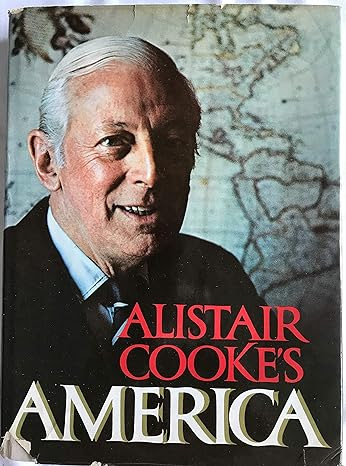
ALISTAIR COOKE'S AMERICA by Alistair Cooke


Published in 1973.

In 1973, undoubtedly to prepare for the upcoming 1976 bicentennial of the American Declaration of Independence, BBC reporter and author Alistair Cooke released a book and a television mini-series telling the history of the United States to the U.K. The book and the series came to America as well with the book selling nearly 2 million copies. This massive "coffee table" type book has 393 pages and weighs in at 3 pounds, 9 ounces (compare that to a random paperback book I weighed at just 5 ounces).

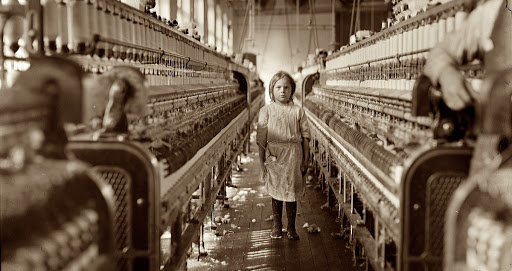
Photo by Lewis Hine
Cooke presents a straight-forward history of America, skimming over lots of details but getting the highlights. This has to be the case when you cover more than nearly 500 years of history in less than 400 pages. He focuses half of the book on the exploration/colonial/Revolutionary War/Constitutional era and it is by far the strongest part of the book.

This book is filled with beautiful, sometimes profound photographs. On pages 312-313 there is a two page spread of a lynching. Cooke claims that "no one knows who took this picture, or exactly when." (p. 311)   It was taken by Lawrence Beitler in Marion, Indiana on August 7, 1930. Beitler sold this photo for 10 days straight to sell as souvenirs of the lynching. Here is a link to a great book on the topic: 
A Lynching in the Heartland: Race and Memory in the Heartland by James H. Madison. Here is a link to the Wikipedia page on this lynching: Lynching of Thomas Shipp and Abram Smith.

The photograph of the girl working in a clothing factory in North Carolina is another great photograph in book full of great paintings and photographs. I have included it in this review.


It is very readable, but clearly a product of its time, and Cooke is a reporter, not an historian. The book has a bit of a racist feel to it. For example, when discussing where the United States lays on the globe (not too hot, not too cold), he notes: "...the United States spans the limits of the climates that white men can live and work in." Cooke mostly skips over the Native American civilizations that inhabited the Americas before Columbus. He spends almost as much time discussing entertaining but mostly nonsensical theories about the Phoenicians settling in the Americas as he does the actual Native American civilizations themselves. Cooke's reasoning is that he is covering a history of the United States itself, so Native Americans get the short end of the stick, except as an impediment to American expansion for the first 2/3 of the book.

Cooke does a similarly poor job dealing with African Americans, a group that he cringingly calls "the blacks" throughout. 
He does, however, clearly observe (in a clunky manner) that slavery and the continuing racial prejudice against African Americans is an ongoing open sore and has never been dealt with properly.

Final rating - 4 stars out of 5, keeping in mind that this history book is clearly old enough to be an historical artifact itself.

It can be found on Amazon.com here: 
ALISTAIR COOKE'S AMERICA by Alistair Cooke.

RANGE: WHY GENERALISTS TRIUMPH in a SPECIALIZED WORLD (audiobook) by David Epstein


Published by Penguin Audio in 2019.
Read by Will Damron.
Duration: 10 hours, 17 minutes.
Unabridged.


In Range David Epstein presents a strong argument that lateral thinkers (people that know a little about a lot of things) are stronger members of a team than the experts that know a whole lot about a narrow subject.

He also argues that people who pick a specialty later in life have a wider perspective on things and can bring fresh ideas into a stale discussion.

I literally have no problems with anything he says in this book, but I did find the book to be poorly put together. It just rambles along from one (usually, but not always) interesting topic to another and makes all of them about 30% too long. 

So, I am going to rate this book 3 stars out of 5. It can be found on Amazon.com here: RANGE: WHY GENERALISTS TRIUMPH in a SPECIALIZED WORLD


TRESPASSING ACROSS AMERICA: ONE MAN'S EPIC, NEVER-DONE-BEFORE (and SORT of ILLEGAL) HIKE ACROSS the HEARTLAND (audiobook) by Ken Ilgunas


Published by Blackstone Audio in 2016.
Read by Andrew Elden.
Duration: 7 hours, 44 minutes.
Unabridged.


In 2012, Ken Ilgunas embarked on a 1,900 mile hike from the beginning of the proposed Keystone XL pipeline in Alberta, Canada to its terminus on the Gulf Coast of Texas.  He did this because he is opposed to the pipeline and is very concerned about the expanded use of fossil fuels, the environmental damage caused by the mining of oil sands and the potential for spillage from the pipeline. Along the way, he blogs about his experiences with his iPad in the hopes of creating a little buzz about the topic.

He was inspired to do this by a series of conversations he and a friend had during a stint in the kitchen at a Prudhoe Bay oil drilling site. They were going to hike the entire length together, but his friend begged off and fell into a support role, occasionally mailing him food and replacement pieces of equipment and boots (he went through 3 pairs of boots on this hike).

Ilgunas got off to a late start and began hiking as Canada was going into winter, meaning that he faced cold weather and snow almost all of the way through his hike. He tried to follow the path of the pipeline as much as possible in order to save time and to cut back on the amount of miles he would have to walk. The pipeline starts out with a south-east direction and he often walked along its proposed path through pastures and empty fields for miles. The new pipeline will follow a smaller pipeline route that currently exists in many places so it was pretty easy to follow. Other times, he stuck to the roads, especially when the pipeline takes a more due south path in the United States. That is because most roads in Plains states run north-south or east-west, like a giant checkerboard.

He meets a lot of animal life, including moose, coyotes, lots of dogs and cows. Lots and lots and lots of cows. He almost gets killed in a cattle stampede at one point.

Different states have different personalities, it seems. In Canada (yes, I know Canada is not an American state, but just go with it), no one seems to care where he walks. Montana and South Dakota have lots of no trespassing signs, but no one really seems to care much. Ilgunas becomes a mini-celebrity in Nebraska, despite a rough start where he is escorted out of the county (well, almost all of the way) by a deputy on the orders of the sheriff. Those few miles are the only part he didn't walk. He attends an anti-pipeline rally, gets a few local media interviews and for the rest of his hike in Nebraska he is welcomed as the "guy who is hiking the pipeline".

In Kansas, however, his celebrity status evaporates and he gets consistently hassled by the police. He is asked for his ID in Kansas more than he is on the rest of his trip combined.  Oklahoma depresses Ilgunas. It has a massive pipeline junction -  a place that should be well off since everyone says pipelines bring jobs. In his mind, the town where all of the pipelnes meets is the saddest town on his whole hike. 
Keystone Pipeline construction in South Dakota


Along the hike he usually avoids discussions of the topic of global warming since this is a very conservative area that doesn't buy into that theory. As he hikes, he is consistently told that the pipeline will create lots and lots of jobs, but he literally doesn't meet a single employee except at the very end and at the very beginning. But, people across Montana, South Dakota, Nebraska, Kansas, Oklahoma and Texas swear that it will create jobs all along the way.

Ilgunas doesn't really have an answer to the problem of petroleum's ubiquitous role in our society. His tent, his hiking poles, his shoes, and his iPad all have plastic made from petroleum in them. Nor does he address how radically more expensive energy will affect the poor. He talks about how the Ogallala Aquifer is being depleted by its use to make farming on the Great Plains possible. But, he doesn't talk about how that food would be replaced if we didn't farm on the Great Plains.

It's not that I necessarily disagree with any of his points, but the lack of answers, or even suggestions, by Ilgunas is frustrating.

The area he hikes through is certainly part of the Bible belt and Ilgunas finds his anti-Christian bias challenged by the number of people who offer to help him. He points out that only one person evangelized him (a creepy minister in Oklahoma), but the other people of faith shared their food, their homes, their electricity to charge his devices, their wi-fi and their time because they genuinely loved helping others. Ilgunas would arrive in town and search up the local pastor for help in finding a place to pitch his tent. Often, they offered spare rooms, floor space in the church and even once in a loft area in the sanctuary. This made a much more profound impact than the perfunctory hardball Christian sales pitch he received from the minister in Oklahoma.

Andrew Elden read this book and did quite a good job.

When I started listening to this book, I quickly tired of Ilgunas' writing style, which really should be described as an over-writing style. He over-described everything and really tried too hard to create a mood for every scene. Either I got used to it, or he cut back on it. It's not a perfect book, but I do give this book 4 stars out of 5.

This book can be found on Amazon.com here: TRESPASSING ACROSS AMERICA: ONE MAN'S EPIC, NEVER-DONE-BEFORE (and SORT of ILLEGAL) HIKE ACROSS the HEARTLAND  by Ken Ilgunas.


APOSTLES of DISUNION: SOUTHERN SECESSION COMMISSIONERS and the CAUSES of the CIVIL WAR (A NATION DIVIDED: STUDIES in the CIVIL WAR ERA) by Charles B. Dew


Originally published in 2001.


The greatest argument among people who study the Civil War isn't who was the best general or what would have happened if Lincoln hadn't have been assassinated or even what would have happened if the Union had lost at Gettysburg.

No, the greatest argument is this: What caused the Civil War?

For the better part of the last century, the argument has been that the Confederacy seceded in order to protect "their rights". The counter-argument has always been to protect "the right to do what?"

For me, the answer has always been a simple one - they fought for their right to own people and to keep African Americans at the bottom of the heap in Southern society. For the Confederate States of America, slavery was the reason to fight. For the Union army, maintaining the Union, with or without slavery, was the reason to fight - a goal claimed many times by Lincoln himself. 


There will be arguments that claim that Confederate states seceded over differences in culture and differences in attitude and the disagreement over federal tax policy. If you think so, I encourage you to read the Ordinances of Secession (basically Declarations of Independence) from Georgia, Texas, Mississippi, South Carolina and Virginia. They are full of all sorts of reasons to secede, but they keep coming back to slavery-related issues. These are wonderful resources because they are frozen in time, before the loss of the war by the Confederacy. Many post-Civil War authors who fought for the South obscure the importance of slavery, perhaps realizing it was a great moral wrong, or perhaps simply being cognizant that slavery had become politically incorrect and it would hurt their overall argument. Let's face it - many Union soldiers became proud of their role in ending slavery long after the war ended, being indifferent to or even mildly pro-slavery during the war.

 Several of the seceding states did more than issue their own Declarations of Independence. Some of these states sent out ambassadors from their newly independent states to try to convince the other slave states to join them. They were generally referred to as Southern Secession Commissioners. The title of this book, Apostles of Disunion refers to them. The Apostles of Jesus were sent out to teach about Jesus. These apostles were sent out by several secessionist states to to convince the other slave states to join them. Just the fact that they were only sent to slave states should serve as a major clue as to what caused the Civil War.

The texts of their letters and speeches make it very clear that their main arguments were these: fear of the abolition of slavery by "Black Republicans", fear of slave revolt, the loss of the investment of money in their slaves, fear of former slaves having the power to vote and the fear of race mixing. William L. Harris, the Commissioner from Mississippi sent to reach out to the state of Georgia said on December, 17, 1860: "Mississippi is firmly convinced that there us but one alternative: This new union with Lincoln Black Republicans and free negroes, without slavery; or, slavery under old constitutional bond of union, without Lincoln Black Republicans, or free negroes either, to molest us. If we take the former, then submission to negro equality is our fate." (p. 87)


He followed up with a comment about how Mississippi would "...rather see the last of her race, men, women and children, immolated in one common funeral pile, than see them subjected to the degradation of civil, political and social equality with the negro race." (p. 89)

Stephen F. Hale (1816-1862. He served Alabama
as a Secession Commissioner and as a Lt. Colonel
in the 11th Alabama. He died of wounds sustained
during the Battle of Gaines' Mill in 1862.
Hale County, Alabama is named for him
.
Stephen F. Hale of Alabama sent a letter to the Governor of Kentucky to convince him to push for secession. In the letter he calls Lincoln's election "...nothing less than an open declaration of war, for the triumph of this new theory of government destroys the property of the South, lays waste her fields, and inaugurates all the horrors of a San Domingo servile insurrection, consigning her citizens to assassination and her wives and daughters to pollution and violation to gratify the lust of half-civilized Africans."

He continued: "What Southern man, be he a slave-holder or non-slave-holder, can without indignation and horror contemplate the triumph of negro equality, and see his own sons and daughters in the not distant future associating with free negroes upon terms of political and social equality, and the white stripped by the heaven-daring had of fanaticism of that title to superiority over the black race which God himself has bestowed?" (p. 98)

The author of Apostles of Disunion included plenty of similar quotes throughout the book and also includes the entire text of the Harris speech and the Hale letter. He found snippets of speeches and letters from the other Commissioners in newspaper articles and journals and found similar comments to the ones in the complete texts. Combine these texts with ambassadors hand-picked by the newly-seceded states and the Ordinances of Secession and you have the answer to why the Civil War started.


I rate this book 5 stars out of 5. It can be found on Amazon.com here: APOSTLES of DISUNION: SOUTHERN SECESSION COMMISSIONERS and the CAUSES of the CIVIL WAR (A NATION DIVIDED: STUDIES in the CIVIL WAR ERA) by Charles B. Dew.

STARSHIP TROOPERS (audiobook) by Robert A. Heinlein


Originally published in 1959.
Audiobook published in 1998 by Blackstone Audio.
Read by Lloyd James.
Duration: 9 hours, 52 minutes.
Unabridged.

Winner of the Hugo Award for best sci-fi novel of 1960.


Way back when - when I was in high school and Ronald Reagan was President, I used to read a lot of Robert A. Heinlein. Now, as an adult, I find myself all over the place with my ratings of Heinlein, mostly average. With this book, I will have two 5 star ratings, two 3 star ratings and two 2 star ratings. That makes a very mediocre rating of 3.333 out of 5. That would be a C+ on a grading scale and I agree with that assessment.

This book marks the transition in Heinlein's professional career from writing science fiction for kids and young adults to writing for adults. This book was originally supposed to be for kids but the original publisher rejected it so Heinlein shopped it around, found a new publisher and never wrote for kids again.

The book Starship Troopers is a rare book in my opinion. It is a book where the movie is absolutely better than the book, even though the movie is clearly only loosely inspired by the movie. Some sources say the movie was written and the title of the book was attached to it after the fact, and even if that is true, the movie is still better than this book.
Robert A. Heinlein

What's wrong with the book?

-The ratio of literal fascist political lecture by classroom teachers to actual battle action in a book called Starship Troopers is about 2:1. It could just as easily have been called Starship Fascist Lectures.  The lectures go on and on about how democracy was a doomed system and the only way to lead a people was by a system led by people who had served in the military. Throw in a half hour discussion of the proper way to raise children with the threat of a good old fashioned public flogging and you've got the makings of a real disappointment. 

-More than one-third of the book is about basic training. How far they ran, what they ate, where they slept and more for several hours. Sadly, two of the better characters in the book are Johnny Rico's drills sergeant and his captain.

-There was nearly as much in the book about the how the officer's dining room worked on ship as there was actual military action. Just so you know, the army sits on one end of the table, the navy on the other and they sit by descending order with the most junior officers meeting in the middle. Don't give a crap? Neither did I, but Heinlein goes on and on about it like it's extremely important. Maybe it should have been called Starship Dinners.

The audibook was read by Lloyd James. He was fine, but the audio production was sometimes clumsily edited. There were times when you could hear the recording equipment being turned on and off and there were clunky edits where the Lloyd James had gone back and re-read part but it was much quieter and not as crisp sounding as the rest of the book.

I rate this audiobook 2 stars out of 5. The final (and very short) fight scene saves it from being a complete 1 star fiasco. This book can be found on Amazon.com here: Starship Troopers by Robert A. Heinlein.

LEVI COFFIN, QUAKER: BREAKING the BONDS of SLAVERY in OHIO and INDIANA by Mary Ann Yannessa


Originally printed in 2001.

One of my favorite people in history is Levi Coffin. I have visited the Levi Coffin House (an official Historic Site maintained by the state of Indiana) so many times that it feels like I am making a semi-annual pilgrimage when I go.  The thing is, I find myself inspired every time I visit - both as a history lover, a champion of individual rights and as a Christian.

Levi Coffin was an instrumental figure in the Underground Railroad and the abolition movement. He was not simply  a theoretical supporter of the movement that wrote letters and collected donations. He helped more than a thousand slaves escape, many of them spending time in his own home. His home in Indiana was even modified so that he could hide ten or more people at a time, if necessary.

Here is a picture that I took of a great quote from Levi Coffin that is on the wall of the visitors center at his house in Fountain City: 


This short book tells an interesting story of his life from his beginnings in North Carolina to Indiana and finally on to Cincinnati. During his entire life, even as a young man still living at home in North Carolina, he helped slaves escape. He viewed it as his responsibility as a Christian.

But, he even went further than that. He and wife operated a store in Cincinnati that sold goods that were completely free of slave labor, pioneering a concept that many think as a modern incarnation with things like conflict-free diamonds.

During the Civil War, he and his wife opened their home up as a hospital for wounded soldiers, helped find work and schooling for newly freed slaves and helped feed the non-stop flood of refugees streaming away from their masters.

After the war, he continued his efforts for the Freedmen until he finally was too old to do anything any longer.

This book is very approachable and quite an enjoyable read. I am in the midst of a book purge, but this book is staying on my shelf.

I rate this simple book 5 stars out of 5. It can be found on Amazon.com here: 
LEVI COFFIN, QUAKER: BREAKING the BONDS of SLAVERY in OHIO and INDIANA by Mary Ann Yannessa.

DRUNKEN FIREWORKS (audiobook) by Stephen King


Published in 2015 by Simon and Schuster Audio
Read by Tim Sample.
Duration: 1 hour, 20 minutes.
Unabridged.


Stephen King uses the voice talents of Tim Sample, a humorist that specializes in talking about Maine. Fans of Stephen King know that the prolific author loves to set his stories in his home state of Maine. This one is set on the corner of a lake surrounded by vacation homes.

Two families are part of a year-after-year fireworks contest. One is a family from Rhode Island. The other is an older mom and son who grew up in the area and bought their dream home on the lake. They don't know each other well, but their sense of pride get in the way as their desire to "one up" each other gets more and more ridiculous as the years go along.

The folksy manner of the narrator makes this predictable story a lot of fun. It is the perfect matching of author and narrator.

I rate this audiobook 4 stars out of 5. It can be found on Amazon.com here: Drunken Fireworks by Stephen King.


SLEEPING GIANTS (Themis Files #1) (audiobook) by Sylvain Neuvel


Published in 2016 by Random House Audio.

Multicast performance.
Duration: 8 hours, 28 minutes.
Unabridged.

One of my favorite audiobook bloggers wrote a gushing review of this entire trilogy. It was such an enthusiastic review that I almost got all 3 books in the trilogy based on his word alone.

I am glad I didn't.

****Warning: Spoiler Alert****


Sleeping Giants is derivative of two other works of science fiction - and they're not the finest bits of sci-fi. Imagine a mash-up of The Mighty Morphin Power Rangers and Pacific Rim and you've pretty much got this book.

It is like Pacific Rim in that you've got a giant robot weapon that has to be operated by two people at the same time to work. It's like Power Rangers in that certain people have been randomly "chosen" to operate this robot and possibly defend the earth from alien attack.
The chosen ones get to suit up and use the
mighty morphin powerbot in this audiobook.


****Spoilers continue****

The alien threat never materializes and there's an awful lot of weird Cold War politics going back and forth as the United States literally violates the air space of every country on the planet in its quest to find all of the parts of this gigantic mighty morphin powerbot. 


Most of the book, however, doesn't include any action at all. The book is designed to be read as a series of government reports and interviews read and heard one after another to tell the story. Imagine all of the action of reading a report or listening a government after action interview and you get the idea.

This is not to say that this book has nothing going for it, but it is too slow, too unrealistic.

On top of that, I really hated the voice of the unnamed character that I called "The Interrogator". He over-enunciated everything and interrupted constantly. It was the part as written, but the actor just botched all of the interruptions. They didn't sound natural - they sounded like when a bad high school actor reads an interruption in an under-rehearsed play.

****Even more SPOILERS****

And, worst of all - the book isn't even internally consistent. For example, at one point a character puts on the helmet to interface with the robot and all of her bodily injuries are immediately and painfully healed. When another robot operator is horribly injured, no one even discusses using the magical healing helmet. Not once.

I rate this audiobook 2 stars out of 5. It can be found on Amazon.com here: SLEEPING GIANTS (Themis Files #1) (audiobook) by Sylvain Neuvel.

Featured Post

<b><i>BAN THIS BOOK (audiobook)</i></b> by Alan Gratz

Published in 2017 by Blackstone Audio, Inc. Read by Bahni Turpin. Duration: 5 hours, 17 minutes. Unabridged. My Synopsis Ban This Book is t...

Popular posts over the last 7 days