BATMAN: THE LONG HALLOWEEN written by Jeph Loeb and illustrated by Tim Sale


Published in 2011 by DC Comics.

Batman: The Long Halloween is a collection of 13 comics compiled into a single book that tells about the mystery of a serial murderer called Holiday. Holiday always strikes on a major holiday and is particularly fond of killing figures in Gotham City's network of crime families.

Batman, Gordon, and Harvey Dent decide to work together to solve the mystery but this triumvirate of crime-solvers has its own internal troubles as both Bruce Wayne and Harvey Dent become suspects.

Calendar Man is an immediate suspect since this sounds like his kind of crime spree. But, he is locked up in Arkham Asylum. But, lots of other super-criminals are sprung free and pretty soon Gotham is awash in their machinations on top of a serial killer. Plus, Catwoman is also on the prowl...

This was a great mystery - I thought I had it figured out and then I found out that I was entirely wrong - twice! Powerful story and Batman nearly gets taken out. Loeb and Sale are a powerful team.

I rate this graphic novel 5 stars out of 5.

This graphic novel can be found on Amazon.com here: Batman: The Long Halloween
.

BIG HERO 6: THE JUNIOR NOVELIZATION by Irene Trimble


Published by Disney and Blackstone Audio in October of 2014

Read by MacLeod Andrews
Duration: 2 hours, 18 minutes
Unabridged

Big Hero 6 is, in my mind, one of the best superhero movies that has been made in this time of the renaissance of the superhero movie. It is fun and colorful, but it also has loss and shows the power of friendship and love. It also demonstrates how love can be twisted into something evil.

Hiro Hamada is a teenaged robot-building prodigy who competes in robot fighting contests. His brother attends the local university in the future city of San Fransokyo and also builds robots in a high-tech lab in the school with several other talented young engineers. When his brother dies in a horrible explosion at the lab, Hiro is thrown into a profound depression.

He re-discovers Baymax, a health care robot built by his brother, and he and Baymax discover clues that his brother wasn't killed in an accident, but was murdered instead. Baymax, Hiro and his brother's friends from the laboratory use their skills to create the tools they need to confront the villain.
This book closely follows the movie. It does add a few lines and take away a few lines here and there to make the book format work smoothly but it is very faithful to the movie. It perfectly captures the relationship between Baymax and Hiro and the narrator. MacLeod Andrews, absolutely nails the voice of Baymax, which I think was essential to the success of the audiobook.

I rate this audiobook 4 stars out of 5.


You can buy this audiobook on Amazon.com here: BIG HERO 6: THE JUNIOR NOVELIZATION.

A DISEASE in the PUBLIC MIND: A NEW UNDERSTANDING of WHY WE FOUGHT the CIVIL WAR (audiobook) by Thomas Fleming


Published in 2013 by Blackstone Audio.
Read by William Hughes
Duration: 11 hours, 42 minutes.
Unabridged

Thomas Fleming readily admits that he mostly writes about the era of the American Revolution (such as his excellent book Liberty! The American Revolution) but he felt compelled to make a long commentary on the origins of the Civil War by writing A Disease in the Public Mind.

Fleming's take on the causes of the war are based on a comment from James Buchanan's that the furor over slavery was a "disease in the public mind."

Fleming is quite confident that this disease was mostly caused by the North. Shelby Foote alludes to this, in a way, in the Ken Burns Civil War documentary when he notes that there was a war "because we failed to do the thing we really have a genius for, which is compromise...our whole government's founded on it and it failed."


An exhibit at the Lincoln Museum in Springfield, Illinois.
Photo by DWD
Foote meant that both sides had to give in to make an agreement. Fleming clearly identifies the North as the side that refuses to compromise and causes the crisis. He compares the North to the Puritans that prosecuted the Salem Witch Trials and Joseph McCarthy. The difference between the Salem Witch Trials and the Abolitionist attacks on slavery is that witchcraft and magic are not real so there were no witches but slavery, slaves and slave masters were all very, very real. 

Fleming excuses the fact that slave families were broken apart on a regular basis through estate sales by pointing out that Washington did not do this sort of thing. He goes on to use Washington as an archetype of what could have been if the Abolitionists had not started pressing the South. If you had to be a slave, being George Washington's slave was about as good as you could hope for. Washington refused to break up families or dump older slaves who couldn't really work. He also freed his slaves when he died.  Fleming writes at length about how Washington was pressed by his own personal abolitionist - his Revolutionary War comrade the Marquis de Lafayette. Lafayette's efforts were worthy and good but, somehow, the efforts of American abolitionists were the equivalent of the Salem Witch Trial.

Fleming tries to defend slave owners against the charge of taking sexual advantage of their female slaves, saying it was very rare. But, as his narrative continues he points out any number of slaves and former slaves who were mixed race. If it was so rare, how did these people exist? He also completely ignores the story of Thomas Jefferson and Sally Hemmings. This "look at this Founding Father as a great example, but not at that one because he doesn't make my argument" type of cherry-picking is pretty typical throughout the book. 

What Fleming does best is point out that there was a genuine paranoia among Southern Whites about the possibility of a race war like Haiti experienced when its African slaves overthrew the French government. When you look at the political cartoons of the era, like this one that decries the evils of the Emancipation Proclamation, you see evil influences upon Lincoln: multiple representations of the devil, a picture of a sainted John Brown and a large painting glorifying the violence in Saint-Domingue (Haiti). Clearly, this was a worry and not without some justification. There were slave revolts from time to time and this was the stated goal of John Brown's raid on the arsenal at Harper's Ferry.

But, Fleming uses this fear to justify every action the South made to defend slavery, such as refusing to let people petition the Congress concerning slavery - a right established in the First Amendment of the Constitution. The First Amendment! Not one of those pesky rights with the bigger numbers that get lost in the jumble. Plus, the governments of the South searched the mail for newspapers that they did not like and destroyed them. Clearly, another violation of the First Amendment. But, he excuses it because the White Southerners were scared of the power of the Abolitionist press on its slave population.

Fleming never really formulates a thesis beyond that the Abolitionists were pushing the Southerners too hard. Many historians try to argue that slavery was on the way out in the South and that slave owners were searching for a way to safely end slavery. Fleming does not even make this argument. He acknowledges that there was an attempt to expand slavery to the territories and to new states, but he denies it was organized. He completely ignores the fact that Southern politicians (and even John Quincy Adams, for a while) openly proposed conquering Cuba for the express reason of making it a slave state to keep the balance of free state/slave state power in the Congress. James Buchanan himself authored a proposal to take over Cuba before he became President and had it as a goal when he became President in 1857. There were also proposals to take parts of Mexico and Central America and make them slave states. William Walker invaded both Mexico and Nicaragua with that goal. The pre-Civil War pro-slavery group Knights of the Golden Circle advocated making more than 25 slave states out of Mexico, Central America and the Caribbean islands.

There is more, but this is enough to demonstrate that this is a deeply flawed book, albeit an interesting one. Fleming's reminder of the deep-seated fear of a race war like the one in Haiti is an important one. Fleming's argument ends up leaving the American slave population in the untenable position of being involved in a never-ending, ever-expanding slave economy that was, as Fleming himself points out, evolving from a plantation-based system to a factory-based system in some areas and showed little sign of ending. But, if you protested this system from the outside you were in the wrong and most certainly caused the Civil War. These are the reasons that I rate this book 2 stars out of 5.


This audiobook was read by William Hughes. He did a great job of reading at a brisk, easy-to-understand pace. 

This book can be found on Amazon.com here: A Disease in the Public Mind.

MARVEL'S GUARDIANS of the GALAXY: THE JUNIOR NOVEL by Chris Wyatt


Published in 2014 by Disney.
Read by Chris Patton.
Duration: 1 hour, 39 minutes.
Unabridged (sort of).

Guardians of the Galaxy: The Junior Novel is the sanitized, unabridged version of the abridged book of the movie. That means that not all the movie is in this book, but the audiobook version that I listened to does have everything that the abridged book has in it.

We picked this up to listen to on a short family trip. We are all fans of the movie but we were interested in a version with no cursing and less sexual references when we were listening in the car. Some scenes are edited and lots of great dialogue has been added that was not in the movie. It makes me wonder if the author was working from an early script.

The reader, Chris Patton, does a good job of voicing each of the Guardians, especially Rocket and Drax.

But....despite all of these good things the book ends at just past the halfway point - the point where the Guardians just lost the Infinity Stone to Rona the Accuser. The story just ends at the low point of the movie and there is an epilogue that says something like this" "...and they go on to have lots of amazing adventures and save the day when they confront Ronan." It was longer than that but you get the idea.

So, I rate this audiobook 2 stars out of 5. What was there was good but it was not the complete story. It is my understanding that there is a longer audiobook version written by a different author. I have no idea if it has been rendered more "kid friendly" or not.


This audiobook can be found on Amazon.com here: Marvel's Guardians of the Galaxy.

NEVER GO BACK (Jack Reacher #18) by Lee Child


Published in 2013 by Random House Audio.

Read by Dick Hill.
Duration: 13 hours, 43 minutes.
Unabridged.

Admittedly, I bounce around as a I read the Jack Reacher (so far I have read #8, #11, #14 and #18) but I was very pleased to note that #14 and #18 are tied together so that I had sort of a seamless experience while still skipping around.

In #14 Jack Reacher meets, via telephone, Susan Turner. Susan Turner has Reacher's old job in the military police and they make a connection. In Never Go Back, Reacher decides to hitchhike across the country to meet her only to find out that she has been arrested and he is not allowed to see her. To top it off, he has been recalled into the army so they can file charges against him - a person he investigated for selling stolen military weaponry in Los Angeles more than 15 years before has passed away from injuries that he claims Reacher inflicted during an interrogation.

Of course, Reacher won't stand for this kind of silliness and he starts his own investigation. Of course, he needs help and Susan Turner is just sitting there in the lockup...

This was a great "buddy" book. Lots of action, a lot of fun comments and it was well read by Dick Hill who perfectly catches the sardonic commentary placed in the narrative by Lee Child. This was an enjoyable whirlwind of a book.

I rate this book 5 stars out of 5.

This book can be found on Amazon.com here: Never Go Back (Jack Reacher #18).

OFF the GRID (Joe Pickett #16) by C. J. Box


Published in 2016 by G.P. Putnam's Sons


This installment in the saga of Joe Pickett starts out with a bear encounter in the mountains and ends up in a violent confrontation in Wyoming's Red Desert.

Joe Pickett's special relationship with the Governor is coming to an end in Off the Grid because the Governor's term is coming to an end. But, that doesn't stop him from going on one last special mission to the Red Desert area of Wyoming.

Meanwhile, Nate Romanowski has been approached by men from a secret group of government agents who are worried about national security issues. They know all about Nate and his delicate legal situation and promise to clear all of that up if he goes on a special assignment for them in the Red Desert area of Wyoming.

Also, Joe's daughter Sheridan goes for a weekend camping trip to volunteer to help an unknown activist group in (you guessed it) the Red Desert area of Wyoming.

As you know, if you follow this series, when Nate and Joe and Joe's family get involved in some sort of nefarious activity, there's bound to be plenty of action and drama.

Despite the obvious forced coincidence of having all of these characters show up in the same corner of Wyoming at the same time, the action and spending more time with these characters makes up for it.

I rate this book 4 stars out of 5.

This book can be found on Amazon.com here: Off the Grid by C.J. Box.

GOOD TALK, DAD: THE BIRDS and the BEES and OTHER CONVERSATIONS WE FORGOT to HAVE by Bill Geist and Willie Geist


Published in 2014 by Grand Central Publishing.

Bill Geist has been a favorite of mine for years on CBS's Sunday morning show. His son, Willie is a relative unknown to me because I don't have cable or satellite television. They team up in this book to talk about the topics they, perhaps, should have spoken about while Willie was younger with a lot of humorous insights and commentary. 

They talk about "the birds and the bees" as the title suggests and they also discuss such topics as "what really happened at summer camp", how Willie lost a lawn mower while working on a mowing crew, Bill's love of Elvis, weird extended family, Bill's experiences in Vietnam, teenagers and alcohol and Bill's announcement that he has Parkinson's.

Full of cute stories, this book is fun if not particularly profound. 


This book can be found on Amazon.com here: Good Talk, Dad: The Birds and the Bees and Other Conversations We Forgot to Have.

I rate this book 4 stars out of 5.

UNHOLY NIGHT by Seth Grahame-Smith


Brilliant!

Published in 2012 by Hachette Book Group

Seth Grahame-Smith is, perhaps, most famous for his books Abraham Lincoln: Vampire Hunter and Pride, Prejudice and Zombies, two books that I have never read and probably never will because I care not one wit for vampire or zombie tales. But, this book intrigued me and I am very glad that I read it.

As in the other books I mentioned, Seth Grahame-Smith has a talent to take an existing story and put a twist to it. Unholy Night takes the traditional Christmas nativity story and makes this little change: What if the Three Wise Men were actually not three learned scholars but three criminals posing as three learned scholars?

That's it - that's the heart of the book. But, what a twist!

Here is all anyone really knows about the the Three Wise Men from the Biblical account, from Matthew 2, verses 1-12:


In the time of King Herod, after Jesus was born in Bethlehem of Judea, wise men from the East came to Jerusalem, asking, "Where is the child who has been born king of the Jews? For we observed his star at its rising, and have come to pay him homage." 

A 6th century mosaic of the Three Wise Men
 in Ravenna, Italy
.
When King Herod heard this, he was frightened and all Jerusalem with him; and calling together all the chief priests and scribes of the people, he inquired of them where the Messiah was to be born. They told him, "In Bethlehem of Judea; for so it has been written by the prophet: 'And you, Bethlehem, in the land of Judah, are by no means least among the rulers of Judah; for from you shall come a ruler who is to shepherd my people Israel.'

Then Herod secretly called for the wise men and learned from them the exact time when the star had appeared. Then he sent them to Bethlehem, saying, "Go and search diligently for the child; and when you have found him, bring me word so that I may also go and pay him homage." 


When they had heard the king, they set out; and there, ahead of them, went the star that they had seen at its rising, until it stopped over the place where the child was. When they saw that the star had stopped, they were overwhelmed with joy. On entering the house, they saw the child with Mary his mother; and they knelt down and paid him homage. Then, opening their treasure chests, they offered him gifts of gold, frankincense, and myrrh. And having been warned in a dream not to return to Herod, they left for their own country by another path.

They are mentioned in one other verse in which King Herod is angered because the Wise Men do not report back to him and he proceeds with his plan to slaughter all of the male infants in Bethlehem. That's it. The traditional names (Balthazar, Gaspar and Melchyor) are not named. Their actual number of Wise Men is not named. 

This book covers all of these aspects without skipping a beat - so long as you look at things from a certain point of view.

In Unholy Night, Balthazar is a master thief and pickpocket who has no problem killing Herod's soldiers to stay out of jail. But, he is caught and brought to King Herod in Jerusalem for judgment. While awaiting execution he is held with Gaspar and Melchyor, two violent men awaiting execution for a variety of major crimes. Balthazar engineers a chance for a final meeting with three religious scholars in order to set himself right with God, overwhelms them, switches identities with them and escapes into the night towards Bethlehem with some goods that they managed to steal along the way: gold, frankincense and myrrh. 


Of course, they meet up with Mary, Joseph and the baby Jesus (the three criminals are looking in the stable for fresh mounts) and it does not go well. However, once Herod's men arrive to start slaughtering the infants these three criminals are moved to rescue this clueless family and the real adventure starts.

This book could have gone wrong on so many levels but, somehow, Grahame-Smith manages to change the story but yet maintain the commitment to the religious aspects of the story. I
t does treat faith and religion seriously. The Christmas Star is there. The virgin birth is there.  There are miracles and struggles with the concepts of faith and forgiveness. And, it does not all get wrapped up in a neat little bow in the end and everyone does not live happily ever after. And, I enjoyed it immensely.

Be warned, this book is often violent and gruesome, like the story that it comes from. Let's face it, if you are telling the story of a diseased old tyrant who orders the murder of babies, it's bound to be gruesome. 


I rate this book 5 stars out of 5.

This book can be found on Amazon.com here: Unholy Night by Seth Grahame Smith.

THREE CENTS a MILE (audibook) by Mark Mooney


Published in October of 2016 by Mark Mooney
Read by the author, Mark Mooney
Duration: 5 hours, 57 minutes
Unabridged

CNN Money editor Mark Mooney's Three Cents a Mile tells the story of his 2 year trek across the world as a vagabond traveler more than 35 years ago. He left New York City and headed east, visiting Ireland, England, France, North Africa, Greece, Turkey, Iran, Pakistan, India, Thailand and even more destinations with nothing more than a few dollars in his pocket and a typewriter and a notebook to compose travelogue articles that he sold to newspapers back in America.

Along the way he met playwrights, authors, poets, star-crossed lovers, thieves, hippies, drug burnouts, farmers, beggars, mystics, and he turned down the chance to meet Mother Theresa. He slept on beaches, in flophouses, on buses, above a bookstore with other aspiring writers, in an apartment building filled with strippers/prostitutes and in a barn. He traveled by plane, by ferry, by bicycle, by bus and, of course, by foot and barely made it out of Iran before Ayatollah Khomeini's revolution took completely took hold of the country. His story of the buses having to carry the right picture (the Shah or his opponent the Ayatollah) in order to be granted safe passage was both scary and funny.

Interspersed with the travel adventures are remembrances of a troubles childhood, especially his relationship with his father, a difficult man. This tense relationship is most likely the reason why Mooney took off on his world-spanning trek in the first place.

I listened to this story as an audiobook. It is read by the author, Mark Mooney, who does not have the typical voice of an audiobook reader. At first I was turned off by his reading style and the fact that I could hear papers rustling from time to time. It was clear to me that he did not put as much into the audio production as the books that I generally listen to. But, his personal style grew on me and there are times when the reader can hear that he is genuinely moved by having to actually speak the words of difficult passages and that adds to the story in a way that a professional reader could not.

I rate this audiobook 4 stars out of 5.

Note: I was sent a copy of this audiobook for free in exchange for an honest review.

This audiobook can be found on Amazon.com here: Three Cents a Mile.

THE GENERALS: PATTON, MACARTHUR, MARSHALL and the WINNING of WORLD WAR II (audiobook) by Winston Groom


Published in November of 2015 by Blackstone Audio, Inc.
Read by Robertson Dean
Duration: 16 hours, 2 minutes
Unabridged

Winston Groom, forever associated with his iconic character Forrest Gump, has written an interesting and solid history of three equally iconic World War II generals: George Patton, Douglas MacArthur and George Marshall. 

Groom's triple biography format works quite well as all three of these men's life stories were on parallel tracks once they entered World War I and they all knew one another and had worked with one another in one capacity or another through the years (the story of Patton and MacArthur meeting up and working together on the front lines of World War I is a great one).

The histories of these men during peacetime only served to reinforce my impression that both of these men were eccentric, sometimes to the point of being bizarre - especially Patton. But, in wartime these men all shined, despite some controversies. I never had much of a positive opinion about MacArthur. He always seemed to me to more of a strutting peacock than he was a competent general - more good PR than real talent. But, this book has changed my opinion of the man's talents as a general. Still a strutting peacock, though...

This was an enjoyable and informative read. Winston Groom weaves the three biographies together in an interesting way, generally using their parallel lives to reinforce each other's stories. The reader, Robertson Dean, gave distinctive voices to each of the three generals and his reading enhanced an already strong text. 

I rate this audiobook 5 stars out of 5.

This audiobook can be found on Amazon.com here: The Generals: Patton, MacArthur, Marshall and the Winning of World War II

THE WORLD ACCORDING to STAR WARS (audiobook) by Cass R. Sunstein


Published in May of 2016 by HarperAudio.
Read by Kaleo Griffith
Duration: 5 hours, 44 minutes
Unabridged

Besides being a Law Professor at Harvard and a former member of the Obama Administration, Cass R. Sunstein is a massive fan of all things Star Wars. 

The World According to Star Wars is a wide-ranging and mostly interesting discussion using Star Wars as a way to explain aspects of the American and world political scene, economics and family dynamics. 

He starts with a little history of how Star Wars came to be, including George Lucas's struggles in writing the screenplay, the way the actors all thought they were acting in an interesting movie that was certain to be a big flop and the reluctance by the studios to really push the movie.

But, despite the odds, Star Wars became a massive phenomenon - the series is the all-time leader in multiple categories and the hits just keep on coming. Sunstein explores why it became a big hit, looking at the timing of its release, what was going on in American culture and the like. This part was a little too long, in my opinion.

But, the rest of it was great. He discusses what the Galactic Empire symbolized, what the Rebellion symbolized and even how Richard Nixon, the USSR and mechanization are possible inspirations. He also talks about Star Wars vs. Star Trek, Fathers and sons and how Star Wars incorporates Christian themes like redemption and how the Jedi incorporate Buddhist themes.

The reader, Kaleo Griffith, keeps the book moving at an enjoyable pace. If you are a super-hardcore fanboy you probably heard a lot of this already, but if you're merely a fan you will find this book to be an interesting take on Star Wars.

I rate this audiobook 4 stars out of 5.


This audiobook can be found on Amazon.com here: The World According to Star Wars.

THOSE GRAND OCCASIONS at the END of the ROAD (audiobook) by Tom Bodett


Published by Random House Audio in 2009

Read by the author, Tom Bodett
Duration: 2 hours, 15 minutes.
Abridged

This book focuses on town celebrations, thus the references to "Grand Occasions" in the title. The quirky town of End of the Road, Alaska puts its own twist on everything. If you follow this series, that is no surprise. If you have not followed this series, do not start with this one. It is excellent but it depends on the listener actually knowing who the characters are beforehand.

Adolescent Norman Tuttle struggles with being treated like a kid when at Thanksgiving and in other family activities. Meanwhile, the town gets a town Christmas tree thanks to finally getting a public park and, of course, this somehow becomes controversial. New Year's celebrations become more than a bit weird due to the weather. 


Perhaps the funniest story is about how the town tries to open a safe that was used as a time capsule. Why? In their excitement to put important documents in it decades ago someone put the only copy of the plans to the city water system in it and now no one can get the capsule open. In their defense, they were asked to put important documents in the time capsule and the water plans are certainly important and no one needed them for years.

Tom Bodett's voice and the piano accompaniment are perfect for these stories. I cannot recommend this series enough.

I rate this audiobook 5 stars out of 5.


This audiobook can be found on Amazon.com here: Those Grand Occasions at the End of the Road

THE END of the ROAD (audiobook) by Tom Bodett


Originally published in 1989.

Audio edition published in 1999 by Bantam Doubleday Dell Audio
Read by the author, Tom Bodett
Duration: 2 hours, 30 minutes
Abridged

This is the first of Tom Bodett's excellent "End of the Road" series and it is a joy to meet the quirky people who live in this small town in Alaska.

It starts with the annual town parade and festival in the local quarry (it's easier to clean up a quarry, at least that's the theory), complete with fish tossing and a pistol shooting contest and ends up with a great story of two friends who travel from Alaska to Florida to pick up a brand new fire truck and then drive it back to Seattle to ship to Alaska by ship. It is the road trip of a lifetime.

Great quotes from the book:

"Men share some of their most intimate moments leaning against vehicles with their arms crossed, looking at anything but each other." 


"I don't think there's a man in America who didn't spend at least a year of his young life sure that he'd grow up to be a fireman"

This audiobook can be found on Amazon.com here: The End of the Road.

I rate this audiobook 5 stars out of 5.


DIES IRAE: DAY of WRATH: A Novella by William Forstchen


Published in 2014 by Spectrum Literary Agency

William R. Fortschen notes in his introduction to Dies Irae: Day of Wrath that he felt compelled to write the story after a long discussion with a couple of friends about ISIS and the porous nature of America's southern border. What he came up with is this novella that is jam-packed full of action and very short on things like character development and a real resolution. But, it was written as a warning more than anything else.

The main characters are Bob Peterson and his wife Kathy who live in Maine. Bob is a middle school teacher. ISIS-backed terrorists have invaded America to launch a series of attacks on schools in smaller towns across the country, including Bob's.

Bob breaks school rules and state laws by carrying a pistol on his person in the school, and on this day that is a good thing...

Fortschen's descriptions of the ensuing death and mayhem are over the top but effective. To be honest, this book reminded me of Stephen King's orgies of blood and chaos in books like The Stand and Cell and I think that Fortschen would welcome the comparison.

Is this book a great book? No. It is over-the-top and alarmist.

That said, it is a compelling read, even though this public school teacher is very much against arming teachers in a school setting.

I rate this book 4 stars out of 5.

This book can be found on Amazon.com here: Dies Arae: Day of Wrath.

ENDANGERED (Joe Pickett # 15) by C.J. Box


Published in 2015 by G.P. Putnam's Sons

Technically, Endangered is a Joe Pickett and Nate Romanowski novel but they have no interaction throughout the book. Nate has been released from prison because of a complex deal between the feds and Joe Pickett's boss, the Governor of Wyoming. But, one of the conditions of his release is that he cannot have any contact with Joe Pickett - a part of the deal that was tossed in out of spite by the FBI agent that negotiated the deal.

Romanowski agrees and heads off to a new life with his new love interest.  They have opened a business in which he will use his hunting falcons to clear out smaller birds from barns and the like. But, Romanowski soon discovers that he was mostly let out of prison to become bait for the people that he testified against in prison so that the FBI can have a chance to nab them - maybe before they kill Nate, maybe not.

Meanwhile, Wyoming Game Warden Joe Pickett is dealing with troubles of his own. His adopted daughter April has returned to Twelve Sleep County, unbeknownst to her family. They find out when she is discovered on the side of the road nearly beaten to death. Pickett has his suspicions of the real culprit even though the clues are pointing to a strange loner who lives on the edge of town...

This is an exciting, suspenseful addition to the series. Lots of action, lots of drama and multiple story lines. The ending was satisfying, if not a little too pat for my tastes. 


I rate this book 5 stars out of 5.

This book can be found on Amazon.com here: Endangered (Joe Pickett #15)

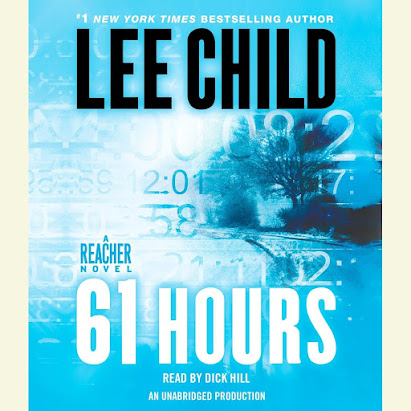
61 HOURS (Jack Reacher #14) (audiobook) by Lee Child


Published by Random House Audio in April of 2011.
Read by Dick Hill
Duration: 13 Hours, 43 Minutes
Unabridged

Jack Reacher is on a tour bus in 61 Hours with a lot of retired folks who took advantage of a discounted tour price to tour South Dakota in the winter time. Reacher paid the driver to hop on the bus, ride along, and skip the tour. They are on their way to Mount Rushmore when the bus skids on an icy patch on the interstate and gets hung up. Normally, that is not such a big deal, but a massive series of snowstorms is coming in and the temperature is dropping in a hurry.

Photo by DWD
The tourists, the driver and Reacher are evacuated to a small town with a big problem. A little old lady witnessed a local biker gang member selling meth to a big-time dealer and the trial is quickly approaching. But, the old lady has been threatened and the local police are expecting an outside hit-man to come to town and kill her so she can't testify and they suspect Reacher just may be that man.

Meanwhile, the snow is piling up, the temperature is dropping, the biker gang is acting stranger and stranger, an abandoned military site is suddenly the center of activity and the real hit-man is on the prowl...

There is a lot of action and lot of bone-shaking cold in this Reacher adventure. Ultimately it is a whodunnit and Lee Child does a great job of dropping clues that lead the reader to suspect all sorts of people. In the end, my first suspect was the real culprit, but I did doubt my suspicions from time to time.

Dick Hill is one of my all-time favorite audiobook readers and he does a solid job here. His tone adds to the ominous nature quite well.

I rate this audiobook 4 stars out of 5.


This audiobook can be found on Amazon.com here: 61 Hours (Jack Reacher #14).

1944: FDR and the YEAR THAT CHANGED HISTORY (audiobook) by Jay Winik


A Review of the Audiobook

Published in 2015 by Simon and Schuster Audio
Read by Arthur Morey
Duration: 21 Hours, 10 minutes
Unabridged

The premise of 1944: FDR and the Year That Changed History is that 1944 is the most important year of World War II - the year that the Allies grew certain that they were going to win the war, the year that post-War plans were laid out, the year of the D-Day invasion and more.

This effort by Jay Winik is very readable and was an informative and entertaining listen. There are times when he creates fabulous images in the listener's mind that are worthy of any novelist. His description of the extent of anti-Jewish operations throughout Europe and particularly in Auschwitz and other death camps are so vivid and so striking that I can readily recommend this book as a good place to start for anyone who wants a serious look.

The book focuses on FDR, his personality and how he shaped the war effort and post-War institutions like the United Nations. Winik details Roosevelt's health problems and points out how Roosevelt's health affected his efforts and possibly affected his judgment.

However, there is a problem with the book and that is the title - what he wrote about does not match the title.

Josef Stalin (1878-1953), FDR (1882-1945) and Winston
Churchill (1874-1965) at the Tehran Conference in 1943.
He has written an excellent book, but I don't think that he proved his assertion of the title that 1944 was THE YEAR. The book covers all of FDR's life and spends a lot of time in every year of the war but 1944. The topics he covered were important and he covers them well. A great deal of the book covers the holocaust and FDR's response to the proof that the "final solution" was underway. I have no problem with this as a topic (I already noted this above) but I do have a problem with a book that purports to talk about the importance of 1944 to world history and goes on to literally spend more time talking about Anne Frank than the entire Pacific Theater of World War II. I am not kidding. Don't get me wrong - Anne Frank's story is compelling, but it is not, in and of itself, worthy of more mention than all of the fighting in Korea, China, the Philippines, the attempted invasion of Australia, the use of the atomic bombs, the war atrocities throughout the theater and the millions of soldiers and sailors involved in fighting throughout the theater.

The reader, Arthur Morey, did an excellent job, even going so far as to mimic the voice of FDR when he read quotes from him.

This is a well-written and immensely informative book that is simply mistitled. 


I rate this book 4 stars out of 5 because of the misleading title.

This audiobook can be found on Amazon.com here: 
1944: FDR and the Year That Changed History.

THE DUCK COMMANDER FAMILY: HOW FAITH, FAMILY and DUCKS BUILT a DYNASTY by Willie and Korie Robertson with Mark Schlabach


A Review of the Audiobook

Published in 2013 by Simon and Schuster Audio.
Read by the authors, Willie and Korie Robertson.
Duration: 5 hours, 50 minutes
Unabridged

Part of a flock of books from the Robertson family (excuse the pun), The Duck Commander Family by the CEO of the family businesses (Duck Commander and Buck Commander), Willie Robertson, and his wife, Korie, looks at how they both got to where they are now and what life is like among the Robertsons.

The book focuses on the much more interesting story of Willie's family, which is appropriate considering their prominence in the hit reality TV show Duck Dynasty. If you have never seen the show, this book will be of little interest to you. I have seen a few episodes, but my carpool partner, my high school-aged daughter, is a fan of the show and has watched multiple seasons. She picked this audiobook for us to hear in the car during our morning commute.


Willie Robertson in 2015. Photo by
Gage Skidmore.
Willie Robertson relates his family's story, starting with his parents and his father's early financial and personal struggles. This is quite interesting and inspiring and takes up approximately the first one-third of the book. Willie and Korie alternate in telling about how they met and their family life. Of course, their religious faith features prominently throughout, including Bible verses that match the theme of the chapter.

The fourth disc of this 5 CD set basically talks about the Duck Commander business and how a series of low-budget duck hunting shows sold on VHS evolved into the Duck Dynasty TV show. He also talks about how their family business really is a family business - many family members and family friends work there.

The last disc tells about how he broadened Duck Commander into the deer hunting business with Buck Commander. Willie tells about baseball players that have appeared in his hunting videos and how he has appeared with various country music stars on stage. The last disc was a difficult listen because I am not a baseball fan or much of a country music fan and, despite Willie's protestations to the contrary as he read, it really was a whole lot of pretty boring name dropping.

At the end of every chapter is a recipe that Willie and his family love. Listening to people read recipes is tedious, at best. If I were the publisher, I would have considered leaving out that part of the text and including the recipes in an insert inside of the box with the CDs. After a while we just skipped over the recipes.

Willie and Korie Robertson read the audiobook. Willie was pretty good, Korie was adequate. It made sense for them to read it, though, since it is told in a first-person voice.

I rate this audiobook 3 stars out of 5.


This audiobook can be found on Amazon.com here: Duck Commander Family: How Faith, Family and Ducks Built a Dynasty.

NPR AMERICAN CHRONICLES: THE CIVIL WAR (audiobook) by NPR


Published in 2011 by HighBridge Audio
Multicast performance
Duration: 2 hours, 59 minutes

NPR has searched through its archives and found 29 stories that make for a very interesting listen if you are a student of the Civil War.

There are interviews with historians, including James McPherson and Shelby Foote and authors like Tony Horwitz, Jay Winik and E.L. Doctorow. Sam Waterston reads the Gettysburg Address (so good!) and Hal Holbrook talks about a project of his about the impact of the Civil War on Iowa.

There are also interviews with regular people, like the African American family that comes to see the original Emancipation Proclamation and turns it into a profound and moving educational event.

None of it is very deep, but all of it is deeply interesting. This is a must-listen for all amateur historians of the Civil War.


I rate this audiobook 5 stars out of 5.

This audiobook can be found here: NPR American Chronicles: The Civil War.

THE BETTER PART of the ROAD (audiobook) by Tom Bodett


Re-published in 2009 by Random House Audio
Read by the author, Tom Bodett

Duration: 2 hours, 9 minutes
Alternate title: The Better Part of the End of the Road

Tom Bodett's "End of the Road" series continues in The Better Part of the Road with Ed Flanigan learning how to get along with just one arm thanks to a horrible accident with heavy equipment. His struggles seem real and Bodett manages to convey them without being patronizing or voyeuristic.

City Manager Emmitt Frank is convinced to move out into a cabin on the edge of town. Emmitt is a former resident of Chicago who came to the End of the Road a city slicker through and through, but is slowly becoming an Alaskan. Calling this cabin rustic would be kind. No running water, no electricity and all of the heating comes from a homemade wood stove and the bathroom is an outhouse. And, sometimes bears show up outside.


Two of the towns older residents find love. This is the best part of the story, by far. Norman Tuttle, the adolescent featured in every episode, has love troubles of his own. Pairing these stories together shows that love is confusing and exciting and potentially embarrassing no matter the age of the participants.

Once again, this is the best series that I have heard all year and I am glad I discovered that they had been re-released in digital format.

I rate this audiobook 5 stars out of 5.

This audiobook can be found on Amazon.com here: The Better Part of the Road.

NPR LAUGHTER THERAPY: A COMEDY COLLECTION for the CHRONICALLY SERIOUS (audiobook) by NPR


Published in 2013 by HighBridge
Multicast performance

Duration: 2 hours, 19 minutes

As NPR readily acknowledges in the description of this collection, they are hardly known for their humor. NPR tends to run a bit stuffy but, from time to time, they do some funny stuff. Or, to be more accurate, NPR is at its funniest when they interview some funny people and let them be themselves.

This is hardly a CD full of comedy routines. In fact, there are a few tracks that are re-plays of a series of April Fools Day fake news bits that NPR has run over the years and they are mostly cute at best and definitely go on for way too long.

On the other hand, the interviews with Drew Carey, Paula Poundstone, Fred Willard with Martin Mull, Eugene Levy and Mel Brooks are simply great. The interviews with Phyllis Diller and Joan Rivers are a cut above. Very good stuff from two ground-breaking comic masters.

I rate this audiobook 4 stars out of 5.


This audiobook can be found here: NPR Laughter Therapy.

A LITTLE HISTORY of the WORLD (audiobook) by E.H. Gombrich


Published by Blackstone Audio in 2006
Translated by Caroline Mustill and E.H. Gombrich
Narrated by Ralph Cosham
Duration: 9 hours, 14 minutes
Unabridged

As the title states A Little History of the World is a small history of, well, everything. Sort of.

This history was originally written in 1935. The author was an unemployed art historian and was asked to write a history of the world for children for an Austrian publisher. The first edition was written in six weeks and it sold well and has sold consistently ever since. Gombrich retained the rights and after World War II set out to keep it updated and translated it into multiple languages. He was working on translating it into English when he died in 2001 at the age of 92. The work was finished by others and no one is quite sure how exactly he was planning on ending it.

The chapter on early man is quite memorable in that it gives early men and women a lot of credit for figuring out a lot of important things like agriculture, cooking with fire, stone tools and so on. Think about it - it really is quite remarkable.

The history is told in a kid-friendly, patronizing, but not annoying way. It is definitely a Eurocentric history, especially after the Mesopotamian Empires (Sumeria, Babylon, etc.) are discussed.
India is mentioned, but mostly as an introduction to Hinduism and Buddhism. China gets a lot more attention, but not much more. The Americas, including the United States are barely mentioned. The Native American civilizations (Mayas, Aztecs, Incas) are only mentioned in the context of being conquered by the Spanish and being brutalized. Africa may not have been mentioned again after Ancient Egypt.

E.H. Gombrich (1909-2001)
However, keeping in mind this bias, this is a pretty solid history of Europe. The reader, Ralph Cosham, sounds like a welcoming old grandfather who is telling the story of the world as he knows it to the little ones. It is easy to imagine him in a chair on a cold winter's night with the little ones gathered around and the fireplace ablaze. And, in a way, this translation was exactly that - a 92 year old man telling the story of the world the best he could.

I  rate this audiobook 4 stars out of 5. It is a limited history and I would never make this the only history book that I handed to my child (it has some popularity among home-school parents), but it is readable and interesting. A good place to start.


This audiobook can be found on Amazon.com here: A Little History of the World.

Featured Post

<b><i>BAN THIS BOOK (audiobook)</i></b> by Alan Gratz

Published in 2017 by Blackstone Audio, Inc. Read by Bahni Turpin. Duration: 5 hours, 17 minutes. Unabridged. My Synopsis Ban This Book is t...

Popular posts over the last 7 days