Posts

Showing posts with the label American History

An Illustrated History of the Civil War: Images of an American Tragedy by The Editors of Time-Life

Image
Published in 2006. As a rule, I'm not terribly fond of the "coffee table" history books produced by the editors of Time-Life Books. Usually, they opt for more glitz than substance and you end up with a hefty (and this one certainly is, weighing in at more than 5 pounds - yes, I weighed it) but bland piece of history. However, this, I am very pleased to say, is a much better book than their usual effort. Although this is an illustrated history, the narrative that begins each chapter is very well written. The topics are interesting, especially the chapters on the abolitionists and the secessionists. They do an excellent job of setting the stage for the Civil War. I have but one complaint, a glaring factual error - they have the Battle of Gettysburg taking place in 1864 rather than 1863. Mistakes like this are easy to make (a stray finger on a keyboard...) but this is the most famous battle of the war! This book can be found on Amazon.com here:   An Illustrated History o...

Flintlock by Jason Manning

Image
Good summer fun! Originally published in 1994. Flintlock is the frontier nickname of Nathaniel Jones, a deadeye shot on the Kentucky frontier. The book is ostensibly about Aaron Burr and his attempt to break the American West away from the rest of the United States in the early 1800s. For those of you not familiar with Burr, he was the former Vice President (Jefferson's first term) who killed America's first Secretary of the Treasury, Alexander Hamilton (the guy on your $10 bill) in a duel. This ruined his political career and he was accused of conspiring to turn the US territory East of the Mississippi and west of the Appalachians into a personal dictatorship. Aaron Burr (1756-1836) The book has a rather large prologue (almost 1/2 of the book) that concerns young Flintlock's exploits as a teen in the Revolutionary War on the Virginia/Kentucky frontier. To be honest, that is the only complaint that I have with the book - its back cover does not accurately describe ...

This Mighty Scourge: Perspectives on the Civil War by James McPherson

Image
A "Must" for All Students of the Civil War Published in 2009 by Oxford University Press. This Mighty Scourge: Perspectives on the Civil War is a collection of 16 essays by well-known historian James McPherson on a number of Civil War-related topics. Some of the essays are brand new, but most have been published before but have been re-worked for this book. The essays fall into five broad categories: 1) Slavery and the Coming of War;  2) The Lost Cause Revisited;  3)  Architects of Victory;  4) Home Front and Battle Front;  5) Lincoln. McPherson discusses the causes of the war in the first essay - a brilliant essay entitled "And The War Came." McPherson directly confronts those that insist that slavery had no part in causing the war. Please, read this essay if you are one of those people before you make that argument again (if you don't want to buy the book for fear of supporting someone who skewers your particular point of view, get it at your library, ...

Mr. Adams's Last Crusade: John Quincy Adams's Extraordinary Post-Presidential Life In Congress by Joseph Wheelan

Image
I have found a new hero from history Published in 2008. I've known about John Quincy Adams's post-Presidential career ever since I read Profiles In Courage  by JFK many, many years ago. However, what I most remember about that description of him was that that he argued against slavery in the Congress when he could have just coasted along in a comfortable political semi-retirement. In the well-written Mr. Adams's Last Crusade , Joseph Wheelan does us all a favor by elaborating on John Quincy Adams's amazing career. Wheelan briefly covers John Quincy Adams's early career in the first 65 pages. As a teenager, John Quincy Adams was an assistant to his father while he was an ambassador to Europe during the Revolutionary War. He served as ambassador to several European countries after the War and also as Secretary of State (the Monroe Doctrine is as much his as Monroe's) and finally President. Oddly enough, that amazing career was only a prelude to his post-Presi...

The Light In The Forest by Conrad Richter

Image
Two incompatible ways of life symbolized by one young man Some books stand the test of time, so do not. The Light in the Forest  was originally published in 1953 and it still rings true - both historically and as a story. Based in Pennsylvania during the years preceding the French and Indian War, the story revolves around True Son, a young man who had been kidnapped from his family by Lenni Lenape Indians at age four. True Son is adopted by an honorable, respected man named Cuyolga to replace a son who died from disease. Over time, True Son forgets his white parents and becomes a full Lenni Lenape. However, a treaty is signed that requires that the white "captives" be returned to their white families. True Son is returned and the bulk of the book concerns itself with True Son's reactions to the white society he was forced to leave more than a decade earlier. Eventually, True Son escapes back to his adopted family and settles back into his comfortable way of life. ...

Founding Father: Rediscovering George Washington by Richard Brookhiser

Image
An interesting biography, a valuable perspective Published in 1997. Founding Father: Rediscovering George Washington  is not a long biography (199 pages), but it is an interesting piece of writing. It is split into 3 areas - about one-half of the book is straight biography, about one-third is an analysis of the character of our first president and the balance is an analysis of what it means to be a founding father, how Washington measures up to that ideal and what kind of "father" he was. The biography section is great - straightforward and written in an engaging and lively style. The character portion bogs down quite a bit and the founding father section is interesting (it asserts that he was the kind of father who was most concerned with preparing his children for life outside of his home - life on their own. He encourage other people to step into leadership roles to fill the vacuum that would be there when he walked away from the national spotlight.) One quote, above...

Muslims in America: A Short History by Edward E. Curtis IV

Image
A Short, Solid History Published in 2009 by Oxford University Press. Muslims in America is the "first single-author history of Muslims in America from colonial times to the present", which is what the back cover proclaims. I have no reason to doubt that this sad statement is true and for that reason this book is a welcome addition to the shelf of any serious student of American history. That being said, this book is not perfect. Since it tries to cover the entire spread of American history the first pages are about isolated Muslim individuals that were brought over as slaves, continued to follow their faith and were noted for doing so. It turns out that only a few people fit all those criteria so we end up with extended biographies of these people. This is not bad, per se, but it does make the last half of the book seemed rushed in comparison. The slow, extended style is put aside for a quicker, less detailed style. That less detailed style in the latter half of the...

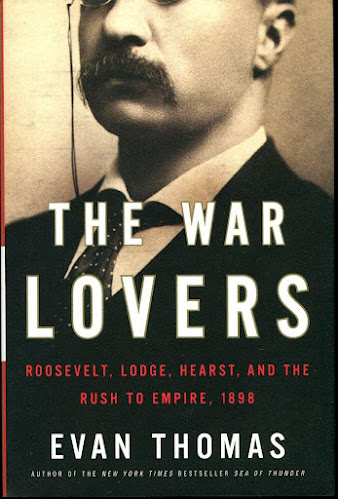
The War Lovers: Roosevelt, Lodge, Hearst, and the Rush to Empire, 1898 by Evan Thomas

Image
Well done Published in 2010 by Little, Brown, and Company. Before this book, I had not had the pleasure of reading one of Evan Thomas' books. I picked The War Lovers up despite these fawning comments by Thomas in June 2009 ("I mean in a way Obama's standing above the country, above - above the world, he's sort of God.") My original thoughts were if this guy can't be any more unbiased in his observations than that, do I really want to read his stab at history? Well, I am happy to say that I was pleasantly surprised. This is a solid history that is told well. The book flows along nicely and the reader is both entertained and informed. Theodore Roosevelt (1858-1919)  with his men in Cuba The book's focus is the build-up of public support for the Spanish-American War (1898). As the title notes, Theodore Roosevelt, Henry Cabot Lodge and William Randolph Hearst are the main subjects in the book but other people round out the story, including Harvard ...

Patriot Pirates: The Privateer War for Freedom and Fortune in the American Revolution (audiobook) by Robert H. Patton

Image
A tedious listen. Published by Tantor Audio in 2008. Duration: 10 hours, 25 minutes. Read by Alan Sklar. Unabridged. I am an avid reader of history. I also enjoy listening to histories as part of my daily commute. I thought Patriot Pirates would be a fantastic diversion since I knew relatively little about the naval history of the Revolutionary War besides the story of Bonhomme Richard and the fact that the Continental Congress authorized the use of privateers. Unfortunately, Patton's dry, overly wordy text coupled with Alan Sklar's (the narrator) ironic, almost mocking tone made me both both bored and irritated at the same time. If it can be said in 50 words, Patton uses 500. He tells the same stories over and over again. After listening to 5 of 9 discs I refused to force myself to slog through another chapter - partially because it was so poorly narrated, partially because I was becoming a public safety hazard - I was literally nodding off. I listen to CDs to make m...

Almost America: From the Colonists to Clinton: a "What If" History of the U.S. by Steve Tally

Image
Very good despite a few little factual errors. Published in 2000 by William Morrow Paperbacks Some of these are really thought-provoking and well thought out. I especially enjoyed the one concerning Teddy Roosevelt following through with his plan to ban college football unless they did something to curb the extreme violence (23 young men died in the 1905 season). The consequences were interesting and I thought very plausible. The book is marred by a few factual errors. They really are not terribly important to the outcome of the author's alternate histories but show a sloppiness in editing. Some examples are placing the Revolutionary War fort of Kaskaskia in present-day Kentucky when it is actually in Illinois and saying that people blamed Lincoln's assassination on people who were wanting to revive the Union cause (obviously the Union cause was in great shape by the point of the war - I assume his editors did not catch it and he meant to say Confederate). Despite the erro...

American History Revised: 200 Startling Facts That Never Made It Into the Textbooks by Seymour Morris, Jr.

Image
Published in 2010   Written like a textbook with double columns, American History Revised is intended to be a supplement to the history your high school textbook ignored or glossed over. This is a fine goal because almost every history textbook is a dry, tedious tome that bores its readers to sleep before they can learn any history. American History Revised approaches this challenge with a scatter-gun style of random facts that are very loosely grouped into categories like "Forgotten by History", "In Pursuit of Riches" and "Simple Mathematics, My Dear Watson." I can only imagine that those who are not already well-acquainted with history would find this jumping back and forth style quite confusing. But, that is not the reason for my concern. I am concerned because there are blatant untruths throughout the text. "Facts" that are not facts. Please note that I an reviewing an uncorrected proof and maybe, just maybe these items have been addre...

Tried By War: Abraham Lincoln as Commander in Chief by James McPherson

Image
Originally printed in 2008. The reviews are right, Tried By War is an unoriginal book, everything in it has already been said (literally by McPherson himself!) but when McPherson writes about the Civil War it's worth my time to read what he has to say, and if you are at all interested in the war, it's worthy of your time as well. What is unique about the book is the focus on Lincoln as the leader of the armed forces. Yes, all histories of the war cover this aspect of Lincoln's presidency, but you have to tease it out of the larger text. For example, all of this was more than covered in Doris Kearns Goodwin's 944 page Team of Rivals: The Political Genius of Abraham Lincoln (an excellent read, by the way) but if you have little interest in the monetary policy of the Lincoln administration, the vagaries of the Lincoln administration's dealings with the European powers or don't care to read about the Homestead Act of 1862 (which had a profound affect on the de...

Hallowed Ground: A Walk at Gettysburg by James McPherson

Image
Well-written. Interesting. Nice amount of details. Originally published in 2003. Hallowed Ground: A Walk at Gettysburg would be an excellent addition for any visitor to the battlefield. The chapters are short enough that a thoughtful tourist would have no problem reading them as he/she stood there. It is a bit pricey for its size but it's a nifty guidebook nonetheless. I know I've seen similarly-priced tour books that weren't as well-written. It would have helped to have pictures to help orient the tourist, but this would necessitate editing of the book if the Parks Department begins the restoration projects McPherson mentions (and hopes for). These include removing woods that have grown up since the battle and restoring fences and orchards that have been removed. I own a number of McPherson's books - he is this generation's preeminent Civil War historian - and I'll be glad to put this one on the shelf with the others. Whenever I can convince my wife to l...

The Negro's Civil War: How American Blacks Felt and Acted During the War for the Union by James McPherson

Image
Published in 2003. James McPherson is the gold standard when it comes to writing Civil War history. In The Negro's Civil War , Mcpherson has compiled a fantastic amount of source material concerning how Blacks felt and acted during the Civil War. In the forward McPherson notes that there is "a need for a documentary collection that will present all aspects of the Negro's role in the war largely in the Negro's own words...this book is designed to fill that need." McPherson strings together quote after quote from Black newspapers, letters and speeches with relatively sparse commentary in between. There was an unexplained hole in the record and, thankfully, McPherson filled it. The book addresses 22 topics - from pre-war commentary on Abraham Lincoln to postwar lamentations about the failure of Reconstruction. James McPherson My thoughts: Unfortunately, the very strength of this book (all of the quotes) made it, at times, a tedious read for me. I found t...