Posts

Showing posts with the label American History

The Significance of the Frontier in American History by Frederick Jackson Turner

Image
Four Classic Essays By a Noted Historian Collection published by Penguin Classics in 2008. The Significance of the Frontier in American History is a collection of four essays written by noted historian Frederick Jackson Turner from 1893 to 1910. Penguin Classics has re-issued these essays as part of its Great Ideas series. Frederick Jackson Turner is featured in just about every U.S. History textbook for his essay  The Significance of the Frontier in American History , written in 1893. I am embarrassed to note that I had never read this classic essay until I read this collection, although I was familiar with its basic thesis. In this essay Turner notes that the 1890 census determined that as of 1890 there was no longer a definable "frontier." He asserts that this is the beginning of something new for the United States as it has always been defined by its (usually) westward boundary. Turner notes that the Western settlers came from all parts of the eastern...
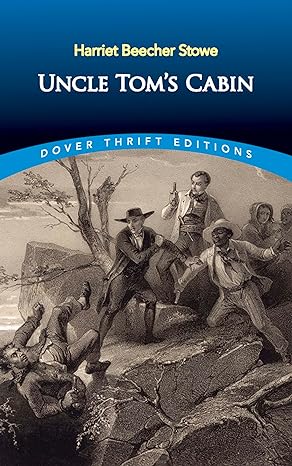
Uncle Tom's Cabin by Harriet Beecher Stowe

Image
A Few Thoughts on Uncle Tom's Cabin First Published in 1852. Harriet Beecher Stowe sat down to write a book that would show the United States the evils of slavery. She wrote Uncle Tom's Cabin; or, Life Among the Lowly in response to the Fugitive Slave Act of 1850, at the urging of her sister-in-law. She succeeded in fueling the debate over slavery and she pointed a finger of shame at the slave owners and at America as a whole. Harriett Beecher Stowe (1811-1896) It created a national sensation. Within ten years, it sold two million copies, making it the best-selling novel of all time in the United States, in proportion to population, according to noted Civil War historian James M. McPherson. The book was so controversial and so powerful that there were attempts to ban it in some parts of the South. Pro-slavery authors attempted to counter the book with their own books with titles like Uncle Robin, in His Cabin in Virginia, and Tom Without One in Boston in an attem...

The Lowdown: A Short History of the Origins of the Vietnam War (audiobook) by Dr. David Anderson

Image
Delivers what it promises Published by Creative Content Ltd in 2011. Narrated by Lorelei King Duration: 1 hour, 20 minutes Creative Content has a whole series of short audiobooks and kindle books in its "The Lowdown" series. The main feature of the series is that they are short (a little more than an hour or about 35 "pages" on the Kindle) and give the reader a quick look at a topic. In this case, the topic is the origin of the Vietnam War. Note, this is not a history of the entire war, but if you ever wondered just how the United States got involved in the Vietnam War, this nifty little history will do the job just fine. President Lyndon Johnson signs the Tonkin Gulf Resolution in August of 1964 Anderson roots his history in the aftermath of World War II. There are two major factors at play. The first is the desire of the French to re-establish their pre-war colonial empire and re-assert themselves as a major player on the world scene despite their be...

Grant: Savior of the Union ("The Generals" series) by Mitchell Yockelson

Image
Published in 2012 by Thomas Nelson Grant: Savior of the Union is an enjoyable, easy-to-read biography of Ulysses S. Grant, the Union General that seemingly came from nowhere to become the man that engineered the conquest of  the Confederacy. Yockelson covers Grant's entire life and also a bit of his father's life, with an appropriate emphasis on Grant's military service in the Mexican War, his resignation from the army between the wars, his difficulties as a civilian and his return to the service once war broke out between the Union and the Confederacy. Two-thirds of the book covers the four years of service in the Civil War. His Presidency and retirement years are quickly brushed over. Grant's career is dealt with fairly throughout the book. His great decisions are applauded, his mistakes are pointed out (Cold Harbor, in particular) and the reader gets strong feel for his calm, determined leadership style and his emphasis on substance over style. This is a much...

Windtalkers DVD

Image
Directed by John Woo. Released in 2002. With the title Windtalkers you'd think it would be centered on the Windtalkers, those Navajo Code Talkers who served in the Pacific Theater of World War II. I'd purposely ignored this movie until I had the time to watch it since I was interested in the topic and have an interest in the Navajo culture, having visited the Four Corners area several times and having read a bit about them. I was hoping for a movie that focused on the Windtalkers themselves - why they fought for a society that had conquered them and now scorned them, what their motivations were, how their culture dealt with the separation from the Navajo lands, the death and destruction of the war (briefly touched on) and so on. That would have been much more interesting and important. Instead, we get a movie that should be called Messed Up In the Head Windtalker Babysitter - a movie about the white guy who minds the Navajo Windtalkers. A movie full of clich...

Saint Patrick's Battalion: A Novel by James Alexander Thom

Image
A disappointment Published by Ballantine Books in 2006. To start, let me establish my bona fides as a fan of Mr. Thom's work. Three of his novels sit on a shelf less than two feet from this computer. I have the featured review on Amazon.com one of his novels ("The Red Heart"). One of his books is on my Favorite Books List on my profile page. I actually designed a long-term project for my world history classes using historical fiction with his books in mind, and I told him so when I met him at a state-wide conference for social studies teachers. So, I approached St. Patrick's Battalion with much hope. Instead of his usual quality, I found this book to be simplistic, with less detail and bent on beating two points home time after time: the Irish were treated brutally and shamefully by the U.S. army during the Mexican War and the Mexican War was an unjust war. James Alexander Thom Thom makes it clear in the opening dedication and acknowledgments that ...

Letters from a Slave Girl: The Story of Harriet Jacobs by Mary E. Lyons

Image
The fictionalized version of a real-life runaway slave story. Originally published in 1996. Mary E. Lyons' book Letters from a Slave Girl is a fictionalized account of the true story of Harriet Jacobs, a slave girl from North Carolina who escaped and hid in her grandmother's attic for seven years, beginning in 1835, before making her way north to freedom. Lyons chose to use a fictional diary format to tell the story of Harriet Jacobs. In real life Jacobs could read and write and actually published a book about her life in 1861 called Incidents in the Life of a Slave Girl . The reward notice for Harriet Jacobs The diary format has some strengths - it is an efficient way to note the passage of time and to tell about Harriet's feelings. However, it is not nearly as memorable as telling her story as a novel. The letters just do not have the same flow and impact as a story. The book also include a set of pictures of some of the real people and places involved,...

The Glory Field by Walter Dean Myers

Image
Published by Scholastic in January of 1994. The Glory Field is the story of an African-American family and their tie to a piece of land on Curry Island in South Carolina over the course of 250 years. Reminiscent of the James Michener sagas that follow the same format, The Glory Field is not nearly as detailed or as rich as a Michener selection. However, Michener's primary audience was adults and Myers' intended audience is young adults, most of whom would not have the patience or the courage to pick up a 1,000+ page book. Myers has broken this book up into a series of six stories, snapshots of the Lewis family throughout nearly 250 years of history. The quality of the stories goes up and down. The 2nd, 3rd and 4th stories are so-so. The first is vivid, strong and way too short. The last two are so strong that, in my mind, they saved the book. I was considering not including it in my classroom library because of the middle stories - they drug along and just didn...

The Founders' Key: The Divine and Natural Connection Between the Declaration and the Consititution and What We Risk by Losing It by Larry P. Arnn

Image
Published in 2012 by Thomas Nelson Larry P. Arnn is the president of Hillsdale College and I suppose I should tell you that I receive Hillsdale's free monthly bulletin,  Imprimis , which features excerpts of speeches given by guests at Hillsdale College. President Arnn is featured annually so I was fairly familiar with his work before I picked up this book. In fact, that was the reason I picked The Founders' Key up in the first place. Arnn's main point is that the Declaration of Independence and the Constitution are highly inter-related and that the efforts of some politicians and academics to separate them are not only incorrect but are also symptomatic of a larger effort to redefine and dilute the rights and governments described in both documents. Arnn makes this point early and brilliantly in simple and soaring language. He demonstrates that the series of complaints against King George III in the Declaration describe how the King did not act as a faithful repres...

John Ericsson and the Inventions of the War (The History of the Civil War Series) by Ann Brophy

Image
Published in 1991 by Silver Burdett Press 118 pages of text. 8 pages of timelines, sources and an index at the end. This book is part of a larger series (The History of the Civil War Series). It is very readable with a good balance of national history versus the biography of Swedish immigrant inventor John Ericsson, with the glaring exception I note below. John Ericsson (1803-1889) was almost the stereotypical nutty professor type inventor - he never properly patented many of his best inventions. Ericsson built a great number of inventions, but unlike Alexander Graham Bell and Thomas Edison, he never really built any industries around them. He seemed to have trouble with personal relationships and was happiest when the was building in his laboratory. John Ericsson (1803-1889) Among other things, Ericsson invented a screw propeller, a "caloric" engine and, most importantly, he was the designer of the famed U.S.S. Monitor, the first ironclad in the Union navy, part...

Morning of Fire: John Kendrick's Daring American Odyssey in the Pacific by Scott Ridley

Image
Well-researched but ultimately fails in its goal Published by William Morrow in 2010 John Kendrick was a well-respected sailor from the Boston area during the Revolutionary War era. He was rumored to have participated in the Boston Tea Party. He captained a privateer, captured prizes and was highly regarded by political and business leaders and the men who sailed on his ships. As America struggled to revive its foreign trade after the Revolutionary War (The United States was officially cut off from English trade) tales came to Boston about the beautiful furs available along the Northern Pacific coast of North America. Investors hired Kendrick to lead an expedition of two ships to explore the trading opportunities in the Pacific. Kendrick set off in 1787 to find new markets for American goods. He ended up visiting what is now Alaska, Washington State and British Columbia, Hawaii, China and Japan. He nearly sparked a war between Spain and England, got involved in a brutal war in Haw...

Abraham Lincoln and Frederick Douglas: The Story Behind an American Friendship by Russell Freedman

Image
Another winning book by Russell Freedman Published in June of 2012 by Clarion Books (DWD's Reviews received an advance copy for review purposes) Russell Freedman received the Newbery Medal for his 1989 book Lincoln: A Photobiography and he returns to familiar ground with this dual biography. He begins with Douglass and then alternates back and forth between the two men, highlighting important aspects of their lives and the areas that they had in common (such as being self-educated, self-made men). The almost square shape of Abraham Lincoln and Frederick Douglass: The Story Behind an American Friendship lends itself to pictures and Freedmen fills the book with drawings, etchings and photographs of the era, including the image I have included here of a "Watch Meeting." Thousands of people gathered together to await word of Lincoln signing the Emancipation Proclamation (he had promised to do so several months earlier unless the Confederate States returned to the Uni...

Where the Action Was: Women War Correspondents in World War II by Penny Colman

Image
Published in 2002 by Crown Publishers (Random House) This book is aimed at students from grades 5-12, although I found it interesting and learned a lot. World War II histories abound. Histories of the complete war, various theaters, biographies of units and single officers fill the bookshelves. I have seen books that look at the role of women in the war - the home front, as pilots, intelligence officers and so on. But, I have never seen anything about female war correspondents. I did not even know that there were female war correspondents in World War II - I simply assumed that the sexist attitudes of the day would have not allowed them to work. Happily, I have been enlightened by Penny Colman and her book Where the Action Was . She tells the story of the war through the eyes of several female war correspondents - sometimes through direct quotes, sometimes through reproductions of the headlines of their articles that are placed throughout like in a scrapbook. The history of the w...

The Good Fight: How World War II Was Won by Stephen E. Ambrose

Image
Great book for school age kids Published in 2001 by Atheneum Books for Young Readers Stephen E. Ambrose is perhaps best known as the author of Band of Brothers , the book that inspired the HBO mini-series of the same name. His passion for World War II continues in this book aimed at upper elementary through high school students. A Kamikaze plane about to hit an American ship (In the book on page 78) While there is nothing new in The Good Fight , it is a fantastic introduction to the war. All of the major theaters are covered and, perhaps best of all, there is a full page 10" x 10"  picture from the war that show everything from the home front to kamikaze planes to Hitler in a elaborate Nazi rally to Holocaust victims and even more. Those pictures and the little ones scattered on the other pages make the book much more vivid. There are also plenty of pictures of the young men and women that were involved - pictures that make the war seem more real. Th...

David Farragut and the Great Naval Blockade (The History of the Civil War Series) by Russell Shorto

Image
Solid history for grade 5 and above. Published in 1991 by Silver Burdett Press 119 pages of text. 9 pages of timelines, sources and and index at the end. David Farragut and the Great Naval Blockade is part of a larger series (The History of the Civil War Series). It is very readable with a good balance of national history versus the biography of David Farragut. Farragut joined the United States Navy at age 9 in 1810, fought against the Barbary Pirates and in the War of 1812. Until the Civil War, Farragut was known as an great officer, the kind of officer that sailors were glad to work under, but also the kind of officer that just missed doing something great. He was not sent to "open" Japan with Matthew Perry. He tried to get involved in the Mexican War but the fighting in Veracruz was over by the time his ship arrived. When the Civil War began, it was assumed that Farragut would go with the Confederacy. After all, he was born in Tennessee, he lived in Norfolk, Virgi...

Undaunted Courage : Meriwether Lewis, Thomas Jefferson and the Opening of the American West (abridged) (audiobook) by Stephen E. Ambrose

Image
Wonderful, just wonderful. Published by Simon and Schuster Audio Read by Cotter Smith Duration: 4.5 hours  Abridged A family friend gave me the abridged audio version of Undaunted Courage . It has been on my "to read" list for years and I'd never quite gotten around to it but, boy, am I glad I finally did. Meriwether Lewis (1774-1809) In Ambrose's hands the story of the Lewis & Clark expedition is lifted from the stale and stilted pages of the history textbooks and it becomes an exciting narrative - full of adventure, wonder and tons of hard work. Ambrose is a gifted writer. I am reminded of the David McCullough quote: "No harm's done to history by making it something someone would want to read." No danger of that with Ambrose. Not only has he read everything there is to be found on the topic but has traveled the route several times. William Clark (1770-1838) Cotter Smith did a great job of reading the text and keeping...