Posts

Showing posts with the label American History

America, 1908: The Dawn of Flight, the Race to the Pole, the Invention of the Model T and the Making of a Modern Nation by Jim Rasenberger

Image
The strong points are very strong but there are flaws Originally published in 2007 by Scribner. America, 1908 covers some of the key cultural, political, manufacturing and just plain odd events that happened in 1908 in the United States in an easy-to-read, often fun format. These include the Race to the North Pole, the New York to Paris automobile race, the introduction of the Model T, the last time the Cubs won the World Series for more than a century, the Wright Brothers proving to the world that they really could fly (and do it for hours, not just seconds) and a series of horrible race-based lynchings. While I enjoyed learning more about the Wright Brothers and the Model T, other parts seemed more than a bit skewed towards events in New York City (the Cubs win their last World Series and it's told from the point of view of the New York Giants?) and against rural areas and the South (the only references to the South are from newspapers mentioning events in NYC or ...

The Invention of Air: A Story Of Science, Faith, Revolution, And The Birth Of America by Steven Johnson

Image
Meandering book felt more like an expanded magazine article  Published in 2008.  I am a history teacher and thought The Invention of Air: A Story Of Science, Faith, Revolution, And The Birth Of America might be an interesting new perspective on the Enlightenment and the American Revolution from the perspective of English theologian, philosopher and scientist Joseph Priestley. We get a hefty dose of scientific history which is appropriate but not my area of interest. We don't get a lot of detail on his theological writings that caused him to flee England for America and later made him unpopular with some politicians in America as well. We also get a lot of off-topic meanderings such as his pages full of information on the Carboniferous era (millions of year ago) that form a rhetorical touchstone for the rest of the book but mostly seemed to fill the book with extra pages. Joseph Priestley (1733-1804) In fact, the large-type print, off-topic musings and s...

This Hallowed Ground: The Story of the Union Side of the Civil War by Bruce Catton

Image
An Amazing One Volume History of the Civil War Originally published in 1956. When I was a freshman in college, way back in 1986, I happened upon a Bruce Catton (1899-1978) book in the bookstore while buying all of my textbooks for my first semester. I picked it up just because I was in a mood to be educated with something that looked more interesting and less daunting than my economics and math textbooks. My fascination with all things Civil War began with that book. I traded it in a fit of stupidity a couple of years later at a used book store near campus. I read his trilogy, re-printed articles in American Heritage and then I moved on to other talented authors, such as James McPherson. Bruce Catton (1899-1978) I had forgotten how truly gifted Catton was as a writer and I just assumed that because Catton was the historian of my childhood, he was an inferior writer. Why? I don't know. I picked up this older copy (see picture above) of   This Hallowed Ground: The Story of ...

Greeks & Romans Bearing Gifts: How the Ancients Inspired the Founding Fathers by Carl J. Richard

Image
Great book even though it was not quite what I thought it was. Published in 2008. So, if it was not quite what I thought it was, what is it? Greeks and Romans Bearing Gifts: How the Ancients Inspired the Founding Fathers is a very succinct, well-written and entertaining history of the Ancient Greeks and the Romans with a little commentary at the end of each section about how these histories influenced the Founding Fathers. For example, he has seven pages on a history of the Spartans (probably the best short explanation of the Spartans I have ever read) and two pages about the lessons learned. There are 13 pages on the Persian Wars and just one page about the lesson learned. This book does fill a serious gap in our education nowadays. Unfortunately, in the world of education, it is not uncommon to think of Western history as not important to our lives ("Hey! Ho! Western culture's got to go!" - Stanford protesters in 1988). But, this book demonstrates that t...

Lincoln and Chief Justice Taney: Slavery, Secession and the President's War Powers by James F. Simon

Image
An interesting head-to-head biography about two gentlemen who went head-to-head quite often during the Civil War. Published in 2006 by Simon and Schuster. James F. Simon's Lincoln and Chief Justice Taney shines an interesting light on two overlooked aspects of 19th century American history. The first overlooked aspect is the Supreme Court, specifically the person of Roger Taney (pronounced Tawney), the Chief Justice most famous for what may be known for all time as his single worst legal opinion, and one of the most controversial and ill-considered opinions of all time - Dred Scott. Roger Taney   (1777-1864) Simon tells the story of Taney's life, including his surprisingly liberal views on slavery and his legal defense of blacks who were seized illegally to be sold into slavery, the fact that he freed most of his family's slaves and even provided a modest pension for the elderly ones. Taney even defended an the rights of an abolitionist preacher to preach his m...

Rise to Rebellion and The Glorious Cause by Jeff Shaara

Image
T he Glorious Cause is the second in Shaara's two volume piece historical fiction concerning the Revolutionary War. Rise to Rebellion was the first, and I believe the superior of the two, but The Glorious Cause is an excellent novel as well. Rise to Rebellion is the superior of the two novels due to the changes of heart that the readers sees in John Adams and Benjamin Franklin concerning the issue of independence from England. The Glorious Cause has little of that type deep soul-searching. However, it is a fantastic portrayal of the difficulties encountered by the Continental Army and George Washington, in particular. If I were to have my druthers, I would have preferred that Shaara had broken the second 600+ page novel into two novels  to make it a trilogy and expanded them both by delving more into the politics of the day and the difficulties of fighting a war with the governmental structures and restrictions that the Continental Congress was hampered with. ...

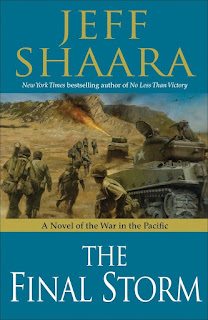
The Final Storm: A Novel of the War in the Pacific by Jeff Shaara

Image
A bit disappointing. Published in 2011 by Ballantine Books. Jeff Shaara's European Theater World War II trilogy covered America's participation in that theater completely - from before the invasion of North Africa to the occupation of Germany. All of my reviews of those books can be seen by clicking here . He did a great job of discussing the grand strategies and showing the view from the trenches. I really was hoping for the same treatment here. Shaara alludes to problems with his publisher in an introduction, but the reader is left with a truncated version of the war in the Pacific Theater. Shaara picks up this story with the dates he left off in his European Theater trilogy - Spring of 1945.So, no Pearl Harbor, Battle of Midway or threat of invasion of Australia. No occupation of the Aleutian Islands. No Bataan Death March. The B-29 bomber Enola Gay Instead, we are told the story of one major campaign (Okinawa) and the story of the Enola Gay and the bombing of ...

The Civil War: Strange and Fascinating Facts by Burke Davis

Image
Fun to read, but be warned... Published in 1982. ...you had better be up on your Civil War basics before attempting to read this book. It assumes that the reader is well aware of the main battles, campaigns, personalities and relative strengths and weaknesses of both the North and the South. Union General William Tecumseh Sherman (1820-1891) As the title suggests, the book is primarily a collection of facts and oddball "did you know?" type of stories that are not really intended to re-tell the story of the Civil War but are mostly aimed at  people who know the story fairly well and are looking for some new stories (in my case, these are new stories I can use to bore my wife in new and different ways with the Civil War). There's bound to be something new in here for everyone but the hardest of the hard core Civil War aficionados. Well-written, breezy, although oftentimes disjointed and random. This book is also published under the titles Our Incredible Civ...

To Make Men Free: A Novel of the Battle of Antietam by Richard Croker

Image
This Civil War buff thoroughly enjoyed it Originally Published in 2004 by William Morrow To Make Men Free , like an epic feature from the 1950s, features a cast of thousands which is both its strength and weakness. A lot of reviewers complain about the lack of depth in the characters, which is fair to say about the book. Unlike Shaara's The Killer Angels , the gold standard of Civil War fiction, there is not much character development. But, to be fair, Shaara focuses on precious few personalities of the War while Croker includes Lincoln, many cabinet members, Lee, McClellan and at least a dozen of the generals, not to mention colonels, sergeants and even a couple of privates. George B. McClellan  (1826-1885) The inclusion of so many characters does contribute to a lack of character exploration but it also contributes to a wide view of the mayhem of the battlefield. Croker also delves into political intrigues that went hand in hand with this bloodiest day in Am...

Harriet Tubman: Conductor on the Underground Railroad by Ann Lane Petry

Image
Well-written biography of a true American hero Originally published in 1955. Harriet Tubman: Conductor on the Underground Railroad is a fantastic little biography of Harriet Tubman (1820-1913). Tubman has always been one of my personal heroes and this book does her story justice. I would say this book can be easily enjoyed by 4th graders and up. It also could serve as a great starting point for adults that don't know much about slavery and the American Abolitionist movement. While telling the story of Tubman's life, Petry also includes at the end of nearly every chapter historical tidbits about the slavery and the Abolitionist movement at the national level. The discussion of her service in the Civil War as a scout in the coastal areas of South Carolina spurred me to do some further research. Her commanding officer in the raids was Colonel James M. Montgomery, the nutty commander in the movie Glory with this memorable line: "You see sesesh has to be cleare...

Jesus Says So (kindle) by Mass. Sabbath School Society

Image
A 19th Century Inspirational Story Originally printed in 1851, Jesus Says So, or A Memorial of Little Sarah G---- is a great example of a witnessing tool from the 19th century. The title derives from the saying of a little girl who quotes the promises of Jesus and proudly proclaims that she believes them because "Jesus says so." Modern witness tracts typically include the story of a person who has sinned in a big way but has turned their life around thanks to a conversion. This tract features an 11 year-old girl who is practically without sin, lives a poverty-stricken life and dies from an unknown illness after a long period of being bedridden. This type of tragic story was very common in the 19th century. This is a very short story, perhaps a 10 minute read. It was printed by the Mass. Sabbath School Society. Even if you are not interested in the religious content it does provide a window into American culture in the 19th century and invites comparison with...

Undying Glory: The Story of the Massachusetts 54th Regiment by Clinton Cox

Image
Comments from a history teacher Published in 1991 by Scholastic. Okay - so hear I am once again reading a kid's book. However, it is for my classroom library - I try to read them all so I can make recommendations. Sgt. William Carney  of the 54th  Massachusetts, the first African American to receive the Congressional Medal of Honor For those not in the know, Undying Glory: The Story of the Massachusetts 54th Regiment   is a brief history of the 54th Massachusetts - the first official regiment of blacks in the American Civil War. The unit was immortalized in the Academy Award winning film Glory , starring Denzel Washington. Cox has the great majority of his facts straight (I have some quibbles, such as when he claims that a good soldier could load and shoot a civil war rifle in about 45 seconds, when the reality was that a competent soldier could do it up to 3 times per minute.) The larger problem goes from being factual to the problem of being written in s...

Curiosities of the Civil War: Strange Stories, Infamous Characters, and Bizarre Events by Webb Garrison

Image
Too scattered for this student of the Civil War. Published in 2011 by Thomas Nelson Webb Garrison's Curiosities of the Civil War: Strange Stories, Infamous Characters, and Bizarre Events is a well-researched , hefty book that does deliver what it promises - a collection of odd things about the Civil War. I read a lot of history and it seems to me that there are two main ways to organize a book about history. You can go with the more traditional timeline approach - tell the story in the order that it happened (narrative history). Or, you can go with themes - study the themes of the history as the writer sees them. For example, a Civil War historian can look into the evolution of military technology and techniques or focus on civil rights in the North and the South. Most historians try for a combination of the two and pick several themes and follow them as they tell a narrative history.   Curiosities of the Civil War goes with the less popular "bathroom reader" styl...

The Confessions of Nat Turner by William Styron

Image
The controversial winner of the 1968 Pulitzer Prize for fiction Here we are, decades years later and The Confessions of Nat Turner is still in the news. Recently, Henry Louis Gates, Jr made comments (positive ones, now. Originally negative impressions, years ago) about the book. The primary controversy is quite simple - how can a white man, a southerner, and the descendant of slave owners write a novel about one of the few slaves who actually stood up and demanded his freedom by leading a rebellion? Some have even asserted that he did not even have the right to write the book in the first place - after all, it is not HIS history. But, is Nat Turner to be forever held apart? Is African-American history to be held apart? Can an African-American write about the Japanese Shogunate? Can an Asian-American write about the Alamo? Of course and of course. Gates makes this point in his comments (correctly). History is human history. Nat Turner (1800-1831) Styron's fictionalized...

The Dangerous Book of Heroes by Conn Iggulden and David Iggulden

Image
Oh, how I wanted to be able to recommend this book! Published in 2010 by William Morris As a history teacher I often decry the politically and factually correct, but dreadfully dry and boring history textbooks. I was hoping that this book, The Dangerous Book of Heroes, could be a popular antidote and a return to the famous Landmark books series that I grew up reading. Mostly, The Dangerous Book of Heroes is just that - a collection of biographies - some just a few pages, some longer. They are illustrated with the same kind of line drawings that I remember from the Landmark books. But, this book does have a danger to it, and not the tongue-in-cheek kind suggested by the title. The publisher markets this as a book for children with the phrase "here are amazing stories of heroism that parents can share with their children."   Captain Sir Richard Francis Burton (1821-1890) One of the authors claims it is aimed at 14 year olds and above. That may be so, but the ser...

Free To Choose: A Personal Statement (audiobook) by Milton and Rose Friedman

Image
A prototype of the current crop of approachable books on economics Originally published in 1980. Duration:12 hours, 15 minutes Read by James Adams Unabridged. Free To Choose: A Personal Statement is the manifesto on the power of capitalism and freedom (and how they go hand in hand) that was designed to be read, digested and discussed by the common man, not the economist. In fact, this is the book that was designed as a follow-up companion to a 10 part PBS mini-series that fleshed out the ideas in the series and addressed issues and further questions that came up in the making of the television program. Milton Friedman won the Nobel Prize for economics in 1976 (he always credited his wife for helping develop his theories so I would imagine he considered it a shared prize). The audiobook follows the lead of the mini-series and has 10 broad areas that it covers, including: -The Power of the Market; -The Anatomy of a Crisis (an in-depth study of the Great Depress...