Posts

Showing posts with the label African Americans

Streets of Fire (audiobook) by Thomas H. Cook

Image
"That's the trouble with a situation like this - you just don't know who is who." Published by Highbridge Audio in 2012 Read by Ray Chase Duration: 11 hours, 35 minutes. Unabridged. Thomas H. Cook's Streets of Fire is set in Birmingham, Alabama in the spring of 1963 during Martin Luther King's famed "Birmingham Campaign" that featured the Children's March, "Bull" Connor, boycotts and fire hoses being turned on demonstrators. Sergeant Ben Wellman is called away from taking detailed notes on Martin Luther King's speeches at the Sixteenth Street Baptist Church (one of many policemen that were used as spies who filled notebooks and turned them in to their superiors) to investigate a dead body found in a shallow grave in an abandoned ball field in Bearmatch, a black neighborhood. Generally, the all white Birmingham police department didn't do much investigating into murders in this working class Black neighborhood - they ar...

Master of the Mountain: Thomas Jefferson and His Slaves (audiobook) by Henry Wiencek

Image
Published by HighBridge Company in 2012 Read by Brian Holsopple Duration: 11 hours, 5 minutes. Unabridged I am a history teacher. My favorite area of study is the American Civil War but the American Revolution comes in at a close second. I cannot even count the number of books that I have read about the Revolutionary Era and I thought that I had a pretty solid handle on Jefferson - until I read Master of the Mountain: Thomas Jefferson and His Slaves . I had always pictured Jefferson as a Unitarian (who was willing to go "more" religious for political reasons) who wrote eloquently about freedom and tyranny but somehow compartmentalized this in his own life when it came to slavery. Or, was unable to free his slaves due to crushing debts incurred because he was a philosopher and not a businessman. The debts are always mentioned, usually in conjunction with the renovations to Monticello, reinforcing the impression that the philosopher was happily spending his way to obliv...

It Worked for Me: In Life and Leadership by Colin Powell with Tony Koltz

Image
Published in 2012 by Harper Colin Powell updates his 2003 memoir My American Journey with It Worked For Me: In Life and Leadership . The book is really two books. The first part is an expansion on an article that was written about him for Parade magazine in 1989. In that article he listed 13 rules he had for life: It ain't as bad as you think. It will look better in the morning. Get mad, then get over it. Avoid having your ego so close to your position that when your position falls, your ego goes with it. It can be done! Be careful what you choose. You may get it. Don't let adverse facts stand in the way of a good decision. You can't make someone else's choices. You shouldn't let someone else make yours. Check small things. Share credit. Remain calm. Be kind. Have a vision. Be demanding. Don't take counsel of your fears or naysayers. Perpetual optimism is a force multiplier. Colin Powell speaking at the United Nations Powell then expands ...

Killing Kennedy: The End of Camelot (audiobook) by Bill O'Reilly and Martin Dugard

Image
Published in 2012 by MacMillan Audio Duration: 8 hours, 25 minutes Unabridged Read by the author, Bill O'Reilly I was a little reluctant to listen to this audiobook because of the author. Not Martin Dugard. This is the third book I have read or listened to that he has written or co-written and I know he can really tell a story. No, it's Mr. "No Spin Zone" that I cannot stand. Our politics are similar but I just find O'Reilly difficult to stomach. That being said, I enjoyed this audiobook quite a lot. John Fitzgerald Kennedy (1917-1963) O'Reilly narrates Killing Kennedy , which means it's a mixed bag for me. He speaks for a living so he reads it well and knows what phrases and words he wanted to emphasize but, like I said above, a little O'Reilly goes a long way for me. Also, his frequent use of dramatically read foreshadowing that alludes to the date of JFK's assassination got very old very fast. But, the positives are the way the bo...

10 Days That Unexpectedly Changed America (audiobook) by Steven M. Gillon

Image
Published in June of 2006 by Random House Audio Read by Stephen Hoye. Unabridged Duration: 8 hours, 51 minutes. The book and audiobook for  10 Days That Unexpectedly Changed America  are companion works for a History Channel series of the same name. They cover the same ten days but are independently researched and written. These dates are not the super-obvious ones like July 4, 1776 and December 7, 1941. One could quibble with the choices (it is part of the fun of a project like this one) but his choices are good ones. Here are the ten days and a few comments: 1) May 26, 1637 The date of a Puritan massacre of Indians at Mystic. He argues that King Philip's War is the model of American/Indian relations for the next 250+ years. 2) January 25, 1787 Shay's Rebellion and its influence on the Constitution. Emphasized the need for a more centralized government. 3) January 24, 1848 California Gold Rush. Focused on environmental degradation and not so much on the e...

Team of Rivals: The Political Genius of Abraham Lincoln (abridged) by Doris Kearns Goodwin

Image
Published by Simon and Schuster in 2005 Read by Richard Thomas Duration: 9 hours, 29 minutes Abridged This is technically a re-read of Team of Rivals for me. I read the original 944 page hardcover book (see my review by clicking here ) and I have marveled when I have seen the 41+ hour unabridged version at the library. I love audiobooks but that is a commitment that I am not prepared to make. But, this abridgment is a very reasonable length and gives the listener a solid grasp of the political talents of Lincoln and some of what he faced. While the book does not cover all of his difficulties, it does a solid job of  presenting the relationship between William Seward and Lincoln, George McClellan and Lincoln, Ulysses S. Grant and Lincoln and Salmon P. Chase and Lincoln. Those were his most important relationships in the cabinet and they were all very different. Two became great allies (one after a bit of a struggle, one not) and two became political enemies (one w...

The Impeachment of Abraham Lincoln by Stephen L. Carter

Image
I Expected So Much... Published by Alfred A. Knopf in July of 2012 I love Stephen L. Carter - the essayist. He writes brilliant essays. He makes me think and I learn a lot. I have now determined that I just don't care much for Stephen L. Carter the novelist and I will stick to the essays. When I saw the topic of this book I was thrilled. Carter is a law professor so he knows all of the legal angles. I am an enthusiastic student of the Civil War so I was already very familiar with all of the politics, legal issues and personalities that would have been involved with an impeachment of Lincoln. The premise of the story is that Lincoln was not killed by John Wilkes Booth, although he was gravely injured. Vice President Andrew Johnson was killed and Secretary of State William Seward was injured so badly that he has not been seen publicly since the attempt on his life. Secretary of War Edwin Stanton (1814-1869) plays a key role in this alternate history novel. In real life,...

Indomitable Will: LBJ in the Presidency by Mark K. Updegrove

Image
Published by Crown Publishers in March of 2012 Indomitable Will: LBJ in the Presidency is a biography composed mostly of snippets of interviews edited together to tell President Lyndon Johnson's story. The book is designed to give the reader a view of Lyndon Johnson - the man. Johnson was a controversial man  - easily one of the most controversial of the 1960's. He is easily caricatured and mis-characterized. This ambiguity is odd considering that he was one of the most successful presidents of all time when it came to pursuing and passing a legislative agenda. If not for the Vietnam War, his legacy might be much different today. Lyndon Baines Johnson (1908-1973) While I learned a lot more facts about Johnson than I knew before reading this book, I did not get a better read on the man himself. His motivations were so mixed and his outbursts so frequent that I could not (and still cannot) tell if he put himself behind legislation like the Civil Rights ...

War on the Waters: The Union and Confederate Navies, 1861-1865 (audiobook) by James M. McPherson

Image
Published by Blackstone Audio in 2012. Read by Joe Barrett Duration: 8 hours, 55 minutes . Unabridged James McPherson is undoubtedly the most popular living Civil War historian. He writes in a common, easy-to-understand style that flows nicely and does not dumb down the facts. His latest book, War on the Waters: The Union and Confederate Navies, 1861-1865 continues that tradition. Union Admiral David D. Porter - Leader of the Naval forces in the Vicksburg campaign. If you read a typical Civil War history you get a just a little bit of the information, usually in passing, about the war on the open sea, in the bays, harbors, up and down the rivers and even in the swamps. McPherson reverses that arrangement in this book and focuses on the strategies, personalities and challenges that faced both navies and mentions the land campaigns in passing. If you are a frequent reader of Civil War books, little of this material will be new. But, the special focus does make th...

Superman Versus the Ku Klux Klan: The True Story of How the Iconic Superhero Battled the Men of Hate by Rick Bowers

Image
A Dual Biography of Sorts Published by National Geographic in 2012. Note: This is a YA book aimed at 5th graders and above. This adult enjoyed the book also. From time to time the dual biography comes back into vogue. Dual biographies are a great way to compare and contrast two people's lives and, in this case, this style is used to compare and contrast two different organizations: The Ku Klux Klan and Superman, Inc. and see how these two radically different groups interacted. There is, of course, so such thing as Superman, Inc. - I made that up. Superman is owned by D.C. Comics, but there are people who make all sorts of decisions on how to present Superman. What will he stand for and stand against? What will the next comic be like? How about the next movie? Superman Versus the Ku Klux Klan   tells the story of the creation of Superman (and the two young Jewish boys from Ohio who created him) and how Superman quickly caught on once a publisher finally took him on in 1938. ...

Jackson: The Iron-Willed Commander (The Generals Series) by Paul Vickery

Image
A Nifty Little Biography Published by Thomas Nelson in 2012. Jackson: The Iron-Willed Commander   is a welcome addition to a larger series called The Generals that offers relatively short biographies (about 200 pages) of America's better-known generals. This book is by no means the definitive biography of Andrew Jackson, but it is great introduction to this controversial man. Andrew Jackson lived most of his life on the American frontier. His most famous battle was, of course, the Battle of New Orleans in the last moments of the War of 1812 (technically, it took place after the treaty was signed) but by that time Jackson was a veteran of many battles. He had already fought the British in two wars, skirmished with the Spanish several times and was involved in multiple frontier wars with Native Americans. Throw in Jackson's willingness to duel and one quickly realizes that Jackson thrived on action and danger. A great deal of his life seems to be consumed by organizing for...

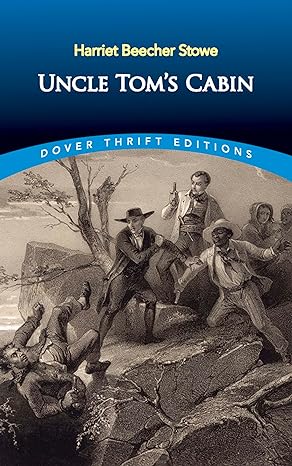
Uncle Tom's Cabin by Harriet Beecher Stowe

Image
A Few Thoughts on Uncle Tom's Cabin First Published in 1852. Harriet Beecher Stowe sat down to write a book that would show the United States the evils of slavery. She wrote Uncle Tom's Cabin; or, Life Among the Lowly in response to the Fugitive Slave Act of 1850, at the urging of her sister-in-law. She succeeded in fueling the debate over slavery and she pointed a finger of shame at the slave owners and at America as a whole. Harriett Beecher Stowe (1811-1896) It created a national sensation. Within ten years, it sold two million copies, making it the best-selling novel of all time in the United States, in proportion to population, according to noted Civil War historian James M. McPherson. The book was so controversial and so powerful that there were attempts to ban it in some parts of the South. Pro-slavery authors attempted to counter the book with their own books with titles like Uncle Robin, in His Cabin in Virginia, and Tom Without One in Boston in an attem...

Grant: Savior of the Union ("The Generals" series) by Mitchell Yockelson

Image
Published in 2012 by Thomas Nelson Grant: Savior of the Union is an enjoyable, easy-to-read biography of Ulysses S. Grant, the Union General that seemingly came from nowhere to become the man that engineered the conquest of  the Confederacy. Yockelson covers Grant's entire life and also a bit of his father's life, with an appropriate emphasis on Grant's military service in the Mexican War, his resignation from the army between the wars, his difficulties as a civilian and his return to the service once war broke out between the Union and the Confederacy. Two-thirds of the book covers the four years of service in the Civil War. His Presidency and retirement years are quickly brushed over. Grant's career is dealt with fairly throughout the book. His great decisions are applauded, his mistakes are pointed out (Cold Harbor, in particular) and the reader gets strong feel for his calm, determined leadership style and his emphasis on substance over style. This is a much...

Letters from a Slave Girl: The Story of Harriet Jacobs by Mary E. Lyons

Image
The fictionalized version of a real-life runaway slave story. Originally published in 1996. Mary E. Lyons' book Letters from a Slave Girl is a fictionalized account of the true story of Harriet Jacobs, a slave girl from North Carolina who escaped and hid in her grandmother's attic for seven years, beginning in 1835, before making her way north to freedom. Lyons chose to use a fictional diary format to tell the story of Harriet Jacobs. In real life Jacobs could read and write and actually published a book about her life in 1861 called Incidents in the Life of a Slave Girl . The reward notice for Harriet Jacobs The diary format has some strengths - it is an efficient way to note the passage of time and to tell about Harriet's feelings. However, it is not nearly as memorable as telling her story as a novel. The letters just do not have the same flow and impact as a story. The book also include a set of pictures of some of the real people and places involved,...